2,281 posters, 63 videos, 56 audios, 43 topics, 18 sessions, 6,174 authors, 2,323 institutions
ePostersLive by SciGen Technologies S.A. All rights reserved.
RCOG World Congress 2025
June 23 - 25, 2025 | ExCeL London, UK
PP.0102
Navigating Complexity: Inspiring National MDT Journey to Combat MDR UTIs in Pregnancy
Poster Presenter
Part of Topic
Maternal medicine
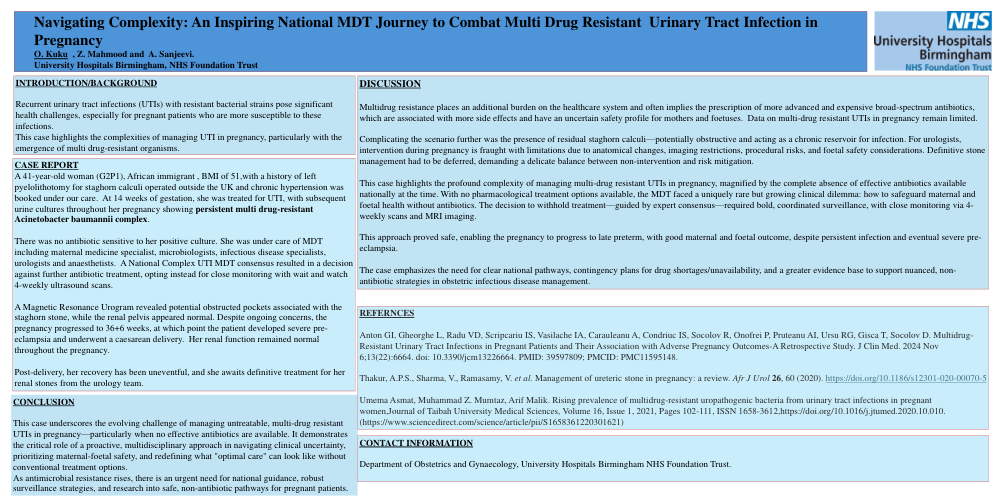
TITLE: Navigating Complexity: An Inspiring National MDT Journey to Combat Multi Drug Resistant Urinary Tract Infection in Pregnancy
O. Kuku , Z. Mahmood and A. Sanjeevi.
University Hospitals Birmingham, NHS Foundation Trust
INTRODUCTION/BACKGROUND
Recurrent urinary tract infections (UTIs) with resistant bacterial strains pose significant health challenges, especially for pregnant patients who are more susceptible to these infections.
This case highlights the complexities of managing UTI in pregnancy, particularly with the emergence of multi drug-resistant organisms.
CASE REPORT
A 41-year-old woman (G2P1), African immigrant , BMI of 51,with a history of left pyelolithotomy for staghorn calculi operated outside the UK and chronic hypertension was booked under our care. At 14 weeks of gestation, she was treated for UTI, with subsequent urine cultures throughout her pregnancy showing persistent multi drug-resistant Acinetobacter baumannii complex.
There was no antibiotic sensitive to her positive culture. She was under care of MDT including maternal medicine specialist, microbiologists, infectious disease specialists, urologists and anaesthetists. A National Complex UTI MDT consensus resulted in a decision against further antibiotic treatment, opting instead for close monitoring with wait and watch 4-weekly ultrasound scans.
A Magnetic Resonance Urogram revealed potential obstructed pockets associated with the staghorn stone, while the renal pelvis appeared normal. Despite ongoing concerns, the pregnancy progressed to 36+6 weeks, at which point the patient developed severe pre-eclampsia and underwent a caesarean delivery. Her renal function remained normal throughout the pregnancy.
Post-delivery, her recovery has been uneventful, and she awaits definitive treatment for her renal stones from the urology team.
DISCUSSION
Multidrug resistance places an additional burden on the healthcare system and often implies the prescription of more advanced and expensive broad-spectrum antibiotics, which are associated with more side effects and have an uncertain safety profile for mothers and foetuses. Data on multi-drug resistant UTIs in pregnancy remain limited.
Complicating the scenario further was the presence of residual staghorn calculi—potentially obstructive and acting as a chronic reservoir for infection. For urologists, intervention during pregnancy is fraught with limitations due to anatomical changes, imaging restrictions, procedural risks, and foetal safety considerations. Definitive stone management had to be deferred, demanding a delicate balance between non-intervention and risk mitigation.
This case highlights the profound complexity of managing multi-drug resistant UTIs in pregnancy, magnified by the complete absence of effective antibiotics available nationally at the time. With no pharmacological treatment options available, the MDT faced a uniquely rare but growing clinical dilemma: how to safeguard maternal and foetal health without antibiotics. The decision to withhold treatment—guided by expert consensus—required bold, coordinated surveillance, with close monitoring via 4-weekly scans and MRI imaging.
This approach proved safe, enabling the pregnancy to progress to late preterm, with good maternal and foetal outcome, despite persistent infection and eventual severe pre-eclampsia.
The case emphasizes the need for clear national pathways, contingency plans for drug shortages/unavailability, and a greater evidence base to support nuanced, non-antibiotic strategies in obstetric infectious disease management.
CONCLUSION
This case underscores the evolving challenge of managing untreatable, multi-drug resistant UTIs in pregnancy—particularly when no effective antibiotics are available. It demonstrates the critical role of a proactive, multidisciplinary approach in navigating clinical uncertainty, prioritizing maternal-foetal safety, and redefining what "optimal care" can look like without conventional treatment options.
As antimicrobial resistance rises, there is an urgent need for national guidance, robust surveillance strategies, and research into safe, non-antibiotic pathways for pregnant patients
REFERNCES
Anton GI, Gheorghe L, Radu VD, Scripcariu IS, Vasilache IA, Carauleanu A, Condriuc IS, Socolov R, Onofrei P, Pruteanu AI, Ursu RG, Gisca T, Socolov D. Multidrug-Resistant Urinary Tract Infections in Pregnant Patients and Their Association with Adverse Pregnancy Outcomes-A Retrospective Study. J Clin Med. 2024 Nov 6;13(22):6664. doi: 10.3390/jcm13226664. PMID: 39597809; PMCID: PMC11595148.
Thakur, A.P.S., Sharma, V., Ramasamy, V. et al. Management of ureteric stone in pregnancy: a review. Afr J Urol 26, 60 (2020). https://doi.org/10.1186/s12301-020-00070-5
Umema Asmat, Muhammad Z. Mumtaz, Arif Malik. Rising prevalence of multidrug-resistant uropathogenic bacteria from urinary tract infections in pregnant women,Journal of Taibah University Medical Sciences, Volume 16, Issue 1, 2021, Pages 102-111, ISSN 1658-3612,https://doi.org/10.1016/j.jtumed.2020.10.010.
(https://www.sciencedirect.com/science/article/pii/S1658361220301621)
CONTACT INFORMATION
Department of Obstetrics and Gynaecology, University Hospitals Birmingham NHS Foundation Trust