2,281 posters, 63 videos, 56 audios, 43 topics, 18 sessions, 6,174 authors, 2,323 institutions
ePostersLive by SciGen Technologies S.A. All rights reserved.
RCOG World Congress 2025
June 23 - 25, 2025 | ExCeL London, UK
EP.1513
Insights on obstetric outcomes in pregnant individuals with Marfan Syndrome
Part of Topic
Maternal medicine
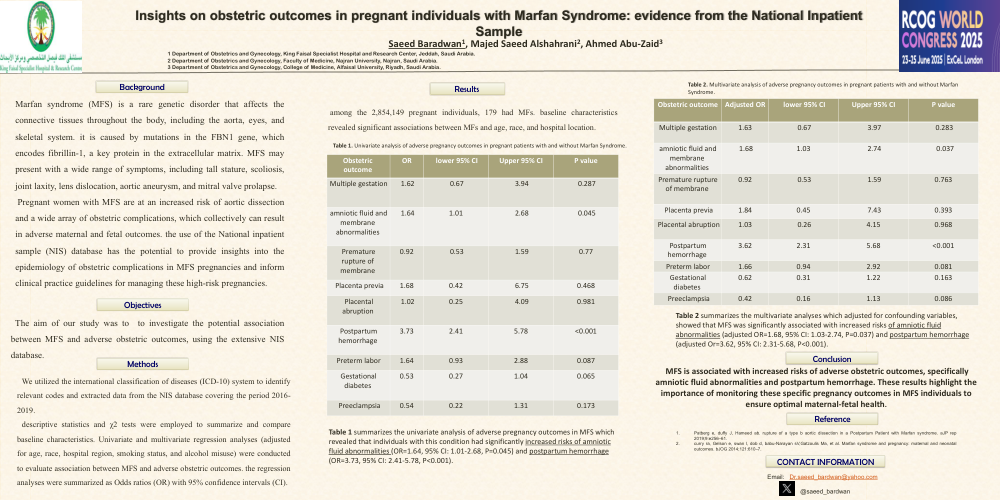
Background: We investigated the potential association between Marfan Syndrome (MFS) and adverse obstetric outcomes using the National Inpatient Sample (NIS) database.
Methods: We utilized the International Classification of Diseases (ICD-10) system to identify relevant codes and extracted data from the NIS database covering the period 2016-2019. Descriptive statistics and χ2 tests were employed to summarize and compare baseline characteristics. Univariate and multivariate regression analyses (adjusted for age, race, hospital region, smoking status, and alcohol misuse) were conducted to evaluate association between MFS and adverse obstetric outcomes. The regression analyses were summarized as Odds Ratios (OR) with 95% confidence intervals (CI).
Results: Among the 2,854,149 pregnant individuals, 179 had MFS. Baseline characteristics revealed significant associations between MFS and age, race, and hospital location. Univariate analysis showed MFS individuals had significantly increased risks of amniotic fluid/membrane abnormalities (AFAs, OR=1.64, 95% CI: 1.01-2.68, P=0.045) and postpartum hemorrhage (PPH, OR=3.73, 95% CI: 2.41-5.78, P<0.001). Several obstetric outcomes showed some trends towards increased (multiple gestation, placenta previa, and preterm labor) and decreased (premature rupture of membrane, gestational diabetes, and preeclampsia) obstetric risks with MFS; however, they were not statistically significant. Multivariate analysis showed MFS was significantly associated with increased risks of AFAs (adjusted OR=1.68, 95% CI: 1.03-2.74, P=0.037) and PPH (adjusted OR=3.62, 95% CI: 2.31-5.68, P<0.001).
Conclusions: MFS is associated with increased risks of adverse obstetric outcomes, specifically AFAs and PPH. These results highlight the importance of monitoring these specific pregnancy outcomes in MFS individuals to ensure optimal maternal-fetal health.