2,281 posters, 63 videos, 56 audios, 43 topics, 18 sessions, 6,174 authors, 2,323 institutions
ePostersLive by SciGen Technologies S.A. All rights reserved.
RCOG World Congress 2025
June 23 - 25, 2025 | ExCeL London, UK
EP.1509
MANAGEMENT OF HYPERTENSIVE DISORDERS OF PREGNANCY - A SYSTEMATIC REVIEW OF INTERNATIONAL GUIDELINES
Poster Presenter
Part of Topic
Maternal medicine
Current Concepts in the Management of Hypertension in Hypertensive Disorders of Pregnancy - A Systematic Review of International Guidelines
Background and Objectives
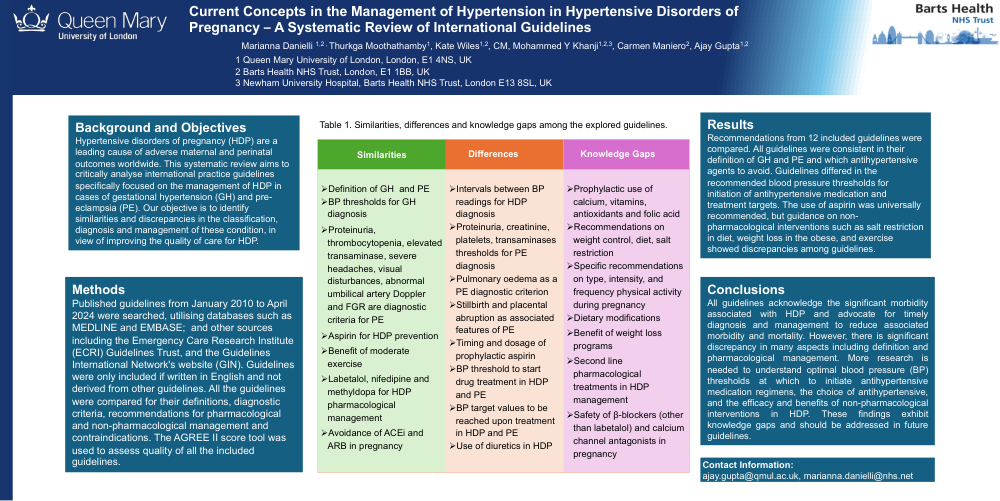
Hypertensive disorders of pregnancy (HDP) are a leading cause of adverse maternal and perinatal outcomes worldwide. This systematic review aims to critically analyse international practice guidelines specifically focused on the management of HDP in cases of gestational hypertension (GH) and pre-eclampsia (PE). Our objective is to identify similarities and discrepancies in the classification, diagnosis and management of these condition, in view of improving the quality of care for HDP.
Methods
Published guidelines from January 2010 to April 2024 were searched, utilising databases such as MEDLINE and EMBASE; and other sources including the Emergency Care Research Institute (ECRI) Guidelines Trust, and the Guidelines International Network's website (GIN). Guidelines were only included if written in English and not derived from other guidelines. All the guidelines were compared for their definitions, diagnostic criteria, recommendations for pharmacological and non-pharmacological management and contraindications. The AGREE II score tool was used to assess quality of all the included guidelines.
Results
Recommendations from 12 included guidelines were compared. All guidelines were consistent in their definition of GH and PE and which antihypertensive agents to avoid. Guidelines differed in the recommended blood pressure thresholds for initiation of antihypertensive medication and treatment targets. The use of aspirin was universally recommended, but guidance on non-pharmacological interventions such as salt restriction in diet, weight loss in the obese, and exercise showed discrepancies among guidelines.
Conclusion
All guidelines acknowledge the significant morbidity associated with HDP and advocate for timely diagnosis and management to reduce associated morbidity and mortality. However, there is significant discrepancy in many aspects including definition and pharmacological management. More research is needed to understand optimal blood pressure (BP) thresholds at which to initiate antihypertensive medication regimens, the choice of antihypertensive, and the efficacy and benefits of non-pharmacological interventions in HDP. These findings exhibit knowledge gaps and should be addressed in future guidelines.