2,281 posters, 63 videos, 56 audios, 43 topics, 18 sessions, 6,174 authors, 2,323 institutions
ePostersLive by SciGen Technologies S.A. All rights reserved.
RCOG World Congress 2025
June 23 - 25, 2025 | ExCeL London, UK
EP.1510
Diagnosing gestational diabetes mellitus with HbA1c, fasted or random plasma glucose.
Poster Presenter
Part of Topic
Maternal medicine
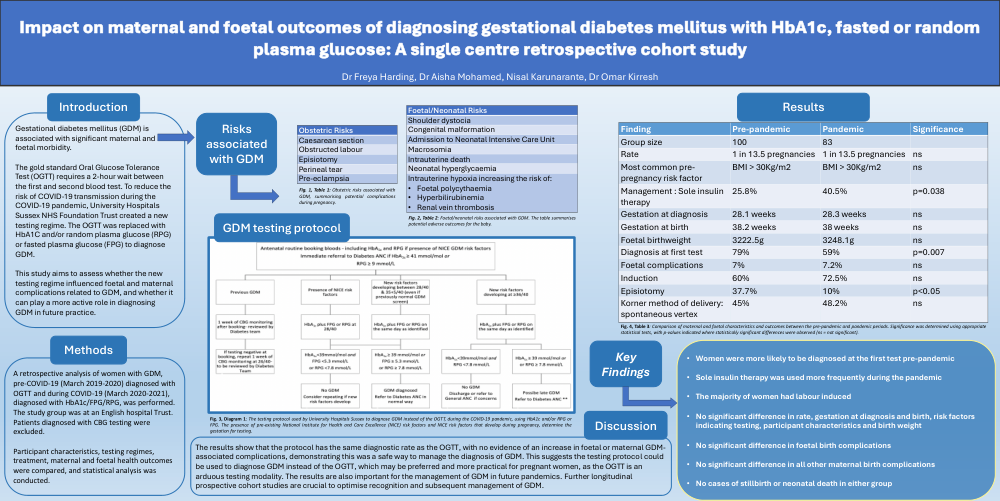
Impact on maternal and foetal outcomes of diagnosing gestational diabetes mellitus with HbA1c, fasted or random plasma glucose: A single centre retrospective cohort study
Dr Freya Harding, Dr Aisha Mohamed, Nisal Karunarante, Dr Omar Kirresh
Introduction
Gestational diabetes mellitus (GDM) is associated with significant maternal and foetal morbidity.
The gold standard Oral Glucose Tolerance Test (OGTT) requires a 2-hour wait between the first and second blood test. To reduce the risk of COVID-19 transmission during the COVID-19 pandemic, University Hospitals Sussex NHS Foundation Trust created a new testing regime. The OGTT was replaced with HbA1C and/or random plasma glucose (RPG) or fasted plasma glucose (FPG) to diagnose GDM.
This study aims to assess whether the new testing regime influenced foetal and maternal complications related to GDM, and whether it can play a more active role in diagnosing GDM in future practice.
Methods
A retrospective analysis of women with GDM, pre-COVID-19 (March 2019-2020) diagnosed with OGTT and during COVID-19 (March 2020-2021), diagnosed with HbA1c/FPG/RPG, was performed. The study group was at an English hospital Trust. Patients diagnosed with CBG testing were excluded.
Participant characteristics, testing regimes, treatment, maternal and foetal health outcomes were compared, and statistical analysis was conducted.
Key Findings
•No significant difference in all other maternal birth complications
Discussion
The results show that the protocol has the same diagnostic rate as the OGTT, with no evidence of an increase in foetal or maternal GDM-associated complications, demonstrating this was a safe way to manage the diagnosis of GDM. This suggests the testing protocol could be used to diagnose GDM instead of the OGTT, which may be preferred and more practical for pregnant women, as the OGTT is an arduous testing modality. The results are also important for the management of GDM in future pandemics. Further longitudinal prospective cohort studies are crucial to optimise recognition and subsequent management of GDM.