2,281 posters, 63 videos, 56 audios, 43 topics, 18 sessions, 6,174 authors, 2,323 institutions
ePostersLive by SciGen Technologies S.A. All rights reserved.
RCOG World Congress 2025
June 23 - 25, 2025 | ExCeL London, UK
PP.0101
Maternal cardiac disease epidemiology in high-resource settings: a systematic review and meta-analysis
Poster Presenter
Authors
Ling Tao, Anshu Ramaiya, Rema Ramakrishnan, Joris Hemelaar, Marian Knight
Affiliations
Part of Topic
Maternal medicine
The frequency and outcomes of maternal cardiac disease in
high-resource settings: a systematic review and meta-analysis
Ling Tao1, Anshu Ramaiya2, Rema Ramakrishnan1, Oliver Rivero-Arias1, Joris Hemelaar1, Marian Knight1
1National Perinatal Epidemiology Unit, Nuffield Department of Population Health, University of Oxford, UK; 2 Medical Sciences Division, University of Oxford, UK
Purpose
Many studies in high-resource settings have identified cardiac disease as a leading
cause of maternal deaths [1–3], with recent large-scale data showing a 25% increase
in its prevalence [4]. However, the burden of maternal cardiac disease in high-
resource settings has not been accurately assessed. This study aimed to estimate
the frequency and outcomes of maternal cardiac disease and its subtypes in high-
resource settings.
Methods
A systematic review was conducted by searching MEDLINE, Embase, CINAHL, and
Google Scholar for studies on maternal cardiac disease in high-resource settings.
Random-effects meta-analyses were performed, and heterogeneity was assessed.
Inclusion
criteria:
Population-based
2013-2023
Journal articles, reports, grey literature
Population: Women during or up to six weeks after pregnancy
in high-resource settings
Outcomes: Prevalence, incidence, and mortality of cardiac disease
Studies screened (n = 4147)
Studies assessed for eligibility (n = 285)
Studies included in review (n = 84)
Data extraction
Risk of bias assessment
Meta-analyses
Publication bias assessment
Results
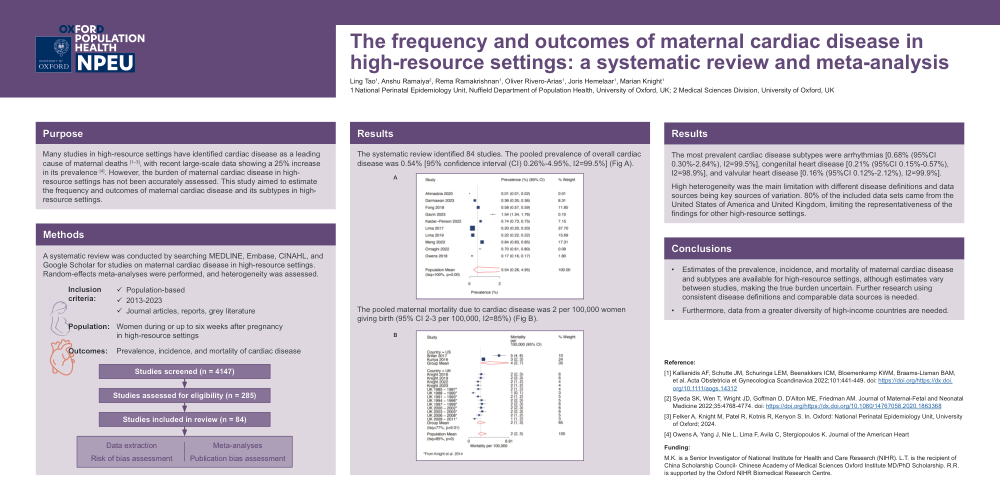
The systematic review identified 84 studies. The pooled prevalence of overall cardiac
disease was 0.54% [95% confidence interval (CI) 0.26%-4.95%, I2=99.5%] (Fig A).
The pooled maternal mortality due to cardiac disease was 2 per 100,000 women
giving birth (95% CI 2-3 per 100,000, I2=85%) (Fig B).
The most prevalent cardiac disease subtypes were arrhythmias [0.68% (95%CI
0.30%-2.84%), I2=99.5%], congenital heart disease [0.21% (95%CI 0.15%-0.57%),
I2=98.9%], and valvular heart disease [0.16% (95%CI 0.12%-2.12%), I2=99.9%].
High heterogeneity was the main limitation with different disease definitions and data
sources being key sources of variation. 80% of the included data sets came from the
United States of America and United Kingdom, limiting the representativeness of the
findings for other high-resource settings.
Conclusions
•Estimates of the prevalence, incidence, and mortality of maternal cardiac disease
and subtypes are available for high-resource settings, although estimates vary
between studies, making the true burden uncertain. Further research using
consistent disease definitions and comparable data sources is needed.
•Furthermore, data from a greater diversity of high-income countries are needed.
Reference:
[1] Kallianidis AF, Schutte JM, Schuringa LEM, Beenakkers ICM, Bloemenkamp KWM, Braams-Lisman BAM,
et al. Acta Obstetricia et Gynecologica Scandinavica 2022;101:441-449. doi: https://doi.org/https://dx.doi.
org/10.1111/aogs.14312
[2] Syeda SK, Wen T, Wright JD, Goffman D, D’Alton ME, Friedman AM. Journal of Maternal-Fetal and Neonatal
Medicine 2022;35:4768-4774. doi: https://doi.org/https://dx.doi.org/10.1080/14767058.2020.1863368
[3] Felker A, Knight M, Patel R, Kotnis R, Kenyon S. In. Oxford: National Perinatal Epidemiology Unit, University
of Oxford; 2024.
[4] Owens A, Yang J, Nie L, Lima F, Avila C, Stergiopoulos K. Journal of the American Heart
Funding:
M.K. is a Senior Investigator of National Institute for Health and Care Research (NIHR). L.T. is the recipient of
China Scholarship Council- Chinese Academy of Medical Sciences Oxford Institute MD/PhD Scholarship. R.R.
is supported by the Oxford NIHR Biomedical Research Centre.