2,281 posters, 63 videos, 56 audios, 43 topics, 18 sessions, 6,174 authors, 2,323 institutions
ePostersLive by SciGen Technologies S.A. All rights reserved.
RCOG World Congress 2025
June 23 - 25, 2025 | ExCeL London, UK
PP.0100
BRAIN ABCESS SECONDARY TO LISTERIOSIS IN PREGNANCY- A CLINICAL DILEMMA
Poster Presenter
Authors
Affiliations
Part of Topic
Maternal medicine
BRAIN ABSCESS SECONDARY TO LISTERIOSIS IN PREGNANCY: A CLINICAL DILEMMA
Shahnaz Nawaz 1, Manahil Jaffer 2, Mishaal Noor 3
1. Consultant Gynaecologist & Obstetrician, Shifa International Hospital Ltd. 2. Senior Registrar, Shifa International Hospital Ltd. 3. Postgraduate trainee, Shifa International Hospital Ltd.
OBJECTIVE
To present a rare case of maternal listeriosis complicated by cerebellar brain abscess during pregnancy, highlighting the diagnostic and therapeutic challenges and underscoring the importance of multidisciplinary management.
CASE
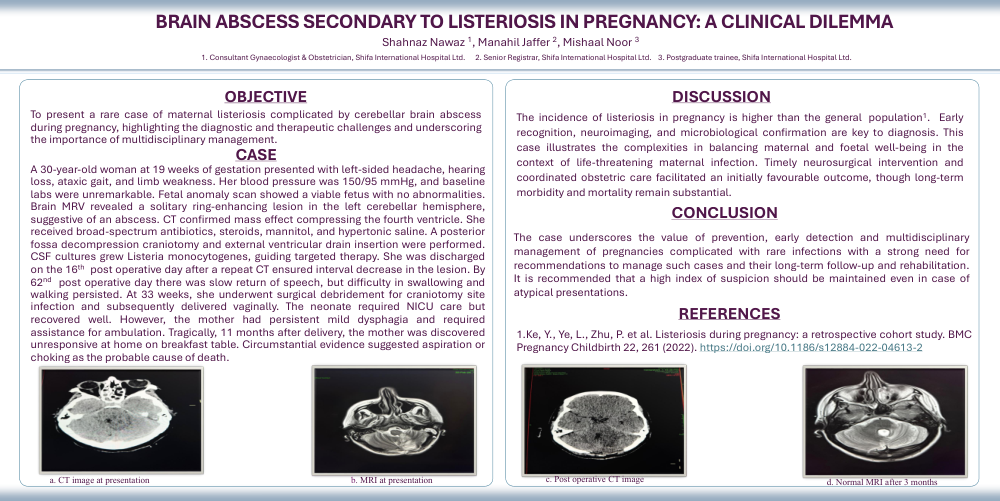
A 30-year-old woman at 19 weeks of gestation presented with left-sided headache, hearing loss, ataxic gait, and limb weakness. Her blood pressure was 150/95 mmHg, and baseline labs were unremarkable. Fetal anomaly scan showed a viable fetus with no abnormalities. Brain MRV revealed a solitary ring-enhancing lesion in the left cerebellar hemisphere, suggestive of an abscess. CT confirmed mass effect compressing the fourth ventricle. She received broad-spectrum antibiotics, steroids, mannitol, and hypertonic saline. A posterior fossa decompression craniotomy and external ventricular drain insertion were performed. CSF cultures grew Listeria monocytogenes, guiding targeted therapy. She was discharged on the 16th post operative day after a repeat CT ensured interval decrease in the lesion. By 62nd post operative day there was slow return of speech, but difficulty in swallowing and walking persisted. At 33 weeks, she underwent surgical debridement for craniotomy site infection and subsequently delivered vaginally. The neonate required NICU care but recovered well. However, the mother had persistent mild dysphagia and required assistance for ambulation. Tragically, 11 months after delivery, the mother was discovered unresponsive at home on breakfast table. Circumstantial evidence suggested aspiration or choking as the probable cause of death.
DISCUSSION
The incidence of listeriosis in pregnancy is higher than the general population1. Early recognition, neuroimaging, and microbiological confirmation are key to diagnosis. This case illustrates the complexities in balancing maternal and foetal well-being in the context of life-threatening maternal infection. Timely neurosurgical intervention and coordinated obstetric care facilitated an initially favourable outcome, though long-term morbidity and mortality remain substantial.
CONCLUSION
The case underscores the value of prevention, early detection and multidisciplinary management of pregnancies complicated with rare infections with a strong need for recommendations to manage such cases and their long-term follow-up and rehabilitation. It is recommended that a high index of suspicion should be maintained even in case of atypical presentations.
REFERENCES
1.Ke, Y., Ye, L., Zhu, P. et al. Listeriosis during pregnancy: a retrospective cohort study. BMC Pregnancy Childbirth 22, 261 (2022). https://doi.org/10.1186/s12884- 022-04613-2