2,281 posters, 63 videos, 56 audios, 43 topics, 18 sessions, 6,174 authors, 2,323 institutions
ePostersLive by SciGen Technologies S.A. All rights reserved.
RCOG World Congress 2025
June 23 - 25, 2025 | ExCeL London, UK
PP.0090
"Navigating Fertility Challenges: Successful Pregnancy in Congenital Adrenal Hyperplasia with Spontaneous Conception"
Poster Presenter
Part of Topic
Maternal medicine
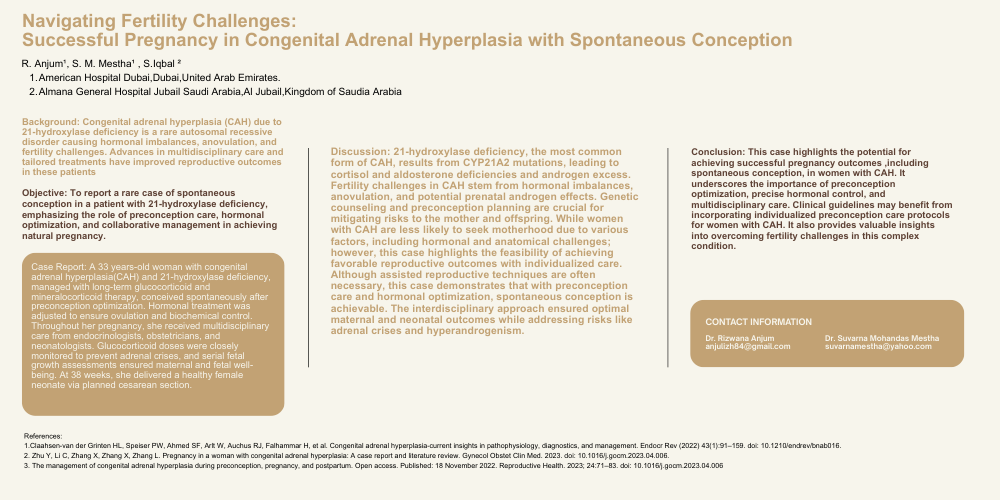
Navigating Fertility Challenges: Successful Pregnancy in Congenital Adrenal Hyperplasia with Spontaneous Conception.
Background: Congenital adrenal hyperplasia (CAH) due to 21-hydroxylase deficiency is a rare autosomal recessive disorder causing hormonal imbalances, anovulation, and fertility challenges. Advances in multidisciplinary care and tailored treatments have improved reproductive outcomes in these patients.
Objective: To report a rare case of spontaneous conception in a patient with 21-hydroxylase deficiency, emphasizing the role of preconception care, hormonal optimization, and collaborative management in achieving natural pregnancy.
Case Report: A 33 years-old woman with congenital adrenal hyperplasia(CAH) and 21-hydroxylase deficiency, managed with long-term glucocorticoid and mineralocorticoid therapy, conceived spontaneously after preconception optimization. Hormonal treatment was adjusted to ensure ovulation and biochemical control. Throughout her pregnancy, she received multidisciplinary care from endocrinologists, obstetricians, and neonatologists. Glucocorticoid doses were closely monitored to prevent adrenal crises, and serial fetal growth assessments ensured maternal and fetal wellbeing. At 38 weeks, she delivered a healthy female neonate via planned cesarean section.
Discussion: 21-hydroxylase deficiency, the most common form of CAH, results from CYP21A2 mutations, leading to cortisol and aldosterone deficiencies and androgen excess. Fertility challenges in CAH stem from hormonal imbalances, anovulation, and potential prenatal androgen effects. Genetic counseling and preconception planning are crucial for mitigating risks to the mother and offspring. While women with CAH are less likely to seek motherhood due to various factors, including hormonal and anatomical challenges; however, this case highlights the feasibility of achieving favorable reproductive outcomes with individualized care. Although assisted reproductive techniques are often necessary, this case demonstrates that with preconception care and hormonal optimization, spontaneous conception is achievable. The interdisciplinary approach ensured optimal maternal and neonatal outcomes while addressing risks like adrenal crises and hyperandrogenism.
Conclusion: This case highlights the potential for achieving successful pregnancy outcomes ,including spontaneous conception, in women with CAH. It underscores the importance of preconception optimization, precise hormonal control, and multidisciplinary care. Clinical guidelines may benefit from incorporating individualized preconception care protocols for women with CAH. It also provides valuable insights into overcoming fertility challenges in this complex condition.