2,281 posters, 63 videos, 56 audios, 43 topics, 18 sessions, 6,174 authors, 2,323 institutions
ePostersLive by SciGen Technologies S.A. All rights reserved.
RCOG World Congress 2025
June 23 - 25, 2025 | ExCeL London, UK
PP.0081
Maternal glycaemic parameters predicting future diabetes in women with gestational diabetes
Poster Presenter
Part of Topic
Maternal medicine
INTRODUCTION
Gestational diabetes (GDM) confers:
• 11-fold increased risk of developing type 2 diabetes (T2DM) in future1 , 12% higher annual risk to the development of T2DM2 & 35 years of sustained risk of future development of T2DM3
• HbA1c performed during pregnancy can be utilised to identify additional patients with GDM; HbA1c done earlier in pregnancy can help to predict development of GDM later in pregnancy.4
• Combining third-trimester HbA1c with OGTT can provide predictive utility and stratify high-risk women, who could be offered targeted and more frequent screening.5
OBJECTIVE
To compare the annual risk of T2DM in women with all three biochemical parameters- fasting plasma glucose (FPG), 2-hour post glucose (2hPG) and HbA1c abnormal on the third trimester oral glucose tolerance test (OGTT) to those who had only two or single parameters abnormality
METHODS
• Retrospective observational cohort analysis of 8542 women with high risk for GDM and who underwent screening for GDM with OGTT and HbA1c between 2009 – 2013
• HbA1c performed with OGTT- standard practice at our hospital
• N= 735 with proven GDM (FPG ≥ 5.6mmol/L or 2hPG ≥ 7.8mmol/L) included
• Women with abnormal FPG, 2hPG and HbA1c ≥ 42mmol/mol labelled as 3-GPA (glycaemic parameters abnormality)
• Hospital and primary care based HbA1c over subsequent 15 years collected
Results
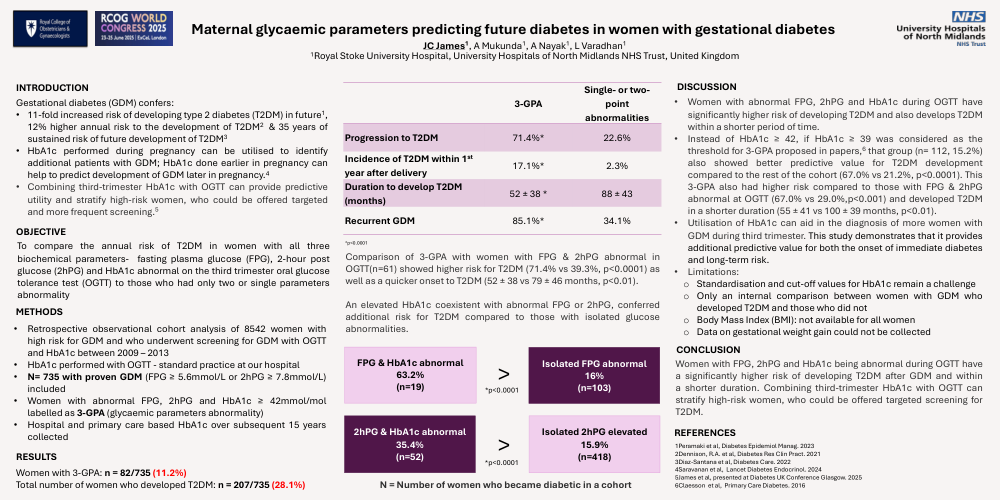
• 207 women developed T2DM during 10 years of follow-up. 82 (11.2%) had 3-GPA. The proportion developing T2DM was significantly higher in 3-GPA compared to 2-GPA or isolated abnormality (71.4% vs 22.6%, p<0.0001). Incidence of T2DM within first year after delivery was higher (17.1% vs 2.3%, p<0.0001). Duration to development of T2DM was significantly shorter (52 ± 38 vs 88 ± 43 months, p<0.0001). Recurrent GDM rate was also higher (85.1% vs 34.1%, p<0.0001)
• On sub-analysis, women with 3-GPA had higher risk than those who had FPG & 2hPG abnormal in OGTT(n=61) (71.4% vs 39.3%, p<0.0001) and developed T2DM quicker too (52 ± 38 vs 79 ± 46 months, p<0.01).
• Women with 2 glycaemic parameters abnormal had higher risk than those with single value glucose abnormalities: FPG & HbA1c abnormal (n=19) vs isolated FPG (n=103) 63.2% vs 16%, p<0.0001; 2hPG & HbA1c abnormal (n=52) vs isolated 2hPG elevated (n=418) 35.4% vs 15.9%, p<0.0001.
• HbA1c ≥ 39 early in pregnancy is considered as a predictor for GDM. Using HbA1c ≥ 39 for 3-GPA (n=112, 15.2%) also showed better predictive value for T2DM development compared to rest of the cohort (67.0% vs 21.2%, p<0.0001). 3- GPA also had higher risk compared to those with FPG & 2hPG abnormal at OGTT (67.0% vs 29.0%, p<0.001) and developed T2DM in shorter duration (55 ± 41 vs 100 ± 39 months, p<0.01)
DISCUSSION
• Women with abnormal FPG, 2hPG and HbA1c during OGTT have significantly higher risk of developing T2DM and also develops T2DM within a shorter period of time.
• Instead of HbA1c ≥ 42, if HbA1c ≥ 39 was considered as the threshold for 3-GPA proposed in papers,6 that group (n= 112, 15.2%) also showed better predictive value for T2DM development compared to the rest of the cohort (67.0% vs 21.2%, p<0.0001). This 3-GPA also had higher risk compared to those with FPG & 2hPG abnormal at OGTT (67.0% vs 29.0%,p<0.001) and developed T2DM in a shorter duration (55 ± 41 vs 100 ± 39 months, p<0.01).
• Utilisation of HbA1c can aid in the diagnosis of more women with GDM during third trimester. This study demonstrates that it provides additional predictive value for both the onset of immediate diabetes and long-term risk.
• Limitations: o Standardisation and cut-off values for HbA1c remain a challenge o Only an internal comparison between women with GDM who developed T2DM and those who did not o Body Mass Index (BMI): not available for all women o Data on gestational weight gain could not be collected.
CONCLUSION
Women with FPG, 2hPG and HbA1c being abnormal during OGTT have a significantly higher risk of developing T2DM after GDM and within a shorter duration. Combining third-trimester HbA1c with OGTT can stratify high-risk women, who could be offered targeted screening for T2DM.
REFERENCES
1Peramaki et al, Diabetes Epidemiol Manag. 2023
2Dennison, R.A. et al, Diabetes Res Clin Pract. 2021
3Diaz-Santana et al, Diabetes Care. 2022
4Saravanan et al, Lancet Diabetes Endocrinol. 2024 5James et al, presented at Diabetes UK Conference Glasgow. 2025
6Claesson et al, Primary Care Diabetes. 2016