2,281 posters, 63 videos, 56 audios, 43 topics, 18 sessions, 6,174 authors, 2,323 institutions
ePostersLive by SciGen Technologies S.A. All rights reserved.
RCOG World Congress 2025
June 23 - 25, 2025 | ExCeL London, UK
EP.2145
Development and delivery of a regional multiprofessional gynaecology surgical simulation course
Poster Presenter
Authors
Affiliations
Part of Topic
Simulation & training
Development and Delivery of a Regional Multiprofessional Gynaecology Surgical Simulation Course aka Gynaecology Surgical Simulation Bootcamp
T Jackson, H Chipeta.
Leeds Teaching Hospitals NHS trust, NHS, Obstetrics and Gynaecology, Leeds. West Yorkshire, United Kingdom
Background
Multi-professional team-based simulation training is now a staple of surgical training. Surgeons who have undergone simulation training tend to display improved efficiency and performance and reduced errors in theatre. There is an increase in self-reported competence and confidence1.
Objective
To design and implement a two-day multi-professional gynaecology surgical simulation training course aimed to improve surgical proficiency and confidence in technical and non-technical gynaecological surgical skills.
Design
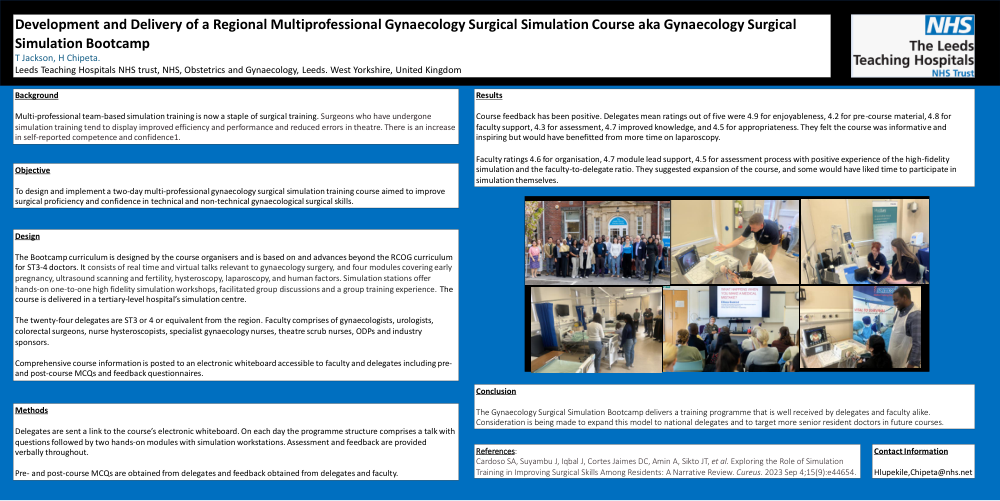
The Bootcamp curriculum is designed by the course organisers and is based on and advances beyond the RCOG curriculum for ST3-4 doctors. It consists of real time and virtual talks relevant to gynaecology surgery, and four modules covering early pregnancy, ultrasound scanning and fertility, hysteroscopy, laparoscopy, and human factors. Simulation stations offer hands-on one-to-one high fidelity simulation workshops, facilitated group discussions and a group training experience. The course is delivered in a tertiary-level hospital’s simulation centre.
The twenty-four delegates are ST3 or 4 or equivalent from the region. Faculty comprises of gynaecologists, urologists, colorectal surgeons, nurse hysteroscopists, specialist gynaecology nurses, theatre scrub nurses, ODPs and industry sponsors.
Comprehensive course information is posted to an electronic whiteboard accessible to faculty and delegates including pre- and post-course MCQs and feedback questionnaires.
Methods
Delegates are sent a link to the course’s electronic whiteboard. On each day the programme structure comprises a talk with questions followed by two hands-on modules with simulation workstations. Assessment and feedback are provided verbally throughout.
Pre- and post-course MCQs are obtained from delegates and feedback obtained from delegates and faculty.
Results
Course feedback has been positive. Delegates mean ratings out of five were 4.9 for enjoyableness, 4.2 for pre-course material, 4.8 for faculty support, 4.3 for assessment, 4.7 improved knowledge, and 4.5 for appropriateness. They felt the course was informative and inspiring but would have benefitted from more time on laparoscopy.
Faculty ratings 4.6 for organisation, 4.7 module lead support, 4.5 for assessment process with positive experience of the high-fidelity simulation and the faculty-to-delegate ratio. They suggested expansion of the course, and some would have liked time to participate in simulation themselves.
Conclusion
The Gynaecology Surgical Simulation Bootcamp delivers a training programme that is well received by delegates and faculty alike. Consideration is being made to expand this model to national delegates and to target more senior resident doctors in future courses