2,281 posters, 63 videos, 56 audios, 43 topics, 18 sessions, 6,174 authors, 2,323 institutions
ePostersLive by SciGen Technologies S.A. All rights reserved.
RCOG World Congress 2025
June 23 - 25, 2025 | ExCeL London, UK
EP.2133
Incidence and risk factors for shoulder dystocia in a Greek maternity hospital
Poster Presenter
Authors
Dimitrios Papoutsis, Nikoleta Chatzipanagiotidou, Angeliki Antonakou, George Valasoulis, Alexandros Daponte
Affiliations
Department of Obstetrics and Gynaecology, Shrewsbury and Telford Hospitals NHS Trust, Department of Midwifery, School of Health Sciences, International Hellenic University, Department of Obstetrics and Gynaecology, Medical School, University of Thessaly
Part of Topic
Simulation & training
Title:Incidence and risk factors for shoulder dystocia in a Greek maternity hospital
Dimitrios Papoutsis1,2, Nikoleta Chatzipanagiotidou1,3, Angeliki Antonakou4, George Valasoulis3, Alexandros Daponte3.
1-Departmentof Midwifery, School of Health Sciences, University of Western Macedonia, 50200, Kozani, Greece.
2-DepartmentofObstetricsandGynaecology, Shrewsbury and Telford Hospitals NHS Trust, Apley Castle, Grainger Drive, Telford, TF16TF, United Kingdom.
3-Department of Obstetrics and Gynaecology, Medical School, University of Thessaly, 41500 Larissa, Greece
4-Department of Midwifery, School of Health Sciences, International Hellenic University, Thessaloniki, Greece.
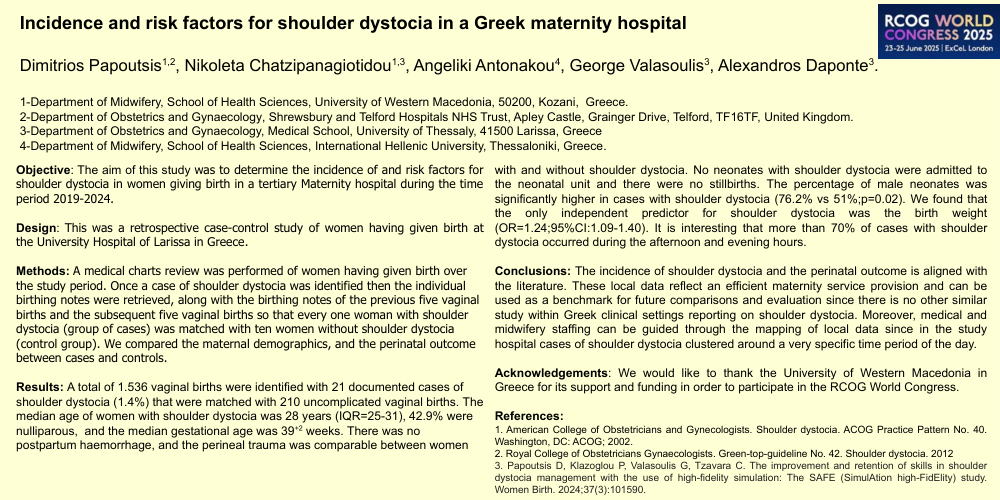
Objective: The aim of this study was to determine the incidence of and risk factors for shoulder dystocia in women giving birth in a tertiary Maternity hospital during the time period 2019-2024.
Design: This was a retrospective case-control study of women having given birth at the University Hospital of Larissa in Greece.
Methods: A medical charts review was performed of women having given birth over the study period. Once a case of shoulder dystocia was identified then the individual birthing notes were retrieved, along with the birthing notes of the previous five vaginal births and the subsequent five vaginal births so that every one woman with shoulder dystocia (group of cases) was matched with ten women without shoulder dystocia (control group). We compared the maternal demographics, and the perinatal outcome between cases and controls
Results:A total of 1.536 vaginal births were identified with 21 documented cases of shoulder dystocia (1.4%) that were matched with 210 uncomplicated vaginal births. The median age of women with shoulder dystocia was 28 years (IQR=25-31), 42.9% were nulliparous, and the median gestational age was 39+2 weeks. There was no postpartum haemorrhage, andtheperineal trauma was comparable between women with and without shoulder dystocia. No neonates with shoulder dystocia were admitted to the neonatal unit and there were no stillbirths. The percentage of male neonates was significantly higher in cases with shoulder dystocia (76.2% vs 51%;p=0.02). We found that the only independent predictor for shoulder dystocia was the birth weight (OR=1.24;95%CI:1.09-1.40). It is interesting that more than 70% of cases with shoulder dystocia occurred during the afternoon and evening hours.
Conclusions: The incidence of shoulder dystocia and the perinatal outcome isaligned with the literature. These local data reflect an efficient maternity service provision and can be used as a benchmark for future comparisons and evaluation since there is no other similar study within Greek clinical settings reporting on shoulder dystocia. Moreover, medical and midwifery staffing can be guided through the mapping of local data since in the study hospital cases of shoulder dystocia clustered around a very specific time period of the day.
Acknowledgements: We would like to thank the University of Western Macedonia in Greece for its support and funding in order to participate in the RCOG World Congress.