2,281 posters, 63 videos, 56 audios, 43 topics, 18 sessions, 6,174 authors, 2,323 institutions
ePostersLive by SciGen Technologies S.A. All rights reserved.
RCOG World Congress 2025
June 23 - 25, 2025 | ExCeL London, UK
EP.2132
Improving time-perception in shoulder dystocia management with the use of high-fidelity simulation
Poster Presenter
Authors
Dimitrios Papoutsis, Angeliki Antonakou, Paraskevi Klazoglou, George Valasoulis, Chara Tzavara
Affiliations
Department of Obstetrics and Gynaecology, Shrewsbury and Telford Hospitals NHS Trust, Department of Midwifery, School of Health Sciences, University of Western Macedonia, Department of Midwifery, School of Health Sciences, International Hellenic University, Department of Obstetrics and Gynaecology, Medical School, University of Thessaly, Department of Hygiene, Epidemiology and Medical Statistics, Medical School, National and Kapodistrian University of Athens
Part of Topic
Simulation & training
Title: Improving time-perception in shoulder dystocia management with the use of high-fidelity simulation
Dimitrios Papoutsis1,2, Angeliki Antonakou3, Paraskevi Klazoglou1, George Valasoulis4, Chara Tzavara5.
1-Department of Midwifery, School of Health Sciences, University of Western Macedonia, 50200, Kozani, Greece.
2-Department of Obstetrics and Gynaecology, Shrewsbury and Telford Hospitals NHS Trust, Apley Castle, Grainger Drive, Telford, TF16TF, United Kingdom.
3-Department of Midwifery, School of Health Sciences, International Hellenic University, Thessaloniki, Greece.
4-Department of Obstetrics and Gynaecology, Medical School, University of Thessaly, 41500 Larissa, Greece
5-Department of Hygiene, Epidemiology and Medical Statistics, Medical School, National and Kapodistrian University of Athens, 115 27, Athens, Greece.
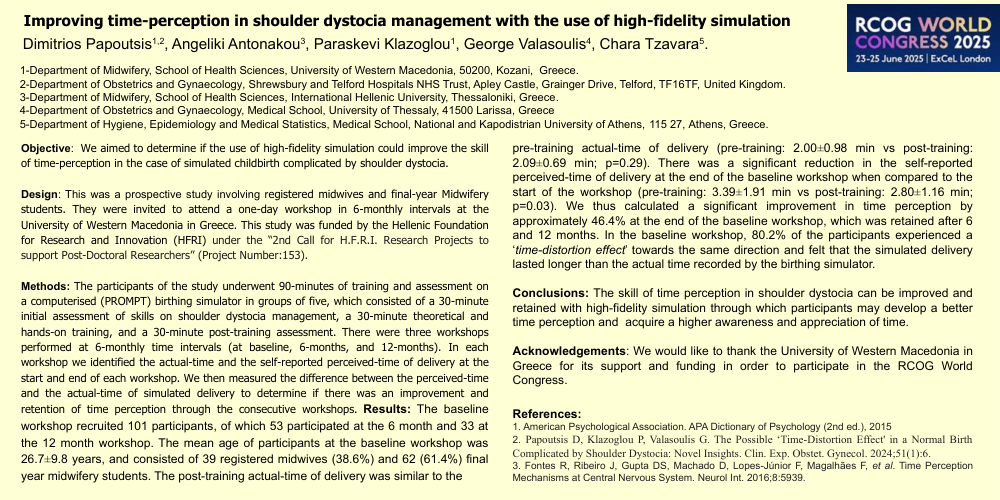
Objective: We aimed to determine if the use of high-fidelity simulation could improve the skill of time-perception in the case of simulated childbirth complicated by shoulder dystocia.
Design: This was a prospective study involving registered midwives and final-year Midwifery students. They were invited to attend a one-day workshop in 6-monthly intervals at the University of Western Macedonia in Greece. This study was funded by the Hellenic Foundation for Research and Innovation (HFRI) under the "2nd Call for H.F.R.I. Research Projects to support Post-Doctoral Researchers" (Project Number:153).
Methods: The participants of the study underwent 90-minutes of training and assessment on a computerised (PROMPT) birthing simulator in groups of five, which consisted of a 30-minute initial assessment of skills on shoulder dystocia management, a 30-minute theoretical and hands-on training, and a 30-minute post-training assessment. There were three workshops performed at 6-monthly time intervals (at baseline, 6-months, and 12-months). In each workshop we identified the actual-time and the self-reported perceived-time of delivery at the start and end of each workshop. We then measured the difference between the perceived-time and the actual-time of simulated delivery to determine if there was an improvement and retention of time perception through the consecutive workshops.
Results: The baseline workshop recruited 101 participants, of which 53 participated at the 6 month and 33 at the 12 month workshop. The mean age of participants at the baseline workshop was 26.7±9.8 years, and consisted of 39 registered midwives (38.6%) and 62 (61.4%) final year midwifery students. The post-training actual-time of delivery was similar to the pre-training actual-time of delivery (pre-training: 2.00±0.98 min vs post-training: 2.09±0.69 min; p=0.29). There was a significant reduction in the self-reported perceived-time of delivery at the end of the baseline workshop when compared to the start of the workshop (pre-training: 3.39±1.91 min vs post-training: 2.80±1.16 min; p=0.03). We thus calculated a significant improvement in time perception by approximately 46.4% at the end of the baseline workshop, which was retained after 6 and 12 months. In the baseline workshop, 80.2% of the participants experienced a 'time-distortion effect' towards the same direction and felt that the simulated delivery lasted longer than the actual time recorded by the birthing simulator.
Conclusions: The skill of time perception in shoulder dystocia can be improved and retained with high-fidelity simulation through which participants may develop a better time perception and acquire a higher awareness and appreciation of time.
Acknowledgements: We would like to thank the University of Western Macedonia in Greece for its support and funding in order to participate in the RCOG World Congress.