2,281 posters, 63 videos, 56 audios, 43 topics, 18 sessions, 6,174 authors, 2,323 institutions
ePostersLive by SciGen Technologies S.A. All rights reserved.
RCOG World Congress 2025
June 23 - 25, 2025 | ExCeL London, UK
EP.2131
The effect of a leadership - teamwork module in shoulder dystocia simulation; RCT-study
Poster Presenter
Authors
Dimitrios Papoutsis, Antonios Theofilidis, Angeliki Antonakou, Nikoleta Chatzipanagiotidou
Affiliations
Department of Obstetrics and Gynaecology, Shrewsbury and Telford Hospitals NHS Trust, Department of Midwifery, School of Health Sciences, University of Western Macedonia, Department of Midwifery, School of Health Sciences, International Hellenic University
Part of Topic
Simulation & training
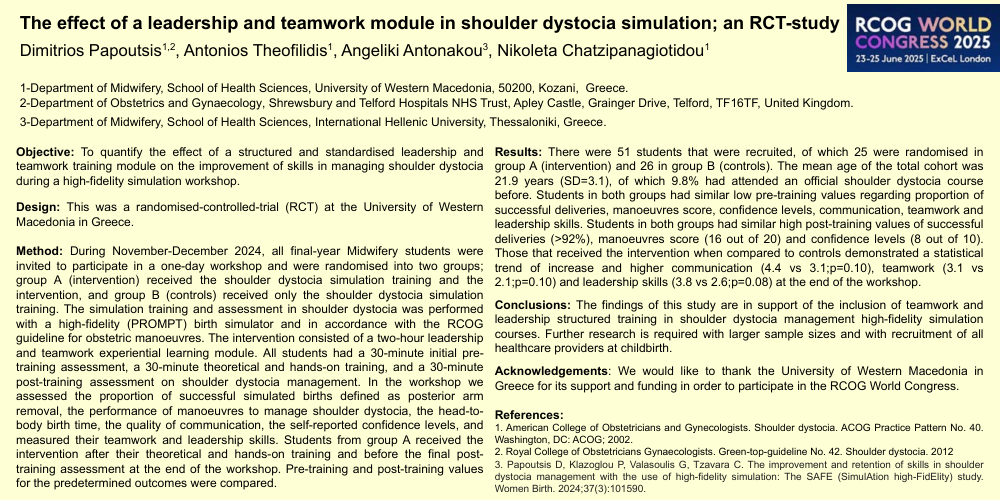
Title:The effect of a leadership and teamwork module in shoulder dystocia simulation; RCT-study
Dimitrios Papoutsis1,2, Antonios Theofilidis1, Angeliki Antonakou3, Nikoleta Chatzipanagiotidou1
1-Departmentof Midwifery, School of Health Sciences, University of Western Macedonia, 50200, Kozani, Greece.
2-DepartmentofObstetricsandGynaecology, Shrewsbury and Telford Hospitals NHS Trust, Apley Castle, Grainger Drive, Telford, TF16TF, United Kingdom.
3-Department of Midwifery, School of Health Sciences, International Hellenic University, Thessaloniki, Greece.
Objective:To quantify the effect of a structured and standardised leadership and teamwork training module on the improvement of skills in managing shoulder dystocia during a high-fidelity simulation workshop.
Design: This was a randomised-controlled-trial (RCT) at the University of Western Macedonia in Greece.
Method: During November-December 2024, all final-year Midwifery students were invited to participate in a one-day workshop and were randomised into two groups; group A (intervention) received the shoulder dystocia simulation training and the intervention, and group B (controls) received only the shoulder dystocia simulation training. The simulation training and assessment in shoulder dystocia was performed with a high-fidelity (PROMPT) birth simulator and in accordance with the RCOG guideline for obstetric manoeuvres. The intervention consisted of a two-hour leadership and teamwork experiential learning module. All students had a 30-minute initial pre-training assessment, a 30-minute theoretical and hands-on training, and a 30-minute post-training assessment on shoulder dystocia management. In the workshop we assessed the proportion of successful simulated births defined as posterior arm removal, the performance of manoeuvres to manage shoulder dystocia, the head-to-body birth time, the quality of communication, the self-reported confidence levels, and measured their teamwork and leadership skills. Students from group A received the intervention after their theoretical and hands-on training and before the final post-training assessment at the end of the workshop. Pre-training and post-training values for the predetermined outcomes were compared.
Results: There were 51 students that were recruited, of which 25 were randomised in group A (intervention) and 26 in group B (controls). The mean age of the total cohort was 21.9 years (SD=3.1), of which 9.8% had attended an official shoulder dystocia course before. Students in both groups had similar low pre-training values regarding proportion of successful deliveries, manoeuvres score, confidence levels, communication, teamwork and leadership skills. Students in both groups had similar high post-training values of successful deliveries (>92%), manoeuvres score (16 out of 20) and confidence levels (8 out of 10). Those that received the intervention when compared to controls demonstrated a statistical trend of increase and higher communication (4.4 vs 3.1;p=0.10), teamwork (3.1 vs 2.1;p=0.10) and leadership skills (3.8 vs 2.6;p=0.08) at the end of the workshop.
Conclusions: The findings of this study are in support of the inclusion of teamwork and leadership structured training in shoulder dystocia management high-fidelity simulation courses.Further research is required with larger sample sizes and with recruitment of all healthcare providersat childbirth.
Acknowledgements: We would like to thank the University of Western Macedonia in Greece for its support and funding in order to participate in the RCOG World Congress.