2,281 posters, 63 videos, 56 audios, 43 topics, 18 sessions, 6,174 authors, 2,323 institutions
ePostersLive by SciGen Technologies S.A. All rights reserved.
RCOG World Congress 2025
June 23 - 25, 2025 | ExCeL London, UK
EP.2144
Evaluation of intra- and inter-variability in Fetal Heart Rate interpretation
Poster Presenter
Authors
Affiliations
Department of Gynaecology and Obstetrics, Charles Nicolle Hospital, Department B- Charles Nicolle Hospital, Gynaecology and Obstetrics Department B, Charles Nicolle Hospital, Department Bof Obstetrics and Gynaecology, Charles Nicolle Hospital, Department of Obstetrics and Gynecology B, Charles Nicolle Hospital, Gynaecology and Obstetrics Department B of Charles Nicolle Hospital, Gynaecology and Obstetrics department B- Charles Nicolle Hospital, Charles Nicolle Hospital, Obstetrics and Gynaecology Service B, Department B of Gynaecology and Obstetrics- Charles Nicolle Hospital, Department B of Obstetrics and Gynecology, Charles Nicolle Hospital
Part of Topic
Simulation & training
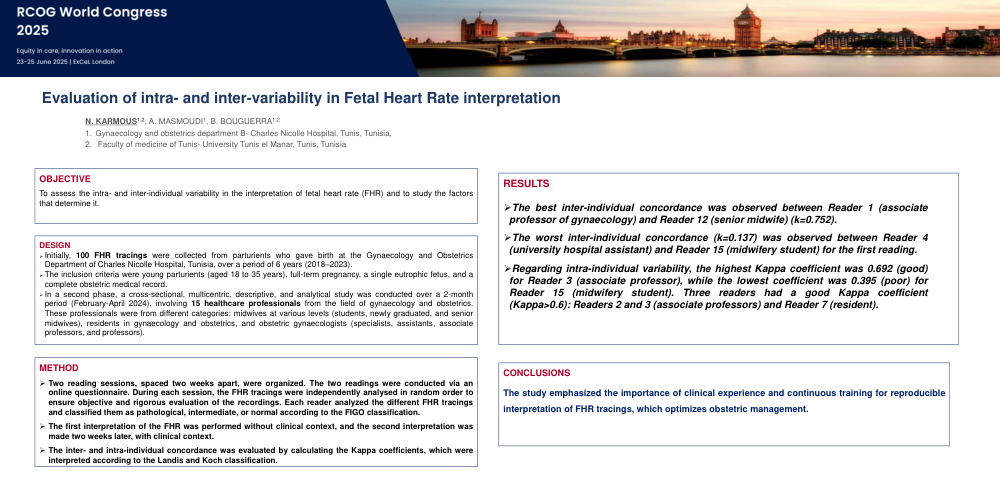
Evaluation of intra- and inter-variability in Fetal Heart Rate interpretation
Objective:
To assess the intra- and inter-individual variability in the interpretation of fetal heart rate (FHR) and to study the factors that determine it.
Design:
Initially, 100 FHR tracings were collected from parturients who gave birth at the Gynaecology and Obstetrics Department B of Charles Nicolle Hospital, Tunisia, over a period of 6 years (2018–2023). The inclusion criteria were young parturients (aged 18 to 35 years), full-term pregnancy, a single eutrophic fetus, and a complete obstetric medical record.
In a second phase, a cross-sectional, multicentric, descriptive, and analytical study was conducted over a 2-month period (February-April 2024), involving 15 healthcare professionals from the field of gynaecology and obstetrics. These professionals were from different categories: midwives at various levels (students, newly graduated, and senior midwives), residents in gynaecology and obstetrics, and obstetric gynaecologists (specialists, assistants, associate professors, and professors).
Method:
Two reading sessions, spaced two weeks apart, were organized. The two readings were conducted via an online questionnaire. During each session, the FHR tracings were independently analysed in random order to ensure objective and rigorous evaluation of the recordings. Each reader analyzed the different FHR tracings and classified them as pathological, intermediate, or normal according to the FIGO classification.
The first interpretation of the FHR was performed without clinical context, and the second interpretation was made two weeks later, with clinical context.
The inter- and intra-individual concordance was evaluated by calculating the Kappa coefficients, which were interpreted according to the Landis and Koch classification.
Results:
The best inter-individual concordance was observed between Reader 1 (associate professor of gynaecology) and Reader 12 (senior midwife) (k=0.752).
The worst inter-individual concordance (k=0.137) was observed between Reader 4 (university hospital assistant) and Reader 15 (midwifery student) for the first reading.
Regarding intra-individual variability, the highest Kappa coefficient was 0.692 (good) for Reader 3 (associate professor), while the lowest coefficient was 0.395 (poor) for Reader 15 (midwifery student). Three readers had a good Kappa coefficient (Kappa>0.6): Readers 2 and 3 (associate professors) and Reader 7 (resident).
Conclusions:
The study emphasized the importance of clinical experience and continuous training for reproducible interpretation of FHR tracings, which optimizes obstetric management.