2,281 posters, 63 videos, 56 audios, 43 topics, 18 sessions, 6,174 authors, 2,323 institutions
ePostersLive by SciGen Technologies S.A. All rights reserved.
RCOG World Congress 2025
June 23 - 25, 2025 | ExCeL London, UK
EP.2142
Development and delivery of a multi-professional team-based emergency gynaecology simulation course.
Poster Presenter
Authors
Affiliations
Part of Topic
Simulation & training
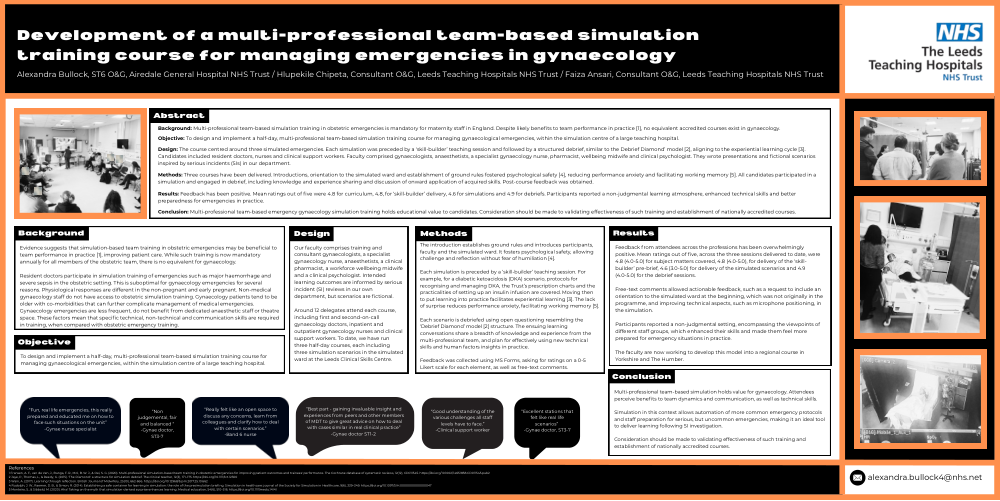
Development of a multi-professional team-based simulation training course for managing emergencies in gynaecology
Alexandra Bullock, ST6 O&G Airedale General Hospital NHS Trust / Hlupekile Chipeta, Consultant O&G, Leeds Teaching Hospitals NHS Trust / Faiza Ansari, Consultant O&G, Leeds Teaching Hospitals NHS Trust
Abstract:
Background: Multi-professional team-based simulation training in obstetric emergencies is mandatory for maternity staff in England. Despite likely benefits to team performance in practice [1], no equivalent accredited courses exist in gynaecology. Objective: To design and implement a half-day, multi-professional team-based simulation training course for managing gynaecological emergencies, within the simulation centre of a large teaching hospital.
Design: The course centred around three simulated emergencies. Each simulation was preceded by a ‘skill-builder’ teaching session and followed by a structured debrief, similar to the Debrief Diamond’ model [2], aligning to the experiential learning cycle [3]. Candidates included resident doctors, nurses and clinical support workers. Faculty comprised gynaecologists, anaesthetists, a specialist gynaecology nurse, pharmacist, wellbeing midwife and clinical psychologist. They wrote presentations and fictional scenarios inspired by serious incidents (SIs) in our department.
Methods: Three courses have been delivered. Introductions, orientation to the simulated ward and establishment of ground rules fostered psychological safety [4], reducing performance anxiety and facilitating working memory [5]. All candidates participated in a simulation and engaged in debrief, including knowledge and experience sharing and discussion of onward application of acquired skills. Post-course feedback was obtained.
Results: Feedback has been positive. Mean ratings out of five were 4.8 for curriculum, 4.8, for ‘skill-builder’ delivery, 4.6 for simulations and 4.9 for debriefs. Participants reported a non-judgmental learning atmosphere, enhanced technical skills and better preparedness for emergencies in practice.
Conclusion: Multi-professional team-based emergency gynaecology simulation training holds educational value to candidates. Consideration should be made to validating effectiveness of such training and establishment of nationally accredited courses.
Background:
Evidence suggests that simulation-based team training in obstetric emergencies may be beneficial to team performance in practice [1], improving patient care. While such training is now mandatory annually for all members of the obstetric team, there is no equivalent for gynaecology.
Resident doctors participate in simulation training of emergencies such as major haemorrhage and severe sepsis in the obstetric setting. This is suboptimal for gynaecology emergencies for several reasons. Physiological responses are different in the non-pregnant and early pregnant. Non-medical gynaecology staff do not have access to obstetric simulation training. Gynaecology patients tend to be older with co-morbidities that can further complicate management of medical emergencies. Gynaecology emergencies are less frequent, do not benefit from dedicated anaesthetic staff or theatre space. These factors mean that specific technical, non-technical and communication skills are required in training, when compared with obstetric emergency training.
Objective:
To design and implement a half-day, multi-professional team-based simulation training course for managing gynaecological emergencies, within the simulation centre of a large teaching hospital.
Design:
Our faculty comprises training and consultant gynaecologists, a specialist gynaecology nurse, anaesthetists, a clinical pharmacist, a workforce wellbeing midwife and a clinical psychologist. Intended learning outcomes are informed by serious incident (SI) reviews in our own department, but scenarios are fictional.
Around 12 delegates attend each course, including first and second-on-call gynaecology doctors, inpatient and outpatient gynaecology nurses and clinical support workers. To date, we have run three half-day courses, each including three simulation scenarios in the simulated ward at the Leeds Clinical Skills Centre.
Methods:
The introduction establishes ground rules and introduces participants, faculty and the simulated ward. It fosters psychological safety, allowing challenge and reflection without fear of humiliation [4].
Each simulation is preceded by a ‘skill-builder’ teaching session. For example, for a diabetic ketoacidosis (DKA) scenario, protocols for recognising and managing DKA, the Trust’s prescription charts and the practicalities of setting up an insulin infusion are covered. Moving then to put learning into practice facilitates experiential learning [3]. The lack of surprise reduces performance anxiety, facilitating working memory [5].
Each scenario is debriefed using open questioning resembling the ‘Debrief Diamond’ model [2] structure. The ensuing learning conversations share a breadth of knowledge and experience from the multi-professional team, and plan for effectively using new technical skills and human factors insights in practice.
Feedback was collected using MS Forms, asking for ratings on a 0-5 Likert scale for each element, as well as free-text comments.
Results:
Feedback from attendees across the professions has been overwhelmingly positive. Mean ratings out of five, across the three sessions delivered to date, were 4.8 (4.0-5.0) for subject matters covered, 4.8 (4.0-5.0), for delivery of the ‘skill- builder’ pre-brief, 4.6 (3.0-5.0) for delivery of the simulated scenarios and 4.9 (4.0-5.0) for the debrief sessions.
Free-text comments allowed actionable feedback, such as a request to include an orientation to the simulated ward at the beginning, which was not originally in the programme, and improving technical aspects, such as microphone positioning, in the simulation.
Participants reported a non-judgmental setting, encompassing the viewpoints of different staff groups, which enhanced their skills and made them feel more prepared for emergency situations in practice.
The faculty are now working to develop this model into a regional course in Yorkshire and The Humber.
Conclusion:
Multi-professional team-based simulation holds value for gynaecology. Attendees perceive benefits to team dynamics and communication, as well as technical skills.
Simulation in this context allows automation of more common emergency protocols and staff preparation for serious, but uncommon emergencies, making it an ideal tool to deliver learning following SI investigation.
Consideration should be made to validating effectiveness of such training and establishment of nationally accredited courses.
References:
[1] Fransen, A. F., van de Ven, J., Banga, F. R., Mol, B. W. J., & Oei, S. G. (2020). Multi-professional simulation-based team training in obstetric emergencies for improving patient outcomes and trainees' performance. The Cochrane database of systematic reviews, 12(12), CD011545. https://doi.org/10.1002/14651858.CD011545.pub2
[2] Jaye, P., Thomas, L., & Reedy, G. (2015). 'The Diamond': a structure for simulation debrief. The clinical teacher, 12(3), 171–175. https://doi.org/10.1111/tct.12300
[3] Wain, A. (2017). Learning through reflection. British Journal of Midwifery, 25(10), 662-666. https://doi.org/10.12968/bjom.2017.25.10.662
[4] Rudolph, J. W., Raemer, D. B., & Simon, R. (2014). Establishing a safe container for learning in simulation: the role of the presimulation briefing. Simulation in healthcare: journal of the Society for Simulation in Healthcare, 9(6), 339–349. https://doi.org/10.1097/SIH.0000000000000047
[5] Monteiro, S., & Sibbald, M. (2020). Aha! Taking on the myth that simulation-derived surprise enhances learning. Medical education, 54(6), 510–516. https://doi.org/10.1111/medu.14141