2,281 posters, 63 videos, 56 audios, 43 topics, 18 sessions, 6,174 authors, 2,323 institutions
ePostersLive by SciGen Technologies S.A. All rights reserved.
RCOG World Congress 2025
June 23 - 25, 2025 | ExCeL London, UK
EP.2141
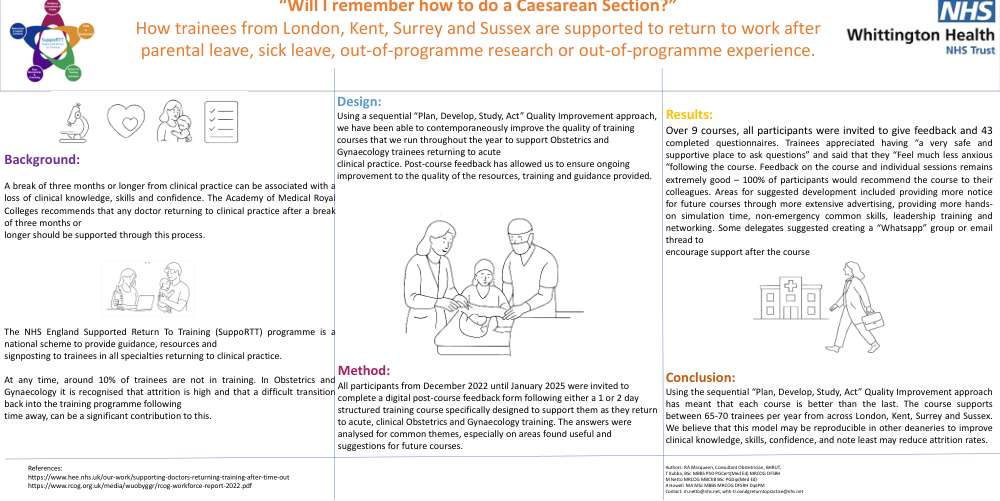
“Will I remember how to do a Caesarean Section?”.
Poster Presenter
Authors
Alice Howell, Manju Netto, Ruth-Anna MacQueen, Kathryn Tompsett
Affiliations
Part of Topic
Simulation & training
“Will I remember how to do a Caesarean Section?”
How trainees from London, Kent, Surrey and Sussex are supported to return to work after
parental leave, sick leave, out-of-programmeresearch or out-of-programmeexperience.
Background:
A break of three months or longer from clinical practice can be associated with a loss of clinical knowledge, skills and confidence. The Academy of Medical Royal Colleges recommends that any doctor returning to clinical practice after a break of three months or
longer should be supported through this process.
The NHS England Supported Return To Training (SuppoRTT) programme is a national scheme to provide guidance, resources and
signposting to trainees in all specialties returning to clinical practice.
At any time, around 10% of trainees are not in training. In Obstetrics and Gynaecology it is recognised that attrition is high and that a difficult transition back into the training programme following
time away, can be a significant contribution to this.
Design:
Using a sequential “Plan, Develop, Study, Act” Quality Improvement approach, we have been able to contemporaneously improve the quality of training courses that we run throughout the year to support Obstetrics and Gynaecology trainees returning to acute
clinical practice. Post-course feedback has allowed us to ensure ongoing improvement to the quality of the resources, training and guidance provided.
Method:
All participants from December 2022 until January 2025 were invited to complete a digital post-course feedback form following either a 1 or 2 day structured training course specifically designed to support them as they return to acute, clinical Obstetrics and Gynaecology training. The answers were analysed for common themes, especially on areas found useful and suggestions for future courses.
Results:
Over 9 courses, all participants were invited to give feedback and 43 completed questionnaires. Trainees appreciated having “a very safe and supportive place to ask questions” and said that they “Feel much less anxious “following the course. Feedback on the course and individual sessions remains extremely good – 100% of participants would recommend the course to their colleagues. Areas for suggested development included providing more notice for future courses through more extensive advertising, providing more hands-on simulation time, non-emergency common skills, leadership training and networking. Some delegates suggested creating a “Whatsapp” group or email thread to
encourage support after the course
Conclusion:
Using the sequential “Plan, Develop, Study, Act” Quality Improvement approach has meant that each course is better than the last. The course supports between 65-70 trainees per year from across London, Kent, Surrey and Sussex. We believe that this model may be reproducible in other deaneries to improve clinical knowledge, skills, confidence, and note least may reduce attrition rates.
Authors: RA Macqueen, Consultant Obstetrician, BHRUT,
T Kubba, BSc MBBS PhD PGCert(Med Ed) MRCOG DFSRH
M Netto MRCOG MBChB BSc PGDip(Med Ed)
A Howell MRCOG MBBS
Contact: m.netto@nhs.net, whh-tr.oandgreturntopractice@nhs.net
References:
https://www.hee.nhs.uk/our-work/supporting-doctors-returning-training-after-time-out
https://www.rcog.org.uk/media/wuobyggr/rcog-workforce-report-2022.pdf