2,281 posters, 63 videos, 56 audios, 43 topics, 18 sessions, 6,174 authors, 2,323 institutions
ePostersLive by SciGen Technologies S.A. All rights reserved.
RCOG World Congress 2025
June 23 - 25, 2025 | ExCeL London, UK
EP.2135
Impact of multi-professional CTG training on participant knowledge, confidence and empowerment
Poster Presenter
Part of Topic
Simulation & training
Impact of multi-professional CTG training on participant knowledge, confidence and empowerment.
Introduction
Fetal monitoring, specifically interpretation of the cardiotocography (CTG) and lack of timely escalation, is a repeated causal theme in reports investigating avoidable harm and deaths of babies in maternity care. Multi-professional training is often cited as a recommendation to improve care and reduce mortality, yet the impact of this training on maternity staff has not been widely researched.
This paper seeks to explore the short and medium-term impact of multi-professional training on staff knowledge, confidence and empowerment, which will inform guidance on the frequency of training updates. The analysis will also examine aspects of empowerment and qualitative data to identify any barriers to applying knowledge and skills in the clinical setting, overall and comparing midwives and obstetricians.
Design and Method
Prospective longitudinal study involving 205 participants recruited from 11 CTG Masterclass training courses run by Baby Lifeline Training across 2022 and 2023.
Quantitative data on knowledge, confidence and empowerment were collected via a combination of Likert Scale (0-4) questionnaires, multiple choice and true/false questions across 3 time points:
1. Pre-course (T1)
2. Immediately post-course (T2)
3. 12 weeks post-course (T3)
Data were analysed using Microsoft Excel with statistical significance determined using t-tests on GraphPad Prism software.
Results
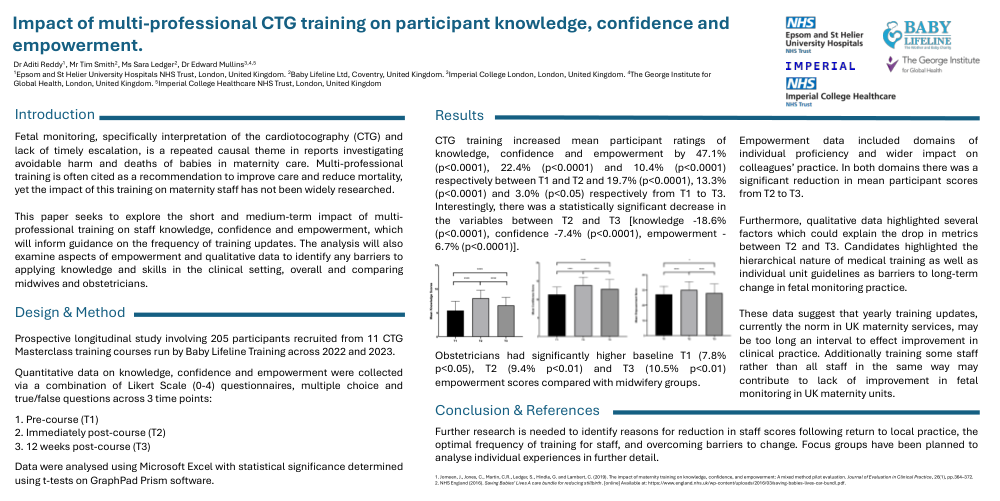
CTG training increased mean participant ratings of knowledge, confidence and empowerment by 47.1% (p<0.0001), 22.4% (p<0.0001) and 10.4% (p<0.0001) respectively between T1 and T2 and 19.7% (p<0.0001), 13.3% (p<0.0001) and 3.0% (p<0.05) respectively from T1 to T3. Interestingly, there was a statistically significant decrease in the variables between T2 and T3 [knowledge -18.6% (p<0.0001), confidence -7.4% (p<0.0001), empowerment -6.7% (p<0.0001)].
Obstetricians had significantly higher baseline T1 (7.8% p<0.05), T2 (9.4% p<0.01) and T3 (10.5% p<0.01) empowerment scores compared with midwifery groups.
Empowerment data included domains of individual proficiency and wider impact on colleagues’ practice. In both domains there was a significant reduction in mean participant scores from T2 to T3.
Furthermore, qualitative data highlighted several factors which could explain the drop in metrics between T2 and T3. Candidates highlighted the hierarchical nature of medical training as well as individual unit guidelines as barriers to long-term change in fetal monitoring practice.
These data suggest that yearly training updates, currently the norm in UK maternity services, may be too long an interval to effect improvement in clinical practice. Additionally training some staff rather than all staff in the same way may contribute to lack of improvement in fetal monitoring in UK maternity units.
Conclusions
Further research is needed to identify reasons for reduction in staff scores following return to local practice, the optimal frequency of training for staff, and overcoming barriers to change. Focus groups have been planned to analyse individual experiences in further detail.