2,281 posters, 63 videos, 56 audios, 43 topics, 18 sessions, 6,174 authors, 2,323 institutions
ePostersLive by SciGen Technologies S.A. All rights reserved.
RCOG World Congress 2025
June 23 - 25, 2025 | ExCeL London, UK
EP.2105
Atypical Intrauterine Contraceptive Devices
Part of Topic
Sexual health & contraception/sexual health & HIV
Atypical Intrauterine Contraceptive Devices
Objective: To describe a rare case of a retained steel intrauterine contraceptive device (IUCD) incidentally discovered on CT imaging in an elderly woman following a motor vehicle accident, requiring removal after 50 years of undetected presence.
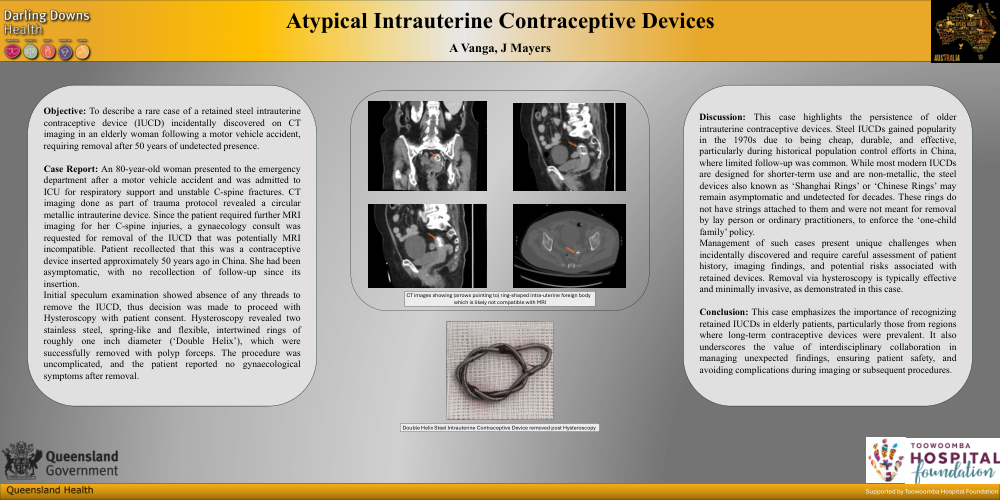
Case Report: An 80-year-old woman presented to the emergency department after a motor vehicle accident and was admitted to ICU for respiratory support and unstable C-spine fractures. CT imaging done as part of trauma protocol revealed a circular metallic intrauterine device. Since the patient required further MRI imaging for her C-spine injuries, a gynaecology consult was requested for removal of the IUCD that was potentially MRI incompatible. Patient recollected that this was a contraceptive device inserted approximately 50 years ago in China. She had been asymptomatic, with no recollection of follow-up since its insertion.
Initial speculum examination showed absence of any threads to remove the IUCD, thus decision was made to proceed with Hysteroscopy with patient consent. Hysteroscopy revealed two stainless steel, spring-like and flexible, intertwined rings of roughly one inch diameter (‘Double Helix’), which were successfully removed with polyp forceps. The procedure was uncomplicated, and the patient reported no gynaecological symptoms after removal.
Discussion: This case highlights the persistence of older intrauterine contraceptive devices. Steel IUCDs gained popularity in the 1970s due to being cheap, durable, and effective, particularly during historical population control efforts in China, where limited follow-up was common. While most modern IUCDs are designed for shorter-term use and are non-metallic, the steel devices also known as ‘Shanghai Rings’ or ‘Chinese Rings’ may remain asymptomatic and undetected for decades. These rings do not have strings attached to them and were not meant for removal by lay person or ordinary practitioners, to enforce the ‘one-child family’ policy.
Management of such cases present unique challenges when incidentally discovered and require careful assessment of patient history, imaging findings, and potential risks associated with retained devices. Removal via hysteroscopy is typically effective and minimally invasive, as demonstrated in this case.
Conclusion: This case emphasizes the importance of recognizing retained IUCDs in elderly patients, particularly those from regions where long-term contraceptive devices were prevalent. It also underscores the value of interdisciplinary collaboration in managing unexpected findings, ensuring patient safety, and avoiding complications during imaging or subsequent procedures.