2,281 posters, 63 videos, 56 audios, 43 topics, 18 sessions, 6,174 authors, 2,323 institutions
ePostersLive by SciGen Technologies S.A. All rights reserved.
RCOG World Congress 2025
June 23 - 25, 2025 | ExCeL London, UK
EP.2083
Linking metabolism and psychosexual health: a prospective study of metformin in PCOS
Poster Presenter
Authors
Konstantin Hofmann, Susanne Singer, Susanne Theis, Anna Dionysopoulou, Roxana Schwab, Annette Hasenburg, Christine Skala
Affiliations
King's Fertility, Fetal Medicine Research Institute, Institute of Medical Biostatistics, Epidemiology, and Informatics, University Medical Center of Johannes Gutenberg University Mainz, Department of Obstetrics and Gynecology, University Medical Center of Johannes Gutenberg University Mainz
Part of Topic
Sexual health & contraception/sexual health & HIV
Linking metabolism and psychosexual health: a prospective study of metformin in PCOS
Konstantin Hofmann MD1,2, Susanne Singer PhD3, Susanne Theis MD2, Anna Dionysopoulou, MD2, Lina Schiestl MD2, Yaman Degirmenci MD2, Annette Hasenburg MD2, Roxana Schwab, MD2, Christine Skala MD2
1. King's Fertility, The Fetal Medicine Foundation, London, United Kingdom
2. Department of Obstetrics and Gynecology, University Medical Center of Johannes Gutenberg University Mainz, Germany
3. Institute of Medical Biostatistics, Epidemiology, and Informatics, University Medical Center of Johannes Gutenberg University Mainz, Germany
Objective
Polycystic Ovary Syndrome (PCOS) is an endocrine-metabolic disorder affecting 5%–18% of women globally. Metabolic disturbances, particularly insulin resistance and obesity, play a central role in its severity and prognosis. Current guidelines recommend metformin for managing metabolic complications in PCOS. However, the impact of metformin on psychosexual health (PSH) in PCOS is not yet fully understood. This study examined the potential effects of metformin therapy on PSH in patients with PCOS.
Design
This study included PCOS patients from the Fertility Center at the University Medical Center Mainz. Participants were divided into two groups based on their individual metabolic profiles: those with metabolic impairment undergoing metformin therapy and those receiving alternative treatments or no treatment.
Methods
PSH and distress levels were evaluated at baseline and after 24 weeks using the Female Sexual Function Index (FSFI) and the Hospital Anxiety and Depression Scale (HADS). Metabolic markers were measured comprehensively in all participants to monitor their metabolic responses to the treatments. Multivariate regression analyses were performed to investigate the relationship between metabolic improvements and changes in PSH and distress.
Results
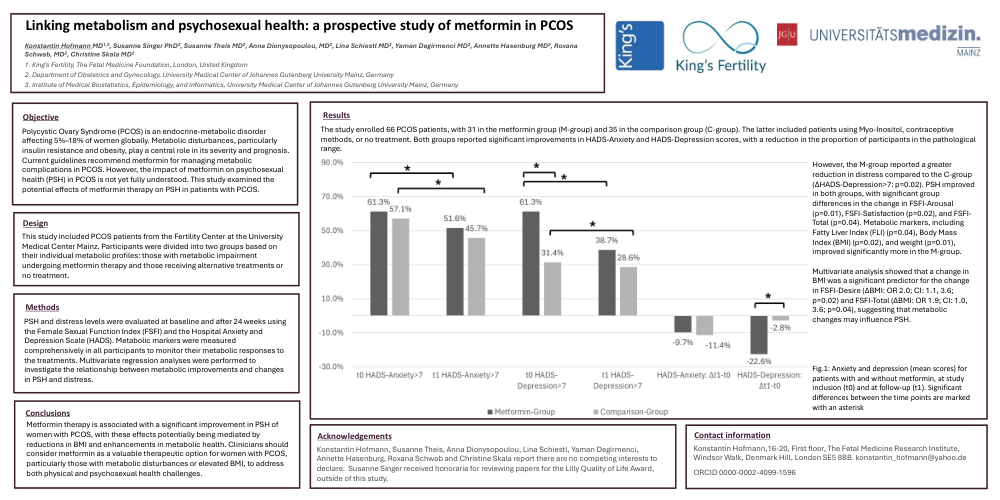
The study enrolled 66 PCOS patients, with 31 in the metformin group (M-group) and 35 in the comparison group (C-group). The latter included patients using Myo-Inositol, contraceptive methods, or no treatment. Both groups reported significant improvements in HADS-Anxiety and HADS-Depression scores, with a reduction in the proportion of participants in the pathological range.
However, the M-group reported a greater reduction in distress compared to the C-group (ΔHADS-Depression>7: p=0.02). PSH improved in both groups, with significant group differences in the change in FSFI-Arousal (p=0.01), FSFI-Satisfaction (p=0.02), and FSFI-Total (p=0.04). Metabolic markers, including Fatty Liver Index (FLI) (p=0.04), Body Mass Index (BMI) (p=0.02), and weight (p=0.01), improved significantly more in the M-group.
Multivariate analysis showed that a change in BMI was a significant predictor for the change in FSFI-Desire (∆BMI: OR 2.0; CI: 1.1, 3.6; p=0.02) and FSFI-Total (∆BMI: OR 1.9; CI: 1.0, 3.6; p=0.04), suggesting that metabolic changes may influence PSH.
Conclusions
Metformin therapy is associated with a significant improvement in PSH of women with PCOS, with these effects potentially being mediated by reductions in BMI and enhancements in metabolic health. Clinicians should consider metformin as a valuable therapeutic option for women with PCOS, particularly those with metabolic disturbances or elevated BMI, to address both physical and psychosexual health challenges.
Acknowledgements
Konstantin Hofmann, Susanne Theis, Anna Dionysopoulou, Lina Schiestl, Yaman Degirmenci, Annette Hasenburg, Roxana Schwab and Christine Skala report there are no competing interests to declare. Susanne Singer received honoraria for reviewing papers for the Lilly Quality of Life Award, outside of this study.
Contact information
Konstantin Hofmann,16-20, First floor, The Fetal Medicine Research Institute, Windsor Walk, Denmark Hill, London SE5 8BB. konstantin_hofmann@yahoo.de
ORCID 0000-0002-4099-1596