2,281 posters, 63 videos, 56 audios, 43 topics, 18 sessions, 6,174 authors, 2,323 institutions
ePostersLive by SciGen Technologies S.A. All rights reserved.
RCOG World Congress 2025
June 23 - 25, 2025 | ExCeL London, UK
EP.2086
Factors Influencing Shared Decision-Making Implementation in Family Planning Counseling: A Scoping Review
Part of Topic
Sexual health & contraception/sexual health & HIV
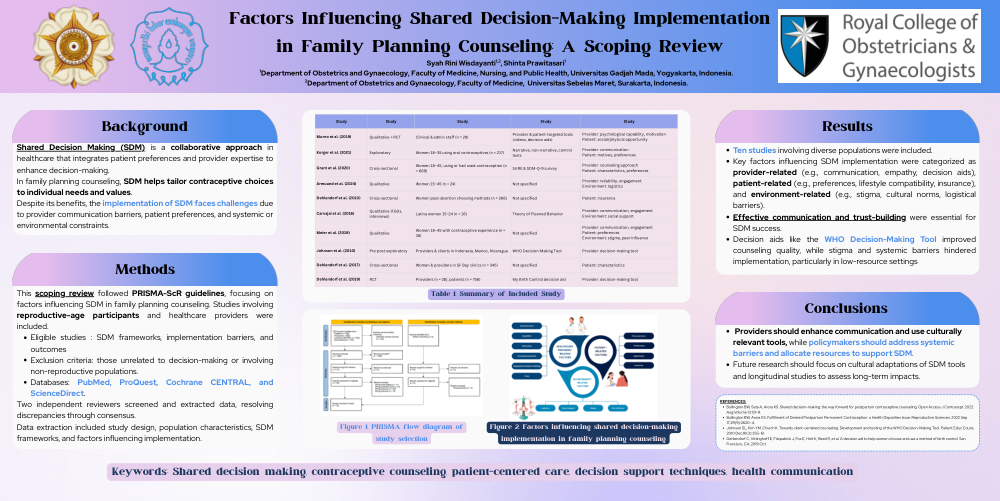
Factors Influencing Shared Decision-Making Implementation
in Family Planning Counseling: A Scoping Review
Shared Decision Making (SDM) is a collaborative approach in
healthcare that integrates patient preferences and provider expertise to
enhance decision-making.
In family planning counseling, SDM helps tailor contraceptive choices
to individual needs and values.
Despite its benefits, the implementation of SDM faces challenges due
to provider communication barriers, patient preferences, and systemic or
environmental constraints.
Methods:
This scoping review followed PRISMA-ScR guidelines, focusing on
factors influencing SDM in family planning counseling. Studies involving
reproductive-age participants and healthcare providers were
included.
Eligible studies : SDM frameworks, implementation barriers, and
outcomes
Exclusion criteria: those unrelated to decision-making or involving
non-reproductive populations.
Databases: PubMed, ProQuest, Cochrane CENTRAL, and
ScienceDirect.
Two independent reviewers screened and extracted data, resolving
discrepancies through consensus.
Data extraction included study design, population characteristics, SDM
frameworks, and factors influencing implementation.
Result:
Ten studies involving diverse populations were included.
Key factors influencing SDM implementation were categorized as
provider-related (e.g., communication, empathy, decision aids),
patient-related (e.g., preferences, lifestyle compatibility, insurance),
and environment-related (e.g., stigma, cultural norms, logistical
barriers).
Effective communication and trust-building were essential for
SDM success.
Decision aids like the WHO Decision-Making Tool improved
counseling quality, while stigma and systemic barriers hindered
implementation, particularly in low-resource settings
relevant tools, while policymakers should address systemic
barriers and allocate resources to support SDM.
Future research should focus on cultural adaptations of SDM tools
and longitudinal studies to assess long-term impacts.