2,281 posters, 63 videos, 56 audios, 43 topics, 18 sessions, 6,174 authors, 2,323 institutions
ePostersLive by SciGen Technologies S.A. All rights reserved.
RCOG World Congress 2025
June 23 - 25, 2025 | ExCeL London, UK
EP.2085
Assessing Patient Satisfaction of Maternity Service Introducing Coil Insertions During Caesarean Section.
Poster Presenter
Authors
Affiliations
Part of Topic
Sexual health & contraception/sexual health & HIV
Assessing Patient Satisfaction of New Maternity Service Introducing Coil Insertions During Caesarean Section at Lister Hospital, UK.
Dr Sacha Bell, Dr Joanna Brecher, Ms Ini Orangun
Introduction
•Patient access to postnatal contraception (PNC) immediately following delivery is a gold standard recommendation from FSRH and RCOG.
•Maternity services across the UK have been slow to adopt this routine practice.
•A 2018 Public Health England survey highlighted that postnatal women often lack PNC information.
•Rising rates of Caesarean sections (CS) means PNC discussion and implementation is crucial to improved maternal and foetal outcomes.
•Insertion of intrauterine contraceptives (IUC) during CS is safe, effective and convenient with lower expulsion rates than following vaginal delivery.
Method
•February 2024: began discussions with patients regarding LARC during antenatal clinic appointments.
•Women who opted in were formally consented and provided with information leaflets.
•IUC inserted as per request at CS following placental delivery.
•Patients were interviewed at least 3-weeks postpartum via telephone questionnaire.
•Any concerns were addressed and directed to GP or local Sexual Health Clinic.
Results
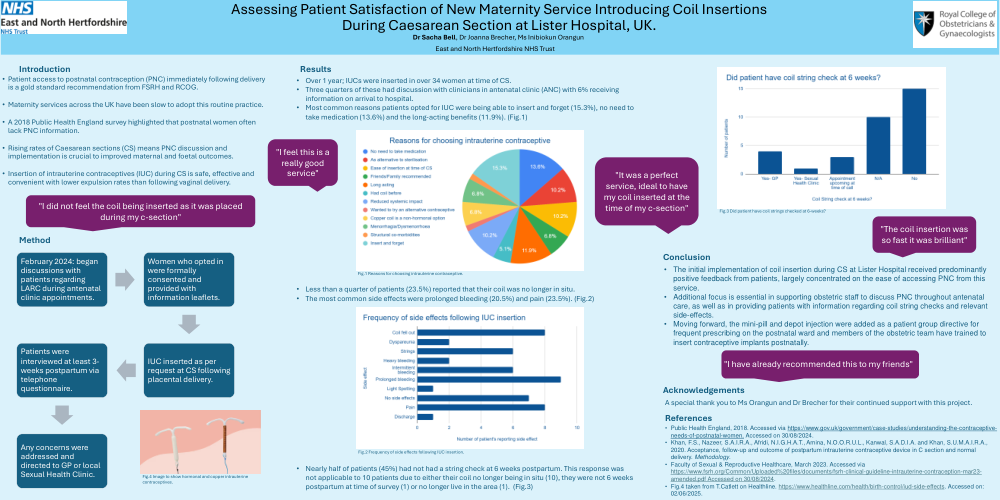
•Over 1 year; IUCs were inserted in over 34 women at time of CS.
•Three quarters of these had discussion with clinicians in antenatal clinic (ANC) with 6% receiving information on arrival to hospital.
•Most common reasons patients opted for IUC were being able to insert and forget (15.3%), no need to take medication (13.6%) and the long-acting benefits (11.9%). (Fig.1)
•Less than a quarter of patients (23.5%) reported that their coil was no longer in situ.
•The most common side effects were prolonged bleeding (20.5%) and pain (23.5%). (Fig.2)
•Nearly half of patients (45%) had not had a string check at 6 weeks postpartum. This response was not applicable to 10 patients due to either their coil no longer being in situ (10), they were not 6 weeks postpartum at time of survey (1) or no longer live in the area (1). (Fig.3)
Conclusion
•The initial implementation of coil insertion during CS at Lister Hospital received predominantly positive feedback from patients, largely concentrated on the ease of accessing PNC from this service.
•Additional focus is essential in supporting obstetric staff to discuss PNC throughout antenatal care, as well as in providing patients with information regarding coil string checks and relevant side-effects.
•Moving forward, the mini-pill and depot injection were added as a patient group directive for frequent prescribing on the postnatal ward and members of the obstetric team have trained to insert contraceptive implants postnatally.
Acknowledgements
A special thank you to Ms Orangun and Dr Brecher for their continued support with this project.
References
•Public Health England, 2018. Accessed via https://www.gov.uk/government/case-studies/understanding-the-contraceptive-needs-of-postnatal-women. Accessed on 30/08/2024.
•Khan, F.S., Nazeer, S.A.I.R.A., Afridi, N.I.G.H.A.T., Amina, N.O.O.R.U.L., Kanwal, S.A.D.I.A. and Khan, S.U.M.A.I.R.A., 2020. Acceptance, follow-up and outcome of postpartum intrauterine contraceptive device in C section and normal delivery. Methodology.
•Faculty of Sexual & Reproductive Healthcare, March 2023. Accessed via https://www.fsrh.org/Common/Uploaded%20files/documents/fsrh-clinical-guideline-intrauterine-contraception-mar23-amended.pdf Accessed on 30/08/2024.
•Fig.4 taken from T.Catlett on Healthline. https://www.healthline.com/health/birth-control/iud-side-effects. Accessed on: 02/06/2025.