2,281 posters, 63 videos, 56 audios, 43 topics, 18 sessions, 6,174 authors, 2,323 institutions
ePostersLive by SciGen Technologies S.A. All rights reserved.
RCOG World Congress 2025
June 23 - 25, 2025 | ExCeL London, UK
EP.2104
Rare case of Tubal Ligation Filshie Clip Migrated into Anterior Abdominal Wall
Poster Presenter
Authors
Affiliations
Part of Topic
Sexual health & contraception/sexual health & HIV
Rare Case of a Migrated Filshie Clip into the Anterior Abdominal Wall
Dr Jasmin Banwait, Dr Clare Wong
Blacktown Hospital Department of Obstetrics and Gynaecology, Sydney, NSW, Australia
Background:
Filshie clips are non-absorbable titanium/ silicone clips used in tubal ligations for occlusion of fallopian tubes.1,2 They provide a reliable method of occlusion, with a relatively low failure rate of 0.05%.3 They are the most common method of permanent sterilisation in Australia and New Zealand,4 however, not without complications..
Case Report:
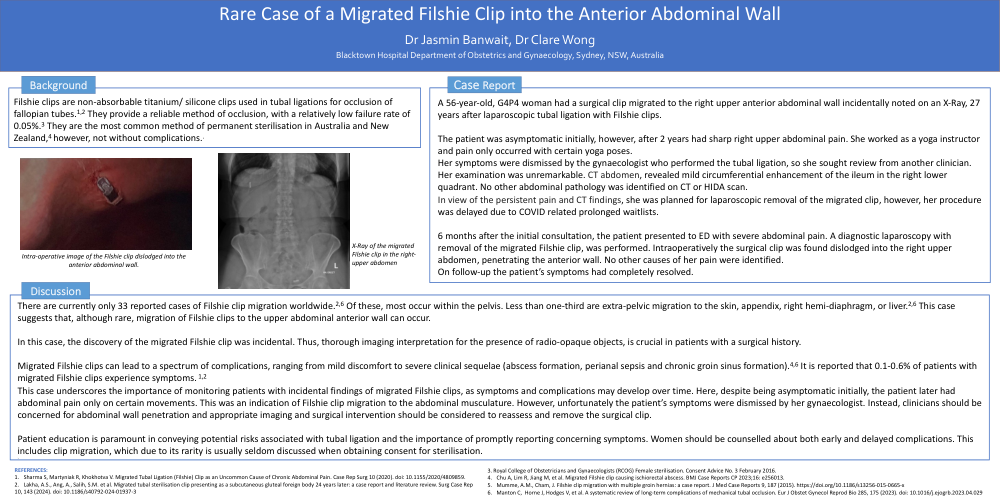
A 56-year-old G4P4 woman had a surgical clip migrated to the right upper anterior abdominal wall incidentally noted on an X-Ray, 27 years after laparoscopic tubal ligation with Filshie clips.
The patient was asymptomatic initially, however, after 2 years had sharp right upper abdominal pain. She worked as a yoga instructor and reported pain only occurred with certain yoga poses.
The patient’s symptoms were dismissed by the gynaecologist who performed the tubal ligation, so she sought review from another clinician. Her examination was unremarkable. She underwent a CT abdomen, which revealed mild circumferential enhancement of the ileum in the right lower quadrant. There was no other abdominal pathology on CT or HIDA scan. In view of the persistent pain and CT findings, she was planned for laparoscopic removal of the migrated clip, however, her procedure was delayed due to COVID related prolonged waitlists.
6 months after the initial consultation, the patient presented to ED with severe abdominal pain. A diagnostic laparoscopy with removal of the migrated Filshie clip, was performed. Intraoperatively the surgical clip was found dislodged into the right upper abdomen, penetrating the anterior wall. No other causes of her pain were identified.
On follow-up the patient’s symptoms had completely resolved.
Discussion:
There are currently only 33 reported cases of Filshie clip migration worldwide.2,6 Of these, most occur within the pelvis. Less than one-third are extra-pelvic migration to the skin, appendix, right hemi-diaphragm, or liver.2,6,7 This case suggests that, although rare, migration of Filshie clips to the upper abdominal anterior wall can occur.
In this case, the discovery of the migrated Filshie clip was incidental. Thus, thorough imaging interpretation for the presence of radio-opaque objects, is crucial in patients with a surgical history.
Migrated Filshie clips can lead to a spectrum of complications, ranging from mild discomfort to severe clinical sequelae (abscess formation, perianal sepsis and chronic groin sinus formation).4,6 It is reported that 0.1-0.6% of patients with migrated Filshie clips experience symptoms. 1,2
This case underscores the importance of monitoring patients with incidental findings of migrated Filshie clips, as symptoms and complications may develop over time. Here, despite being asymptomatic initially, the patient later had abdominal pain only on certain movements. This was an indication of Filshie clip migration to the abdominal musculature. However, unfortunately the patient’s symptoms were dismissed by her gynaecologist. Instead, clinicians should be concerned for abdominal wall penetration and appropriate imaging and surgical intervention should be considered to reassess and remove the surgical clip.
Patient education is paramount in conveying potential risks associated with tubal ligation and the importance of promptly reporting concerning symptoms. Women should be counselled about both early and delayed complications. This includes clip migration, which due to its rarity is usually seldom discussed when obtaining consent for sterilisation.