2,281 posters, 63 videos, 56 audios, 43 topics, 18 sessions, 6,174 authors, 2,323 institutions
ePostersLive by SciGen Technologies S.A. All rights reserved.
RCOG World Congress 2025
June 23 - 25, 2025 | ExCeL London, UK
EP.2098
Postnatal contraception prescribing prior to discharge from a London district general hospital
Poster Presenter
Authors
Affiliations
Part of Topic
Sexual health & contraception/sexual health & HIV
Postnatal contraception prescribing prior to discharge from a London district general hospital.
Faculty of Sexual and Reproductive Health (FSRH) states that all clinicians involved in a pregnant women’s care should provide the opportunity to discuss contraception with a person-centred approach. Services providing care to pregnant women should be able to offer all types of contraception, including long-acting reversible contraception to women before they are discharged from the service.
OBJECTIVE:
To review the number of women prescribed contraception on the postnatal ward prior to discharge, and barriers to its prescribing.
DESIGN/METHOD
Retrospective study reviewing women who were discharged from the postnatal ward, in a London district general hospital, during the period of 1st June 2024 – 15th June 2024.
Postnatal contraception discussions and prescriptions were reviewed via iCare computer system.
12 doctors (foundation year 2, GP trainees, ST1/2 Obstetrics and Gynaecology trainees), who work on the postnatal ward were interviewed with a standard questionnaire for a subjective perspective regarding postnatal contraception prescribing
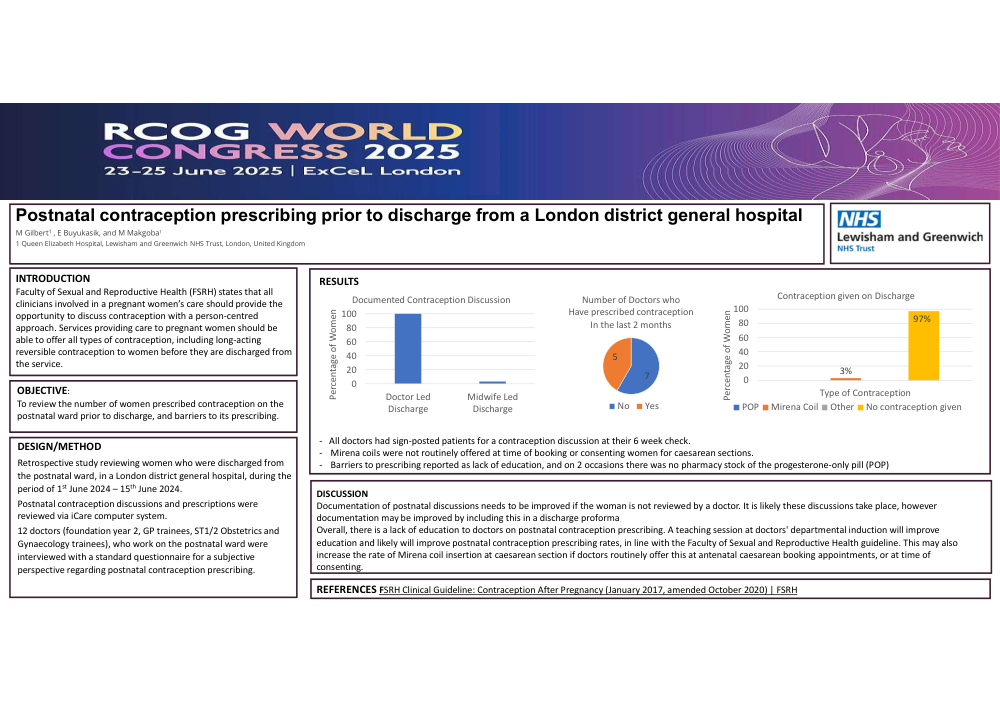
All doctors had sign-posted patients for a contraception discussion at their 6 week check.
DISCUSSION
Documentation of postnatal discussions needs to be improved if the woman is not reviewed by a doctor. It is likely these discussions take place, however documentation may be improved by including this in a discharge proforma.
Overall, there is a lack of education to doctors on postnatal contraception prescribing. A teaching session at doctors' departmental induction will improve education and likely will improve postnatal contraception prescribing rates, in line with the Faculty of Sexual and Reproductive Health guideline. This may also increase the rate of Mirena coil insertion at caesarean section if doctors routinely offer this at antenatal caesarean booking appointments, or at time of consenting.