2,281 posters, 63 videos, 56 audios, 43 topics, 18 sessions, 6,174 authors, 2,323 institutions
ePostersLive by SciGen Technologies S.A. All rights reserved.
RCOG World Congress 2025
June 23 - 25, 2025 | ExCeL London, UK
EP.2096
Initiation and evaluation of a Post-Birth Contraception Service in North West London
Poster Presenter
Part of Topic
Sexual health & contraception/sexual health & HIV
Post-Partum Family Planning (PPFP) plays a crucial role in preventing unintended and closely spaced pregnancies following childbirth. Although over 90% of women wish to delay pregnancy for at least two years postpartum, a significant number are not using contraception. Short birth intervals, especially those under 12 months, are linked to adverse outcomes such as preterm birth, low birth weight, and increased child mortality. As fertility can return unpredictably- often before menstruation resumes- early postpartum contraception is essential.
The goal is to support women in initiating and continuing a suitable contraceptive method for two years or longer, aligned with their reproductive intentions.
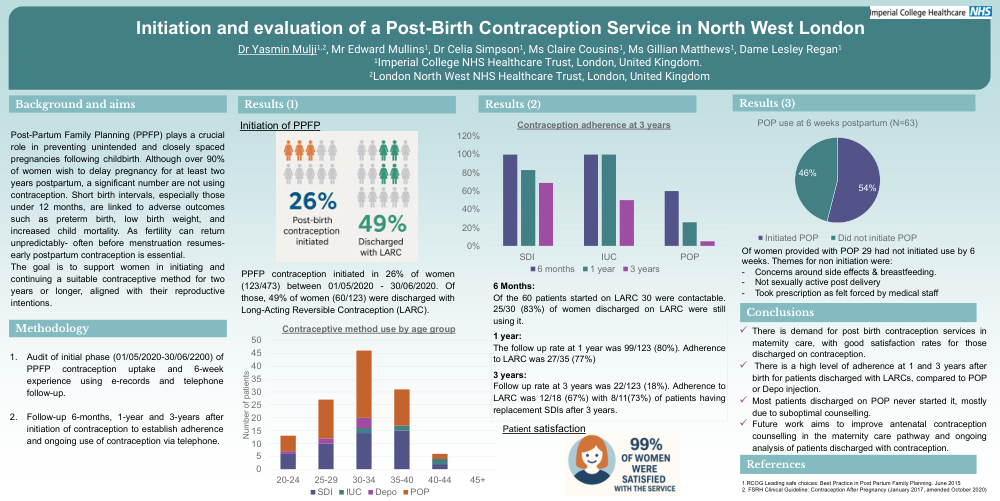
PPFP contraception initiated in 26% of women (123/473) between 01/05/2020 - 30/06/2020. Of those, 49% of women (60/123) were discharged with Long-Acting Reversible Contraception (LARC).
6 Months:
Of the 60 patients started on LARC 30 were contactable. 25/30 (83%) of women discharged on LARC were still using it.
1 year:
The follow up rate at 1 year was 99/123 (80%). Adherence to LARC was 27/35 (77%)
3 years:
Follow up rate at 3 years was 22/123 (18%). Adherence to LARC was 12/18 (67%) with 8/11(73%) of patients having replacement SDIs after 3 years.
Of women provided with POP 29 had not initiated use by 6 weeks. Themes for non initiation were: