2,281 posters, 63 videos, 56 audios, 43 topics, 18 sessions, 6,174 authors, 2,323 institutions
ePostersLive by SciGen Technologies S.A. All rights reserved.
RCOG World Congress 2025
June 23 - 25, 2025 | ExCeL London, UK
EP.2088
Enhancing Contraceptive Counseling: Healthcare Providers Role in Digital Decision Aids
Part of Topic
Sexual health & contraception/sexual health & HIV
ENHANCING CONTRACEPTIVE COUNSELING: HEALTHCARE PROVIDERS ROLE IN DIGITAL DECISION AIDS
BACKGROUND
•The integration of technology-based decision aids in contraceptive counseling transformed the decision-making process
•While these tools empower patients, their growing use raised questions on the evolving role of healthcare patients
AIM
To investigate how digital decision aids influence the role of healthcare providers
METHODS
•Five databases were searched
•Primary evidence from 2017-2020
•Inclusion: reproductive-age couples or potential contraceptive acceptors
RESULT
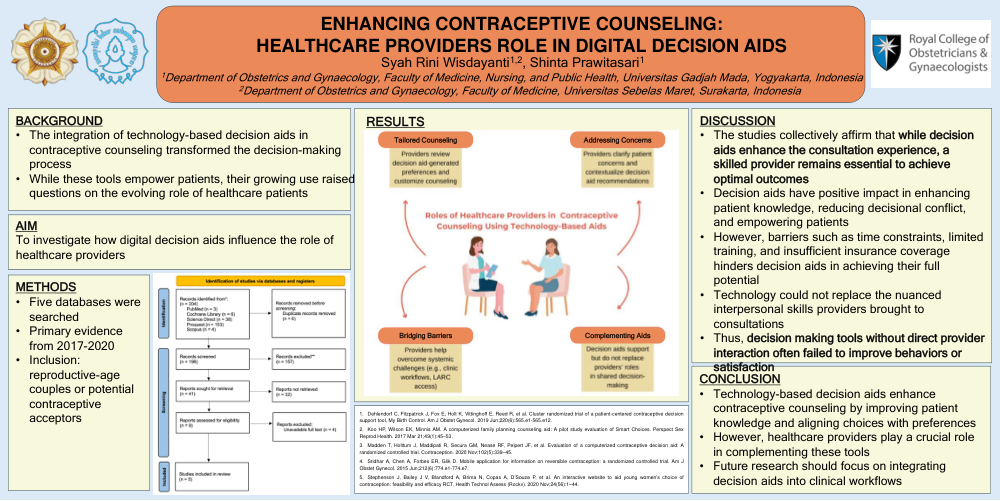
A total of five studies involving diverse populations and interventions were included. The decision aids evaluated included interactive websites, mobile applications, and tablet-based tools designed to align contraceptive choices with patient preferences. Key findings included improved patient knowledge and satisfaction with counseling when decision aids were used, although clinical outcomes such as contraceptive uptake and continuation rates showed no significant differences between intervention and control groups. Healthcare providers remained integral in guiding decision-making, addressing patient concerns, and contextualizing digital information.
DISCUSSION
• The studies collectively affirm that while decision aids enhance the consultation experience, a skilled provider remains essential to achieve optimal outcomes
• Decision aids have positive impact in enhancing patient knowledge, reducing decisional conflict, and empowering patients
• However, barriers such as time constraints, limited training, and insufficient insurance coverage hinders decision aids in achieving their full
potential
• Technology could not replace the nuanced interpersonal skills providers brought to consultations
• Thus, decision making tools without direct provider interaction often failed to improve behaviors orsatisfaction
CONCLUSION
• Technology-based decision aids enhance contraceptive counseling by improving patient knowledge and aligning choices with preferences
• However, healthcare providers play a crucial role in complementing these tools
• Future research should focus on integrating decision aids into clinical workflows