2,281 posters, 63 videos, 56 audios, 43 topics, 18 sessions, 6,174 authors, 2,323 institutions
ePostersLive by SciGen Technologies S.A. All rights reserved.
RCOG World Congress 2025
June 23 - 25, 2025 | ExCeL London, UK
EP.2087
Contraception in Tunisia: determinants of female contraceptive use
Poster Presenter
Authors
Narjes Karmous, Abdelwaheb Masmoudi, Badreddine Bouguerra, Abdennour Karmous
Affiliations
Department of Gynaecology and Obstetrics, Charles Nicolle Hospital, Department B- Charles Nicolle Hospital, Gynaecology and Obstetrics Department B, Charles Nicolle Hospital, Department Bof Obstetrics and Gynaecology, Charles Nicolle Hospital, Department of Obstetrics and Gynecology B, Charles Nicolle Hospital, Gynaecology and Obstetrics Department B of Charles Nicolle Hospital, Gynaecology and Obstetrics department B- Charles Nicolle Hospital, Charles Nicolle Hospital, Obstetrics and Gynaecology Service B, Razi Hospital, Department B of Gynaecology and Obstetrics- Charles Nicolle Hospital, Department B of Obstetrics and Gynecology, Charles Nicolle Hospital
Part of Topic
Sexual health & contraception/sexual health & HIV
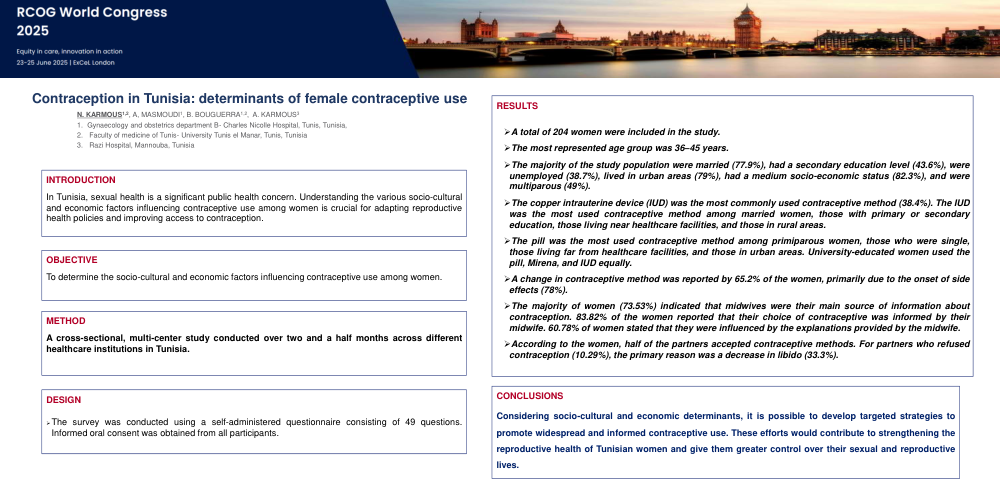
Contraception in Tunisia: determinants of female contraceptive use
Objective:
To determine the socio-cultural and economic factors influencing contraceptive use among women.
Design:
A cross-sectional, multi-center study conducted over two and a half months across different healthcare institutions in Tunisia.
Method: The survey was conducted using a self-administered questionnaire consisting of 49 questions. Informed oral consent was obtained from all participants. Descriptive and inferential statistics were performed with SPSS (IBM,v26).
Results:
A total of 204 women were included in the study.
The most represented age group was 36–45 years. The majority of the study population were married (77.9%), had a secondary education level (43.6%), were unemployed (38.7%), lived in urban areas (79%), had a medium socio-economic status (82.3%), and were multiparous (49%).
The copper intrauterine device (IUD) was the most commonly used contraceptive method (38.4%).
The IUD was the most used contraceptive method among married women, those with primary or secondary education, those living near healthcare facilities, and those in rural areas.
The pill was the most used contraceptive method among primiparous women, those who were single, those living far from healthcare facilities, and those in urban areas.
University-educated women used the pill, Mirena, and IUD equally.
A change in contraceptive method was reported by 65.2% of the women, primarily due to the onset of side effects (78%).
The majority of women (73.53%) indicated that midwives were their main source of information about contraception. 83.82% of the women reported that their choice of contraceptive was informed by their midwife.
60.78% of women stated that they were influenced by the explanations provided by the midwife.
According to the women, half of the partners accepted contraceptive methods. For partners who refused contraception (10.29%), the primary reason was a decrease in libido (33.3%).
Conclusions:
Considering socio-cultural and economic determinants, it is possible to develop targeted strategies to promote widespread and informed contraceptive use. These efforts would contribute to strengthening the reproductive health of Tunisian women and give them greater control over their sexual and reproductive lives.