2,281 posters, 63 videos, 56 audios, 43 topics, 18 sessions, 6,174 authors, 2,323 institutions
ePostersLive by SciGen Technologies S.A. All rights reserved.
RCOG World Congress 2025
June 23 - 25, 2025 | ExCeL London, UK
EP.2056
POSTPARTUM HEMORRHAGE-INDUCED ACUTE KIDNEY INJURY: MATERNAL HEALTH CRISIS IN PESHAWAR
Poster Presenter
Authors
Affiliations
Part of Topic
Risk management
POSTPARTUM HEMORRHAGE-ASSOCIATED ACUTE KIDNEY INJURY:
A MATERNAL HEALTH CRISIS IN TERTIARY CARE HOSPITAL, PESHAWAR
Prof. Dr. Sidra Jabbar Khan1, Asst. Prof Dr. Saima Ayub 2, Dr. Nudrat Ayub3
1,2,3 Consultant Obstetrics and Gynecology,
Northwest General Hospital and Research Centre, Peshawar
INTRODUCTION:
Postpartum Acute Kidney Injury (PPAKI) is a severe obstetric complication contributing significantly to maternal morbidity and mortality, particularly in developing countries. Predominantly caused by obstetric hemorrhage, hypertensive disorders, and glomerular diseases, PPAKI outcomes, including dialysis dependency and high mortality rates, highlighting need for improved care. In Pakistan, its incidence varies widely ranging from 3.59% to 40%, reflecting gaps in diagnosis, management, and reporting.
OBJECTIVE :
This study investigates the incidence, clinical presentations, and outcomes of PPAKI at a tertiary care hospital in Peshawar, aiming to inform strategies for enhanced maternal health care
SETTING:
OBGYN department, Northwest General Hospital, Peshawar
POPULATION:
Postnatal patients who went into PPH and develop AKI
METHODOLOGY:
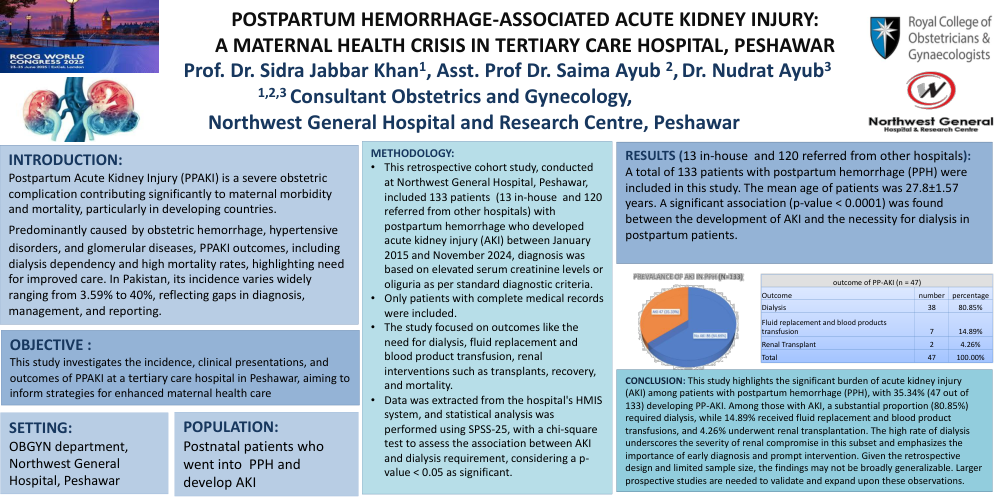
This retrospective cohort study, conducted at Northwest General Hospital, Peshawar, included 133 patients (13 in-house and 120 referred from other hospitals) with postpartum hemorrhage who developed acute kidney injury (AKI) between January 2015 and November 2024, diagnosis was based on elevated serum creatinine levels or oliguria as per standard diagnostic criteria.
Only patients with complete medical records were included.
The study focused on outcomes like the need for dialysis, fluid replacement and blood product transfusion, renal interventions such as transplants, recovery, and mortality.
Data was extracted from the hospital's HMIS system, and statistical analysis was performed using SPSS-25, with a chi-square test to assess the association between AKI and dialysis requirement, considering a p-value < 0.05 as significant.
RESULTS (13 in-house and 120 referred from other hospitals):
A total of 133 patients with postpartum hemorrhage (PPH) were included in this study. The mean age of patients was 27.8±1.57 years. A significant association (p-value < 0.0001) was found between the development of AKI and the necessity for dialysis in postpartum patients.
CONCLUSION: This study highlights the significant burden of acute kidney injury (AKI) among patients with postpartum hemorrhage (PPH), with 35.34% (47 out of 133) developing PP-AKI. Among those with AKI, a substantial proportion (80.85%) required dialysis, while 14.89% received fluid replacement and blood product transfusions, and 4.26% underwent renal transplantation. The high rate of dialysis underscores the severity of renal compromise in this subset and emphasizes the importance of early diagnosis and prompt intervention. Given the retrospective design and limited sample size, the findings may not be broadly generalizable. Larger prospective studies are needed to validate and expand upon these observations.