2,281 posters, 63 videos, 56 audios, 43 topics, 18 sessions, 6,174 authors, 2,323 institutions
ePostersLive by SciGen Technologies S.A. All rights reserved.
RCOG World Congress 2025
June 23 - 25, 2025 | ExCeL London, UK
EP.2052
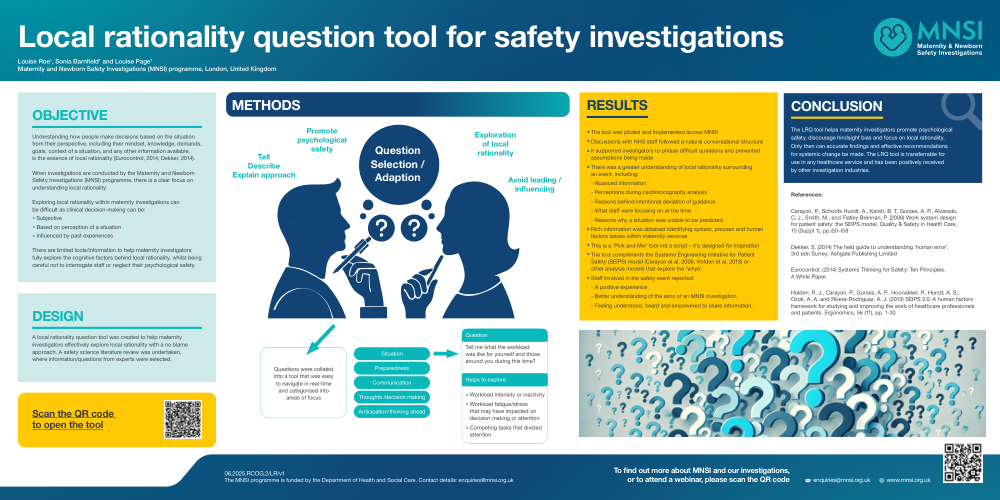
Local rationality question tool for maternity investigations
Poster Presenter
Part of Topic
Risk management
Local rationality question tool for safety investigations
Objective
Understanding how people make decisions based on the situation
from their perspective, including their mindset, knowledge, demands,
goals, context of a situation, and any other information available,
is the essence of local rationality (Eurocontrol, 2014; Dekker, 2014).
When investigations are conducted by the Maternity and Newborn
Safety Investigations (MNSI) programme, there is a clear focus on
understanding local rationality.
Exploring local rationality within maternity investigations can
be difficult as clinical decision-making can be:
• Subjective
• Based on perception of a situation
• Influenced by past experiences
There are limited tools/information to help maternity investigators
fully explore the cognitive factors behind local rationality, whilst being
careful not to interrogate staff or neglect their psychological safety.
Design
A local rationality question tool was created to help maternity
investigators effectively explore local rationality with a no blame
approach. A safety science literature review was undertaken,
where information/questions from experts were selected.
Methods
Question Selection/Adaption
- Exploration of local rationality
- Promote psychological safety
- Avoid leading/influencing
- Tell, Describe, Explain approach
Questions were collated into a tool that was easy to navigate in
real-time and categorised into areas of focus.
Results
• The tool was piloted and implemented across MNSI
• Discussions with NHS staff followed a natural conversational structure
• It supported investigators to phrase difficult questions and prevented
assumptions being made
• There was a greater understanding of local rationality surrounding an event, including:
- Nuanced information
- Perceptions during cardiotocography analysis
- Reasons behind intentional deviation of guidance
- What staff were focusing on at the time
- Reasons why a situation was unable to be predicted
• Rich information was obtained identifying system, process and human
factors issues within maternity services
• This is a ‘Pick and Mix’ tool not a script – it’s designed for inspiration
• The tool compliments the Systems Engineering Initiative for Patient Safety (SEIPS)
model (Carayon et al, 2006; Holden et al, 2013) or other analysis models that explore the ‘whys’.
• Staff involved in the safety event reported:
- A positive experience
- Better understanding of the aims of an MNSI investigation
- Feeling understood, heard and empowered to share information.
Conclusion
The LRQ tool helps maternity investigators promote psychological
safety, discourage hindsight bias and focus on local rationality.
Only then can accurate findings and effective recommendations
for systemic change be made. The LRQ tool is transferrable for
use in any healthcare service and has been positively received
by other investigation industries.
References
Carayon, P., Schoofs Hundt, A., Karsh, B. T, Gurses, A. P., Alvarado,
C. J., Smith, M., and Flatley Brennan, P. (2006) Work system design
for patient safety: the SEIPS model. Quality & Safety in Health Care,
15 (Suppl 1), pp.i50–i58
Dekker, S. (2014) The field guide to understanding ‘human error’.
3rd edn Surrey: Ashgate Publishing Limited
Eurocontrol. (2014) Systems Thinking for Safety: Ten Principles.
A White Paper.
Holden, R. J., Carayon, P., Gurses, A. P., Hoonakker, P., Hundt, A. S.,
Ozok, A. A. and Rivera-Rodriguez, A. J. (2013) SEIPS 2.0: A human factors
framework for studying and improving the work of healthcare professionals
and patients. Ergonomics, 56 (11), pp. 1-30