2,281 posters, 63 videos, 56 audios, 43 topics, 18 sessions, 6,174 authors, 2,323 institutions
ePostersLive by SciGen Technologies S.A. All rights reserved.
RCOG World Congress 2025
June 23 - 25, 2025 | ExCeL London, UK
EP.2054
Risk factors for laparoconversion in gynecological laparoscopic surgery
Poster Presenter
Authors
Affiliations
Department of Gynaecology and Obstetrics, Charles Nicolle Hospital, Department B- Charles Nicolle Hospital, Gynaecology and Obstetrics Department B, Charles Nicolle Hospital, Department Bof Obstetrics and Gynaecology, Charles Nicolle Hospital, Department of Obstetrics and Gynecology B, Charles Nicolle Hospital, Gynaecology and Obstetrics Department B of Charles Nicolle Hospital, Gynaecology and Obstetrics department B- Charles Nicolle Hospital, Charles Nicolle Hospital, Obstetrics and Gynaecology Service B, Department B of Gynaecology and Obstetrics- Charles Nicolle Hospital, Department B of Obstetrics and Gynecology, Charles Nicolle Hospital
Part of Topic
Risk management
Risk factors for laparoconversion in gynecological laparoscopic surgery
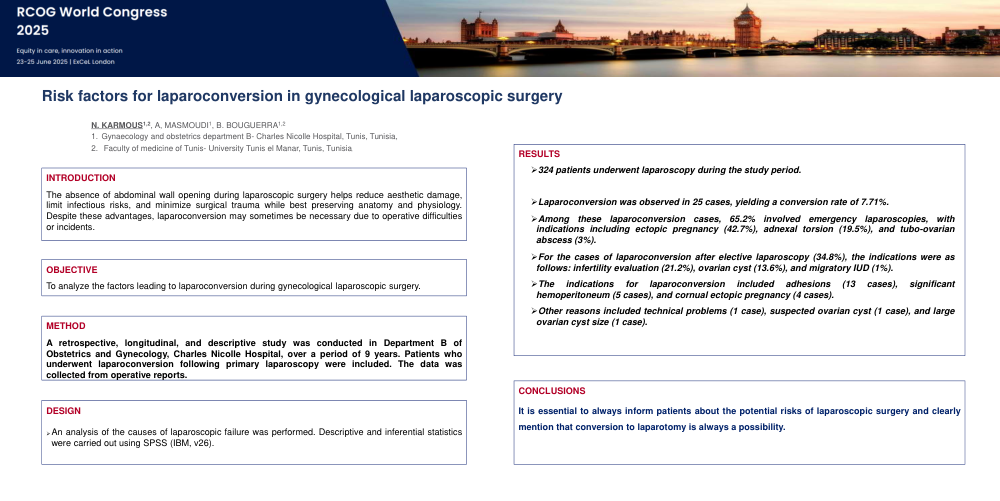
Objective: The absence of abdominal wall opening during laparoscopic surgery helps reduce aesthetic damage, limit infectious risks, and minimize surgical trauma while best preserving anatomy and physiology. Despite these advantages, laparoconversion may sometimes be necessary due to operative difficulties or incidents. Our aim was to analyze the factors leading to laparoconversion during gynecological laparoscopic surgery.
Methods: A retrospective, longitudinal, and descriptive study was conducted in Department B of Obstetrics and Gynecology, Charles Nicolle Hospital, over a period of 9 years. Patients who underwent laparoconversion following primary laparoscopy were included. The data was collected from operative reports.
Design: An analysis of the causes of laparoscopic failure was performed. Descriptive and inferential statistics were carried out using SPSS (IBM, v26).
Results: 324 patients underwent laparoscopy during the study period. Laparoconversion was observed in 25 cases, yielding a conversion rate of 7.71%. Among these laparoconversion cases, 65.2% involved emergency laparoscopies, with indications including ectopic pregnancy (42.7%), adnexal torsion (19.5%), and tubo-ovarian abscess (3%). For the cases of laparoconversion after elective laparoscopy (34.8%), the indications were as follows: infertility evaluation (21.2%), ovarian cyst (13.6%), and migratory IUD (1%). The indications for laparoconversion included adhesions (13 cases), significant hemoperitoneum (5 cases), and cornual ectopic pregnancy (4 cases). Other reasons included technical problems (1 case), suspected ovarian cyst (1 case), and large ovarian cyst size (1 case).
Conclusion: It is essential to always inform patients about the potential risks of laparoscopic surgery and clearly mention that conversion to laparotomy is always a possibility.