2,281 posters, 63 videos, 56 audios, 43 topics, 18 sessions, 6,174 authors, 2,323 institutions
ePostersLive by SciGen Technologies S.A. All rights reserved.
RCOG World Congress 2025
June 23 - 25, 2025 | ExCeL London, UK
EP.1780
BMI Levels Among Adolescents Aged 10-19 Attending Dubai Health Facilities in 2023
Poster Presenter
Authors
Marwah Al Shmanee, Fatimah Resen, Ayesha Almarzooqi, Maha Abdo, Ayesha Al Mheiri
Affiliations
Obstetrics and Gynecology Resident, Latifa Hospital, Dubai Health, Medical Intern at Dubai Health, Family medicine, Dubai Health, Chair of Training, Director of medical internship program, Family medicine, Graduate medical education (MBRU), Dubai Health
Part of Topic
Obesity & public health
BMI Levels Among Adolescents Age 10-19 Attending Dubai Health Facilities In 2023
Introduction
Adolescence is the phase of life between childhood and adulthood, from ages 10 to 19. It's a unique transition period and an important stage for developing healthy behaviors. Abnormal BMI can affect an adolescent’s development, health, and well-being, with potential long-term implications for overall health, including reproductive health and public health outcomes. Therefore, it's important to invest in this important period of life and educate them to build the basic foundation of their health.
Body mass index (BMI) is measured by dividing the weight in kilograms by the square of height in meters. BMI<18.5, is classified as underweight. A BMI of 18.5-24.9 is in the healthy range. A BMI from 25 to <29.9 falls within the overweight range, and a BMI of 30 or higher is within the obesity range.
This study aims to identify the Body Mass Index level (BMI) among adolescents aged 10-19 years attending Dubai Health facilities in 2023.
Methodology
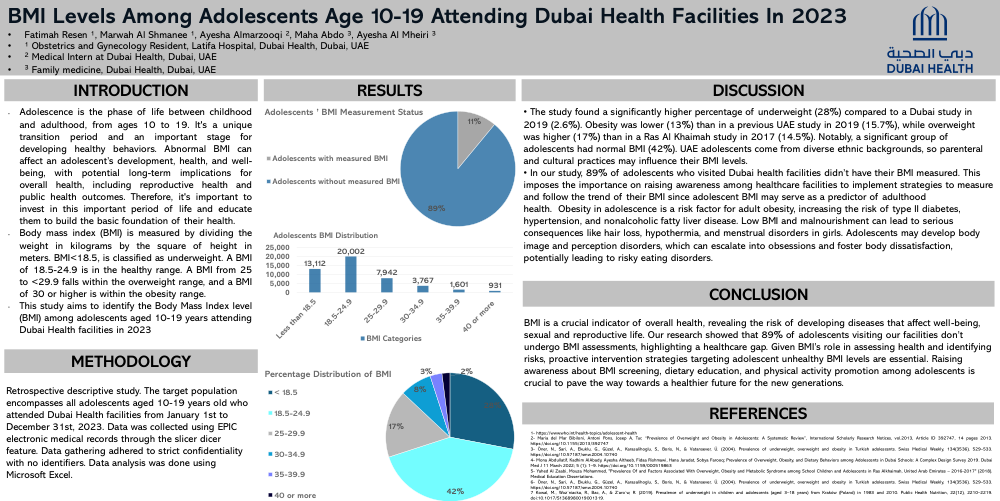
Retrospective descriptive study. The target population encompasses all adolescents aged 10-19 years old who attended Dubai Health facilities from January 1st to December 31st, 2023. Data was collected using EPIC electronic medical records through the slicer dicer feature. Data gathering adhered to strict confidentiality with no identifiers. Data analysis was done using Microsoft Excel.
Discussion
The study found a significantly higher percentage of underweight (28%) compared to a Dubai study in 2019 (2.6%). Obesity was lower (13%) than in a previous UAE study in 2019 (15.7%), while overweight was higher (17%) than in a Ras Al Khaimah study in 2017 (14.5%). Notably, a significant group of adolescents had normal BMI (42%). UAE adolescents come from diverse ethnic backgrounds, so parenteral and cultural practices may influence their BMI levels.
In our study, 89% of adolescents who visited Dubai health facilities didn’t have their BMI measured. This imposes the importance on raising awareness among healthcare facilities to implement strategies to measure and follow the trend of their BMI since adolescent BMI may serve as a predictor of adulthood health. Obesity in adolescence is a risk factor for adult obesity, increasing the risk of type II diabetes, hypertension, and nonalcoholic fatty liver disease. Low BMI and malnourishment can lead to serious consequences like hair loss, hypothermia, and menstrual disorders in girls. Adolescents may develop body image and perception disorders, which can escalate into obsessions and foster body dissatisfaction, potentially leading to risky eating disorders.
Conclusion
BMI is a crucial indicator of overall health, revealing the risk of developing diseases that affect well-being, sexual and reproductive life. Our research showed that 89% of adolescents visiting our facilities don’t undergo BMI assessments, highlighting a healthcare gap. Given BMI’s role in assessing health and identifying risks, proactive intervention strategies targeting adolescent unhealthy BMI levels are essential. Raising awareness about BMI screening, dietary education, and physical activity promotion among adolescents is crucial to pave the way towards a healthier future for the new generations.