2,281 posters, 63 videos, 56 audios, 43 topics, 18 sessions, 6,174 authors, 2,323 institutions
ePostersLive by SciGen Technologies S.A. All rights reserved.
RCOG World Congress 2025
June 23 - 25, 2025 | ExCeL London, UK
EP.1767
Effects of metabolism on quality of life in PCOS-patiens under metformin therapy
Poster Presenter
Authors
Konstantin Hofmann, Susanne Singer, Susanne Theis, Annette Hasenburg, Roxana Schwab, Christine Skala
Affiliations
King's Fertility, Fetal Medicine Research Institute, Institute of Medical Biostatistics, Epidemiology, and Informatics, University Medical Center of Johannes Gutenberg University Mainz, Department of Obstetrics and Gynecology, University Medical Center of Johannes Gutenberg University Mainz
Part of Topic
Obesity & public health
Effects of metabolism on quality of life in PCOS-patiens under metformin therapy
Konstantin Hofmann MD1,2, Susanne Singer PhD3, Susanne Theis MD2, Anna Dionysopoulou, MD2, Lina Schiestl MD2, Yaman Degirmenci MD2, Annette Hasenburg MD2, Roxana Schwab, MD2, Christine Skala MD2
1. King's Fertility, The Fetal Medicine Foundation, London, United Kingdom
2. Department of Obstetrics and Gynecology, University Medical Center of Johannes Gutenberg University Mainz, Germany
3. Institute of Medical Biostatistics, Epidemiology, and Informatics, University Medical Center of Johannes Gutenberg University Mainz, Germany
Objective
Polycystic Ovary Syndrome (PCOS) is an endocrine-metabolic disorder affecting 8%-18% of women globally. The condition is characterized by a range of symptoms, including obesity, insulin resistance, and mental health issues, all of which may contribute to a reduced health-related quality of life (HRQOL). Although metformin has been shown to improve HRQOL in PCOS patients, it remains unclear whether these benefits are directly due to the drug or are secondary to its metabolic effects.
Design
This study enrolled PCOS patients from the Fertility Center at the University Medical Center Mainz. Based on individual metabolic profiles, participants were divided into two groups: those receiving metformin therapy and those receiving alternative treatments or no treatment.
Methods
HRQOL and distress were assessed at baseline and after 24 weeks using the Modified PCOS-Questionnaire (MPCOSQ) and the Hospital Anxiety and Depression Scale (HADS). Comprehensive metabolic markers were assessed in all patients, allowing for monitoring of their metabolic response to the therapy. Statistical analyses were conducted using multivariate linear regression to explore the relationship between metabolic improvements and changes in HRQOL and distress.
Results
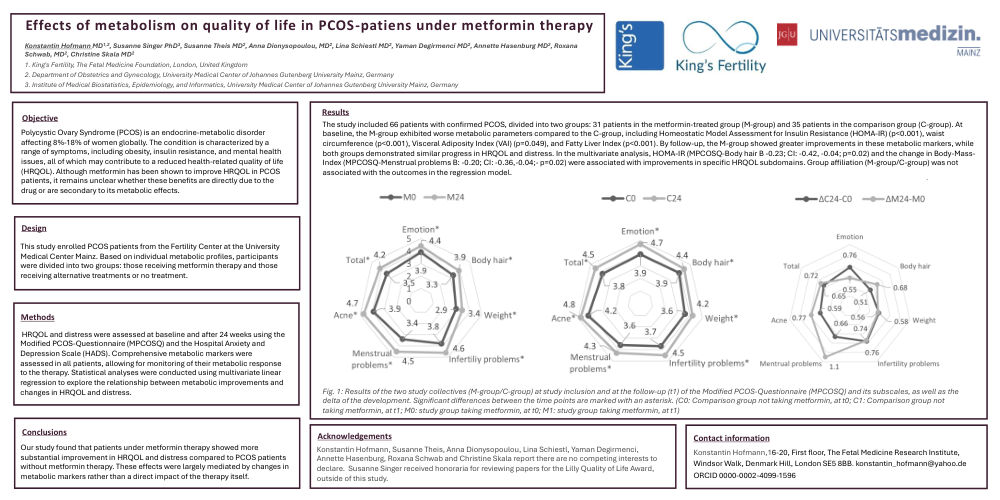
The study included 66 patients with confirmed PCOS, divided into two groups: 31 patients in the metformin-treated group (M-group) and 35 patients in the comparison group (C-group). At baseline, the M-group exhibited worse metabolic parameters compared to the C-group, including Homeostatic Model Assessment for Insulin Resistance (HOMA-IR) (p<0.001), waist circumference (p<0.001), Visceral Adiposity Index (VAI) (p=0.049), and Fatty Liver Index (p<0.001). By follow-up, the M-group showed greater improvements in these metabolic markers, while both groups demonstrated similar progress in HRQOL and distress. In the multivariate analysis, HOMA-IR (MPCOSQ-Body hair B -0.23; CI: -0.42, -0.04; p=0.02) and the change in Body-Mass-Index (MPCOSQ-Menstrual problems B: -0.20; CI: -0.36,-0.04;- p=0.02) were associated with improvements in specific HRQOL subdomains. Group affiliation (M-group/C-group) was not associated with the outcomes in the regression model.
Acknowledgements
Konstantin Hofmann, Susanne Theis, Anna Dionysopoulou, Lina Schiestl, Yaman Degirmenci, Annette Hasenburg, Roxana Schwab and Christine Skala report there are no competing interests to declare. Susanne Singer received honoraria for reviewing papers for the Lilly Quality of Life Award, outside of this study.
Contact information
Konstantin Hofmann,16-20, First floor, The Fetal Medicine Research Institute, Windsor Walk, Denmark Hill, London SE5 8BB. konstantin_hofmann@yahoo.de, ORCID 0000-0002-4099-1596