2,281 posters, 63 videos, 56 audios, 43 topics, 18 sessions, 6,174 authors, 2,323 institutions
ePostersLive by SciGen Technologies S.A. All rights reserved.
RCOG World Congress 2025
June 23 - 25, 2025 | ExCeL London, UK
EP.1768
Determinants of Insulin resistance and Obesity in Newborns of Obese Mothers.
Poster Presenter
Authors
zaheera Saadia, Khalid Nasrallah, Thekra Alsamel, Latifah AlMutlaq
Affiliations
Part of Topic
Obesity & public health
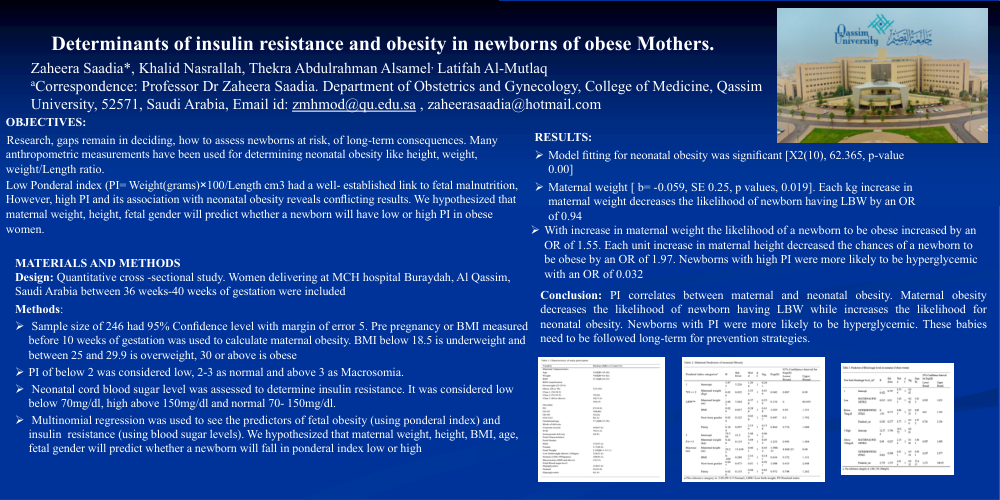
Determinants of insulin resistance and obesity in newborns of obese Mothers.
Zaheera Saadia*, Khalid Nasrallah, Thekra Abdulrahman Alsamel, Latifah Al-Mutlaq
aCorrespondence: Professor Dr Zaheera Saadia. Department of Obstetrics and Gynecology, College of Medicine, Qassim University, 52571, Saudi Arabia, Email id: zmhmod@qu.edu.sa , zaheerasaadia@hotmail.com
OBJECTIVES:
Research, gaps remain in deciding, how to assess newborns at risk, of long-term consequences. Many anthropometric measurements have been used for determining neonatal obesity like height, weight, weight/Length ratio.
Low Ponderal index (PI= Weight(grams)×100/Length cm3 had a well- established link to fetal malnutrition, However, high PI and its association with neonatal obesity reveals conflicting results. We hypothesized that maternal weight, height, fetal gender will predict whether a newborn will have low or high PI in obese women.
MATERIALS AND METHODS
Design: Quantitative cross -sectional study. Women delivering at MCH hospital Buraydah, Al Qassim, Saudi Arabia between 36 weeks-40 weeks of gestation were included
Methods:
►Sample size of 246 had 95% Confidence level with margin of error 5. Pre pregnancy or BMI measured before 10 weeks of gestation was used to calculate maternal obesity. BMI below 18.5 is underweight and between 25 and 29.9 is overweight, 30 or above is obese
►PI of below 2 was considered low, 2-3 as normal and above 3 as Macrosomia.
►Neonatal cord blood sugar level was assessed to determine insulin resistance. It was considered low below 70mg/dl, high above 150mg/dl and normal 70- 150mg/dl.
►Multinomial regression was used to see the predictors of fetal obesity (using ponderal index) and insulin resistance (using blood sugar levels). We hypothesized that maternal weight, height, BMI, age, fetal gender will predict whether a newborn will fall in ponderal index low or high
RESULTS:
►Model fitting for neonatal obesity was significant [X2(10), 62.365, p-value 0.00]
►Maternal weight [ b= -0.059, SE 0.25, p values, 0.019]. Each kg increase in maternal weight decreases the likelihood of newborn having LBW by an OR of 0.94
►With increase in maternal weight the likelihood of a newborn to be obese increased by an OR of 1.55. Each unit increase in maternal height decreased the chances of a newborn to be obese by an OR of 1.97. Newborns with high PI were more likely to be hyperglycemic with an OR of 0.032
Conclusion: PI correlates between maternal and neonatal obesity. Maternal obesity decreases the likelihood of newborn having LBW while increases the likelihood for neonatal obesity. Newborns with PI were more likely to be hyperglycemic. These babies need to be followed long-term for prevention strategies.