2,281 posters, 63 videos, 56 audios, 43 topics, 18 sessions, 6,174 authors, 2,323 institutions
ePostersLive by SciGen Technologies S.A. All rights reserved.
RCOG World Congress 2025
June 23 - 25, 2025 | ExCeL London, UK
EP.1778
Study showing the correlation between Obesity and Metabolic disorders in PCOS patients
Poster Presenter
Authors
Affiliations
Part of Topic
Obesity & public health
Title : Study showing the correlation between Obesity and Metabolic disorders in PCOS patients
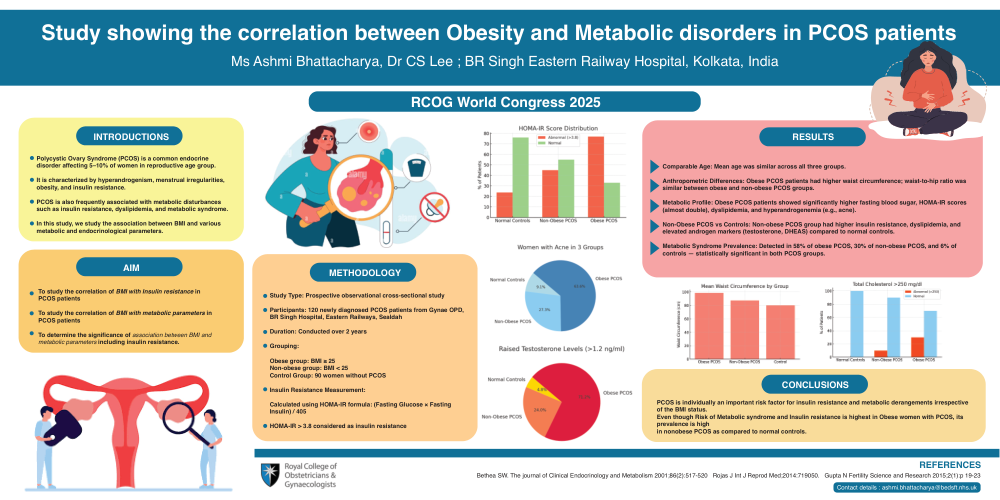
Introduction : Polycystic Ovary Syndrome (PCOS) is a common endocrine disorder affecting 5–10% of women in reproductive age group. It is characterized by hyperandrogenism, menstrual irregularities, obesity, and insulin resistance. PCOS is also frequently associated with metabolic disturbances such as insulin resistance, dyslipidemia, and metabolic syndrome. In this study, we study the association between BMI and various metabolic and endocrinological parameters.
Aim: To study the correlation of BMI with Insulin resistance in PCOS patients To study the correlation of BMI with metabolic parameters in PCOS patients To determine the significance of association between BMI and metabolic parameters including insulin resistance.
Methodology : Study Type: Prospective observational cross-sectional study Participants: 120 newly diagnosed PCOS patients from Gynae OPD, BR Singh Hospital, Eastern Railways, Sealdah Duration: Conducted over 2 years Grouping: Obese group: BMI ≥ 25 Non-obese group: BMI < 25 Control Group: 90 women without PCOS Insulin Resistance Measurement: Calculated using HOMA-IR formula: (Fasting Glucose × Fasting Insulin) / 405 HOMA-IR > 3.8 considered as insulin resistance
Results : Comparable Age: Mean age was similar across all three groups.
Anthropometric Differences: Obese PCOS patients had higher waist circumference; waist-to-hip ratio was similar between obese and non-obese PCOS groups.
Metabolic Profile: Obese PCOS patients showed significantly higher fasting blood sugar, HOMA-IR scores (almost double), dyslipidemia, and hyperandrogenemia (e.g., acne).
Non-Obese PCOS vs Controls: Non-obese PCOS group had higher insulin resistance, dyslipidemia, and elevated androgen markers (testosterone, DHEAS) compared to normal controls. Metabolic Syndrome Prevalence: Detected in 58% of obese PCOS, 30% of non-obese PCOS, and 6% of controls — statistically significant in both PCOS groups.
Conclusions: PCOS is individually an important risk factor for insulin resistance and metabolic derangements irrespective of the BMI status. Even though Risk of Metabolic syndrome and Insulin resistance is highest in Obese women with PCOS, its prevalence is high in nonobese PCOS as compared to normal controls.
References : Bethea SW. The journal of Clinical Endocrinology and Metabolism 2001;86(2):517-520 Rojas J Int J Reprod Med;2014:719050. Gupta N Fertility Science and Research 2015;2(1):p 19-23