2,281 posters, 63 videos, 56 audios, 43 topics, 18 sessions, 6,174 authors, 2,323 institutions
ePostersLive by SciGen Technologies S.A. All rights reserved.
RCOG World Congress 2025
June 23 - 25, 2025 | ExCeL London, UK
EP.1776
Effects of Western diet and pregnancy on liver triglycerides and oxidative stress
Poster Presenter
Authors
Ihsan Shawki Akili, Keara McElroy-Yaggy, R Chris Skinner, David Coggin-Carr
Affiliations
Part of Topic
Obesity & public health
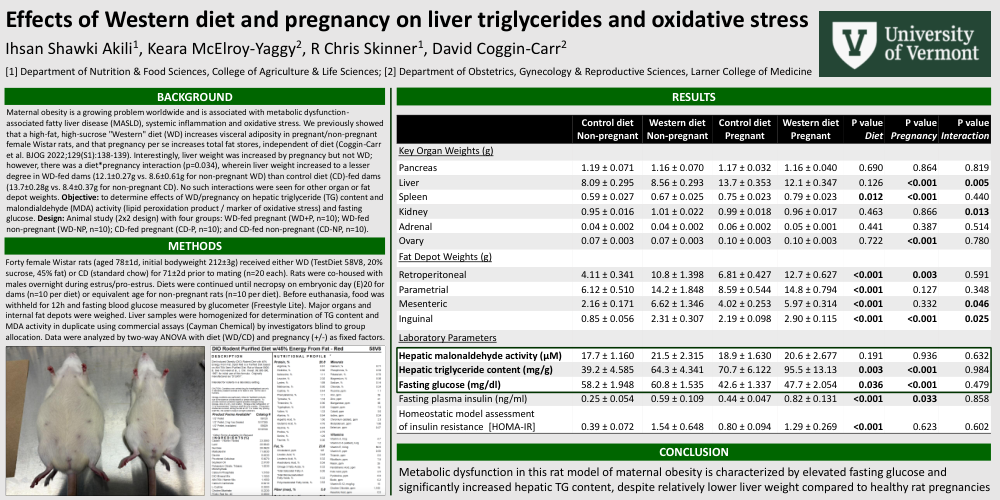
Background: Maternal obesity is a growing problem worldwide and is associated with metabolic dysfunction-associated fatty liver disease (MASLD), systemic inflammation and oxidative stress. We previously showed that a high-fat, high-sucrose "Western" diet (WD) increases visceral adiposity in pregnant/non-pregnant female Wistar rats, and that pregnancy per se increases total fat stores, independent of diet (Coggin-Carr et al. BJOG 2022;129(S1):138-139). Interestingly, liver weight was increased by pregnancy but not WD; however, there was a diet*pregnancy interaction (p=0.034), wherein liver weight increased to a lesser degree in WD-fed dams (12.1±0.27g vs. 8.6±0.61g for non-pregnant WD) than control diet (CD)-fed dams (13.7±0.28g vs. 8.4±0.37g for non-pregnant CD). No such interactions were seen for other organ or fat depot weights.
Objective: To determine effects of WD/pregnancy on hepatic triglyceride (TG) content and malondialdehyde (MDA) activity (lipid peroxidation product / marker of oxidative stress) and fasting glucose.
Design: Animal study (2x2 design) with four groups: WD-fed pregnant (WD+P, n=10); WD-fed non-pregnant (WD-NP, n=10); CD-fed pregnant (CD-P, n=10); and CD-fed non-pregnant (CD-NP, n=10).
Methods: Forty female Wistar rats (aged 78±1d, initial bodyweight 212±3g) received either WD (TestDiet 58V8, 20% sucrose, 45% fat) or CD (standard chow) for 71±2d prior to mating (n=20 each). Rats were co-housed with males overnight during estrus/pro-estrus. Diets were continued until necropsy on embryonic day (E)20 for dams (n=10 per diet) or equivalent age for non-pregnant rats (n=10 per diet). Before euthanasia, food was withheld for 12h and fasting blood glucose measured by glucometer (Freestyle Lite). Major organs and internal fat depots were weighed. Liver samples were homogenized for determination of TG content and MDA activity in duplicate using commercial assays (Cayman Chemical) by investigators blind to group allocation. Data were analyzed by two-way ANOVA with diet (WD/CD) and pregnancy (+/-) as fixed factors.
Results: Previously observed effects/interaction of diet/pregnancy on adiposity and liver weights were replicated. Independent of pregnancy, WD-fed rats demonstrated greater hepatic TG content (p=0.003) and higher fasting glucose (p=0.036) than CD-fed rats. Independent of diet, pregnant rats exhibited greater hepatic TG content and lower fasting glucose than non-pregnant rats (both p<0.001). Neither diet nor pregnancy significantly impacted hepatic MDA activity.
Conclusion: Metabolic dysfunction in this rat model of maternal obesity is characterized by elevated fasting glucose and significantly increased hepatic TG content, despite relatively lower liver weight compared to healthy rat pregnancies.