2,281 posters, 63 videos, 56 audios, 43 topics, 18 sessions, 6,174 authors, 2,323 institutions
ePostersLive by SciGen Technologies S.A. All rights reserved.
RCOG World Congress 2025
June 23 - 25, 2025 | ExCeL London, UK
EP.1774
Bridging the Gap: Folic Acid Dosing for Obese Asian Women Preconception
Poster Presenter
Authors
Priyanka Iyer, Daniella Soussi, Francis Elechi, Rayma Camacho-Risquet, Sangeeta Agnihotri
Affiliations
Part of Topic
Obesity & public health
Bridging the Gap: Folic Acid Dosing for Obese Asian Women Preconception
Priyanka Iyer 1, Daniella Soussi 2, Francis Elechi 3, Rayma Camacho-Risquet 1 Sangeeta Agnihotri 1.
INTRODUCTION
Folic acid, a precursor to tetrahydrofolate, supports DNA and RNA synthesis [1]. During pregnancy, increased demand makes adequate dietary or supplemental intake essential to support development and reduce the risk of neural tube defects (NTDs). Studies show that maternal obesity can increase the risk of NTDs by almost 2 fold [2].
Objective
The RCOG recommends high-dose folic acid (5 mg) for obese women (BMI ≥ 30) to reduce NTD risk [3]. For Asian populations, obesity is defined as BMI ≥ 27.5 (WHO). This study assessed whether obese Asian women, based on these thresholds, were appropriately prescribed high-dose folic acid preconception.
DESIGN AND METHODS
Design
A retrospective audit was conducted at a District General Hospital serving a diverse, socioeconomically deprived population with ~5,200 annual births. Patient records from a one-month period were reviewed for BMI at booking, ethnicity, and folic acid dosage.
Methods
Data were collected from the electronic patient records of all patients attending their booking appointments in April 2024.
DEMOGRAPHICS
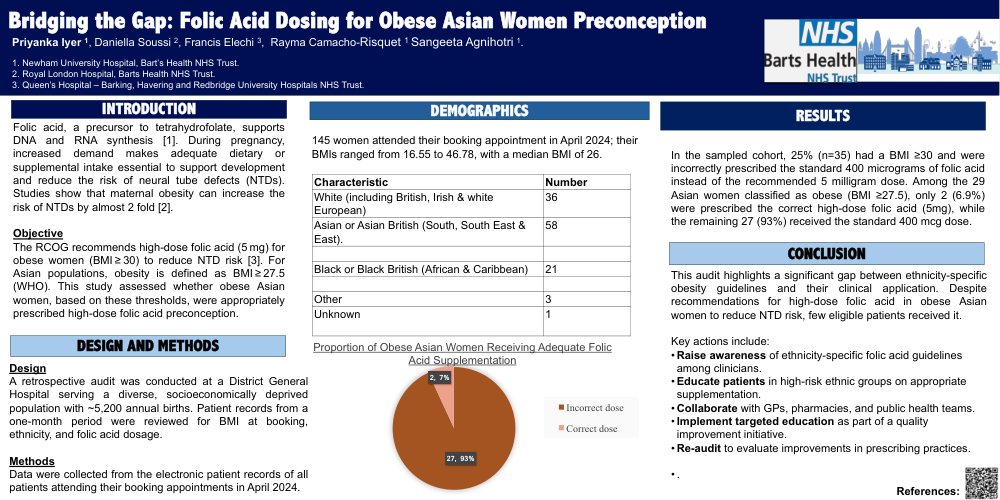
145 women attended their booking appointment in April 2024; their BMIs ranged from 16.55 to 46.78, with a median BMI of 26.
RESULTS
In the sampled cohort, 25% (n=35) had a BMI ≥30 and were incorrectly prescribed the standard 400 micrograms of folic acid instead of the recommended 5 milligram dose. Among the 29 Asian women classified as obese (BMI ≥27.5), only 2 (6.9%) were prescribed the correct high-dose folic acid (5mg), while the remaining 27 (93%) received the standard 400 mcg dose.
CONCLUSION
This audit highlights a significant gap between ethnicity-specific obesity guidelines and their clinical application. Despite recommendations for high-dose folic acid in obese Asian women to reduce NTD risk, few eligible patients received it.
Key actions include: