2,281 posters, 63 videos, 56 audios, 43 topics, 18 sessions, 6,174 authors, 2,323 institutions
ePostersLive by SciGen Technologies S.A. All rights reserved.
RCOG World Congress 2025
June 23 - 25, 2025 | ExCeL London, UK
EP.1700
Undiagnosed ADAMTS 13 deficiency and Thrombocytopenia in Pregnancy
Poster Presenter
Part of Topic
Maternal medicine
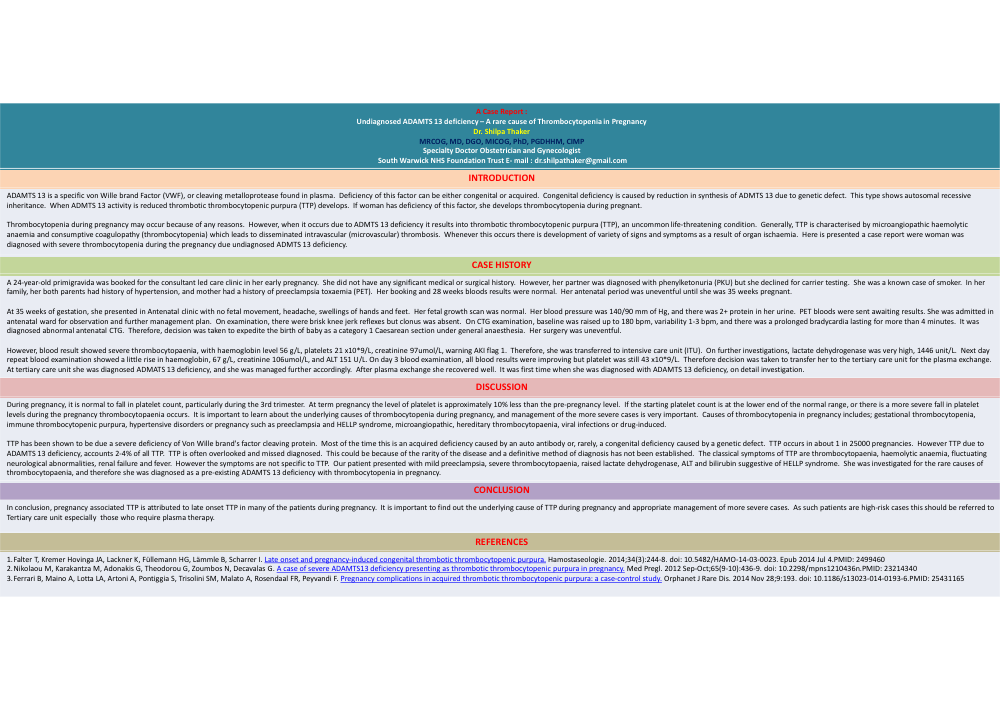
Undiagnosed ADAMTS 13 deficiency – A rare cause of Thrombocytopenia in Pregnancy
Introduction:
ADAMTS 13 is a specific von Willebrand Factor (VW F), or cleaving metalloprotease found in plasma. Deficiency of this factor can be either congenital or acquired. Congenital deficiency is caused by reduction in synthesis of ADMTS 13 due to genetic defect. This type shows autosomal recessive inheritance. When ADMTS 13 activity is reduced thrombotic thrombocytopenic purpura (TTP) develops. If woman has deficiency of this factor, when she becomes pregnant, she develops thrombocytopenia during pregnancy.
Thrombocytopenia during pregnancy may occur because of any reason. However, when it occurs due to ADMTS 13 deficiency it results into thrombotic thrombocytopenic purpura (TTP), an uncommon life-threatening condition. Generally, TTP is characterised by microangiopathic haemolytic anaemia and consumptive coagulopathy (thrombocytopaenia) which leads to disseminated intravascular (microvascular) thrombosis. Whenever this occurs there is development of variety of signs and symptoms as a result of organ ischaemia. Here is presented a case report were woman was diagnosed with severe thrombocytopenia during the pregnancy due undiagnosed ADMTS 13 deficiency.
Case History:
A 24-year-old primigravida was booked for the consultant led care clinic in her early pregnancy. She did not have any significant medical or surgical history. However, her partner was diagnosed with phenylketonuria (PKU) but she declined for carrier testing. She was a known case of smoker. In her family, her both parents had history of hypertension, and mother had a history of preeclampsia toxaemia (PET). Her booking and 28 weeks bloods results were normal. Her antenatal period was uneventful until she was 35 weeks pregnant. At 35 weeks of gestation, she presented in Antenatal clinic with no fetal movement, headache, swellings of hands and feet. Her fetal growth scan was normal. Her blood pressure was 140/90, and there was 2+ protein in her urine. PET bloods were sent awaiting results. She was admitted in Antenatal ward for observation and further management plan. On examination there were brisk knee jerk reflexes but clonus were absent. On CTG examination, baseline was raised up to 180 bpm, variability 1-3 bpm, and there was a prolonged bradycardia lasting for more than 4 minutes. It was diagnosed abnormal antenatal CTG. Therefore, decision was taken to expedite the birth of baby as a category 1 Caesarean section. Her surgery was uneventful. However, blood result showed severe thrombocytopenia, with haemoglobin level 56 grams/litre, platelets 21 x109/L, creatinine 97, warning AKI flag 1. Therefore, she was transferred to intensive care unit (ITU). On further investigations lactate dehydrogenase was very high, 1446 unit/L. Next day on repeat blood examination showed a little rise in haemoglobin, 67 g/L, creatinine 106 umol/L, ALT 151 U/L. On day 3, blood examination, all blood results were improving but platelet was still 43. Therefore decision was taken to transfer her to the Tertiary care unit for the plasma exchange. At Tertiary care unit she was diagnosed ADMATS 13 deficiency, and she was managed further accordingly. After plasma exchange she recovered well. It was 1st time diagnosed with ADAMTS 13 deficiency on detail investigation.
Discussion:
During pregnancy, it is normal to fall in platelet count, particularly during the 3rd trimester. At term pregnancy the level of platelet is approximately 10% less than the prepregnancy level. If the starting platelet count is at the lower end of the normal range, or there is a more severe fall in platelet levels during the pregnancy thrombocytopaenia occurs. It is important to learn about the underlying causes of thrombocytopenia during pregnancy, and management of the more severe cases is very important. Causes of thrombocytopenia in pregnancy includes; gestational thrombocytopenia, immune thrombocytopenic purpura, hypertensive disorders or pregnancy such as preeclampsia and HELLP syndrome, microangiopathic, hereditary thrombocytopaenia, viral infections or drug-induced. TTP has been shown to be G2 a severe deficiency of Von Willebrand's factor cleaving protein. Most of the time this is an acquired deficiency caused by an auto antibody or, rarely, a congenital deficiency caused by a genetic defect. TTP occurs in about 1 in 25000 pregnancies. However TTP due to ADAMTS 13 deficiency, accounts 2-4% of all TTP. TTP is often overlooked and missed diagnosed. This could be because of the rarity of the disease and a definitive method of diagnosis has not been established. The classical symptoms of TTP are thrombocytopaenia, haemolytic anaemia, fluctuating neurological abnormalities, renal failure and fever. However the symptoms are not specific to TTP. Our patient presented with mild preeclampsia, severe thrombocytopaenia, raised lactate dehydrogenase, ALT and bilirubin suggestive of HELLP syndrome. She was investigated for the rare causes of thrombocytopaenia, and therefore she was diagnosed as a pre-existing ADAMTS 13 deficiency with thrombocytopenia in pregnancy.
Conclusion:
In conclusion, pregnancy associated TTP is attributed to late onset TTP in many of the patients during pregnancy. It is important to find out the underlying cause of TTP during pregnancy and appropriate management of more severe cases. As such patients are high-risk cases this should be referred to Tertiary care unit especially those whorequire plasma therapy.
References:
- Falter T, Kremer Hovinga JA, Lackner K, Füllemann HG, Lämmle B, Scharrer I. Late onset and pregnancy-induced congenital thrombotic thrombocytopenic purpura. Hamostaseologie. 2014;34(3):244-8. doi: 10.5482/HAMO-14-03-0023. Epub 2014 Jul 4.PMID: 24994604
- Nikolaou M, Karakantza M, Adonakis G, Theodorou G, Zoumbos N, Decavalas G. A case of severe ADAMTS13 deficiency presenting as thrombotic thrombocytopenic purpura in pregnancy. Med Pregl. 2012 Sep-Oct;65(9-10):436-9. doi: 10.2298/mpns1210436n.PMID: 23214340
- Ferrari B, Maino A, Lotta LA, Artoni A, Pontiggia S, Trisolini SM, Malato A, Rosendaal FR, Peyvandi F. Pregnancy complications in acquired thrombotic thrombocytopenic purpura: a case-control study. Orphanet J Rare Dis. 2014 Nov 28;9:193. doi: 10.1186/s13023-014-0193-6.PMID: 25431165