2,281 posters, 63 videos, 56 audios, 43 topics, 18 sessions, 6,174 authors, 2,323 institutions
ePostersLive by SciGen Technologies S.A. All rights reserved.
RCOG World Congress 2025
June 23 - 25, 2025 | ExCeL London, UK
EP.1694
Malaria in Pregnancy – A Diagnostic Challenge
Poster Presenter
Part of Topic
Maternal medicine
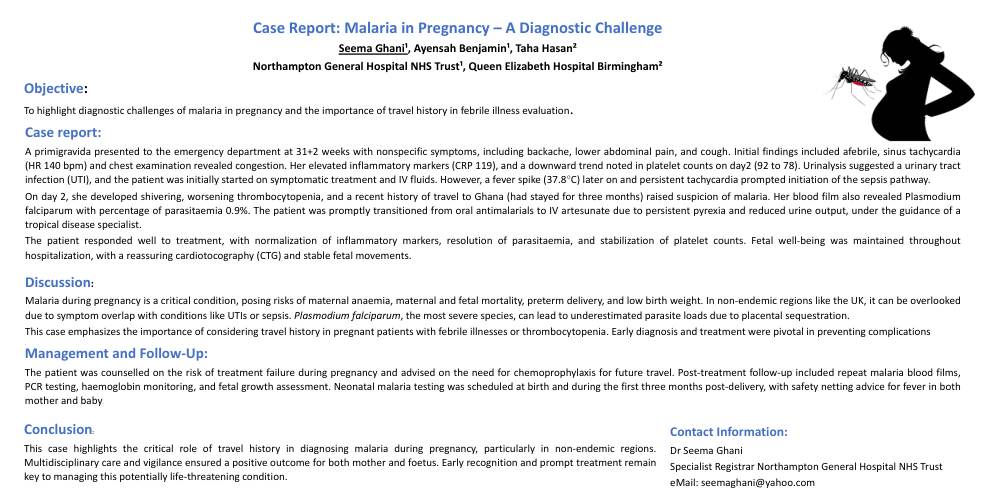
Case Report: Malaria in Pregnancy A Diagnostic Challenge
Seema Ghani¹, Ayensah Benjamin¹, Taha Hasan²
Northampton General Hospital NHS Trust¹, Queen Elizabeth Hospital Birmingham²
Objective
To highlight diagnostic challenges of malaria in pregnancy and the importance of travel history in febrile illness evaluation
Case
report
A
primigravida presented to the emergency department at 31 2 weeks with nonspecific symptoms, including backache, lower abdominal pain, and cough Initial findings included afebrile, sinus tachycardia
(HR 140 bpm) and chest examination revealed congestion Her elevated inflammatory markers (CRP 119 and a downward trend noted in platelet counts on day 2 92 to 78 Urinalysis suggested a urinary tract
infection ( and the patient was initially started on symptomatic treatment and IV fluids However, a fever spike 37 8 C) later on and persistent tachycardia prompted initiation of the sepsis pathway
On
day 2 she developed shivering, worsening thrombocytopenia, and a recent history of travel to Ghana (had stayed for three months) raised suspicion of malaria Her blood film also revealed Plasmodium
falciparum with percentage of parasitaemia 0 9 The patient was promptly transitioned from oral antimalarials to IV artesunate due to persistent pyrexia and reduced urine output, under the guidance of a
tropical disease specialist
The
patient responded well to treatment, with normalization of inflammatory markers, resolution of parasitaemia, and stabilization of platelet counts Fetal well being was maintained throughout
hospitalization, with a reassuring cardiotocography ( and stable fetal movements
Discussion
Malaria
during pregnancy is a critical condition, posing risks of maternal anaemia, maternal and fetal mortality, preterm delivery, and low birth weight In non endemic regions like the UK, it can be overlooked
due to symptom overlap with conditions like UTIs or sepsis Plasmodium falciparum the most severe species, can lead to underestimated parasite loads due to placental sequestration
This
case emphasizes the importance of considering travel history in pregnant patients with febrile illnesses or thrombocytopenia Early diagnosis and treatment were pivotal in preventing complications
.
Management
and Follow Up
The
patient was counselled on the risk of treatment failure during pregnancy and advised on the need for chemoprophylaxis for future travel Post treatment follow up included repeat malaria blood films,
PCR testing, haemoglobin monitoring, and fetal growth assessment Neonatal malaria testing was scheduled at birth and during the first three months post delivery, with safety netting advice for fever in both
mother and baby
Conclusion
This
case highlights the critical role of travel history in diagnosing malaria during pregnancy, particularly in non endemic regions
Multidisciplinary care and vigilance ensured a positive outcome for both mother and foetus Early recognition and prompt treatment remain
key to managing this potentially life threatening condition
Contact
Information
Dr
Seema Ghani
Specialist
Registrar Northampton General Hospital NHS Trust
eMail
seemaghani@yahoo com