2,281 posters, 63 videos, 56 audios, 43 topics, 18 sessions, 6,174 authors, 2,323 institutions
ePostersLive by SciGen Technologies S.A. All rights reserved.
RCOG World Congress 2025
June 23 - 25, 2025 | ExCeL London, UK
EP.1686
Pregnancy symptoms or sinister pathology. A colorectal cancer identified days after delivery.
Poster Presenter
Part of Topic
Maternal medicine
Pregnancy symptoms or sinister pathology: A colorectal cancer identified days after delivery
Azzam O, Kendrick A. Warrington & Halton Hospitals NHS Foundation Trust, Lovely Lane, Warrington WA5 1QG.
Case details: A 38 years old woman with one previous normal vaginal delivery was low risk at booking. She suffered with constipation, nausea and vomiting throughout her pregnancy. She presented to the emergency department at 25 weeks, with right upper quadrant and chest pain. A possible liver haemangioma and mild splenomegaly were identified on ultrasound scan. A microcytic anaemia was determined at 28 weeks (Hb 95, MCV 82), with a further drop in Hb (82) despite oral iron treatment. She attended at 35+2 with generalised abdominal pain and persistent vomiting. During admission spontaneous rupture of membranes occurred and she went into preterm labour, resulting in a normal vaginal delivery. In the days following delivery, she felt generally unwell. Derangement in her liver function tests was noted, and a repeat abdominal ultrasound scan was arranged; multiple irregular lesions were seen throughout the liver. CT abdomen reported a stricturing sigmoid mass with hepatic metastases. A biopsy from the sigmoid colon confirmed an adenocarcinoma.
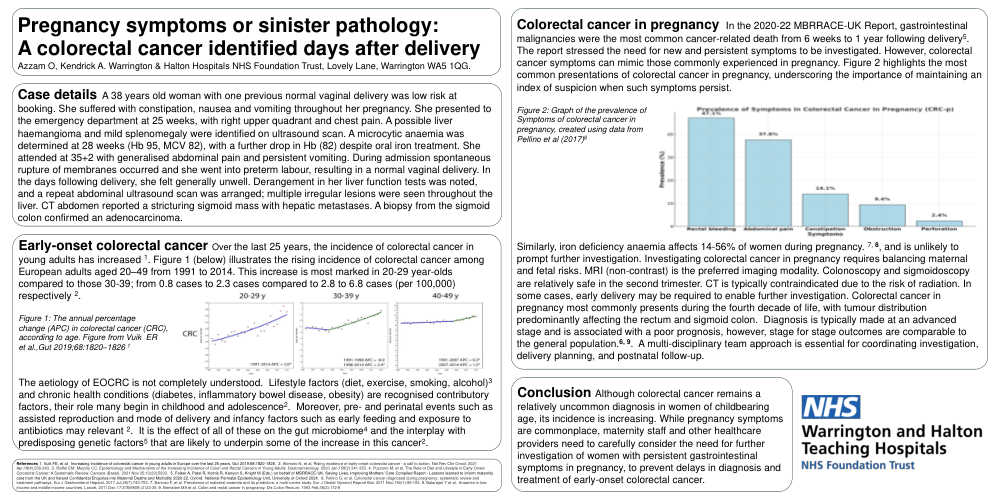
Early-onset colorectal cancer: Over the last 25 years, the incidence of colorectal cancer in young adults has increased 1. Figure 1 (below) illustrates the rising incidence of colorectal cancer among European adults aged 20–49 from 1991 to 2014. This increase is most marked in 20-29 year-olds compared to those 30-39; from 0.8 cases to 2.3 cases compared to 2.8 to 6.8 cases (per 100,000) respectively 2. The aetiology of EOCRC is not completely understood. Lifestyle factors (diet, exercise, smoking, alcohol)3 and chronic health conditions (diabetes, inflammatory bowel disease, obesity) are recognised contributory factors, their role many begin in childhood and adolescence2. Moreover, pre- and perinatal events such as assisted reproduction and mode of delivery and infancy factors such as early feeding and exposure to antibiotics may relevant 2. It is the effect of all of these on the gut microbiome4 and the interplay with predisposing genetic factors5 that are likely to underpin some of the increase in this cancer2.
Colorectal cancer in pregnancy: In the 2020-22 MBRRACE-UK Report, gastrointestinal malignancies were the most common cancer-related death from 6 weeks to 1 year following delivery5. The report stressed the need for new and persistent symptoms to be investigated. However, colorectal cancer symptoms can mimic those commonly experienced in pregnancy. Figure 2 highlights the most common presentations of colorectal cancer in pregnancy, underscoring the importance of maintaining an index of suspicion when such symptoms persist. Similarly, iron deficiency anaemia affects 14-56% of women during pregnancy. 7, 8, and is unlikely to prompt further investigation. Investigating colorectal cancer in pregnancy requires balancing maternal and fetal risks. MRI (non-contrast) is the preferred imaging modality. Colonoscopy and sigmoidoscopy are relatively safe in the second trimester. CT is typically contraindicated due to the risk of radiation. In some cases, early delivery may be required to enable further investigation. Colorectal cancer in pregnancy most commonly presents during the fourth decade of life, with tumour distribution predominantly affecting the rectum and sigmoid colon. Diagnosis is typically made at an advanced stage and is associated with a poor prognosis, however, stage for stage outcomes are comparable to the general population.6, 9. A multi-disciplinary team approach is essential for coordinating investigation, delivery planning, and postnatal follow-up.
Conclusion: Although colorectal cancer remains a relatively uncommon diagnosis in women of childbearing age, its incidence is increasing. While pregnancy symptoms are commonplace, maternity staff and other healthcare providers need to carefully consider the need for further investigation of women with persistent gastrointestinal symptoms in pregnancy, to prevent delays in diagnosis and treatment of early-onset colorectal cancer.