2,281 posters, 63 videos, 56 audios, 43 topics, 18 sessions, 6,174 authors, 2,323 institutions
ePostersLive by SciGen Technologies S.A. All rights reserved.
RCOG World Congress 2025
June 23 - 25, 2025 | ExCeL London, UK
EP.1680
Unusual Pregnancy-Induced Hypertriglyceridemia: A Case Report
Poster Presenter
Authors
Affiliations
Part of Topic
Maternal medicine
Unusual Pregnancy-InducedHypertriglyceridemia:
A Case Report Authrors:AmalAbu Issba , MashhourNaasan , Mohammad Zidan Affliation :1. Istishari ArabHospital , 2. Razancenterfor infertility , 3.ArabHospitalGroup, Ramallah, Palestine
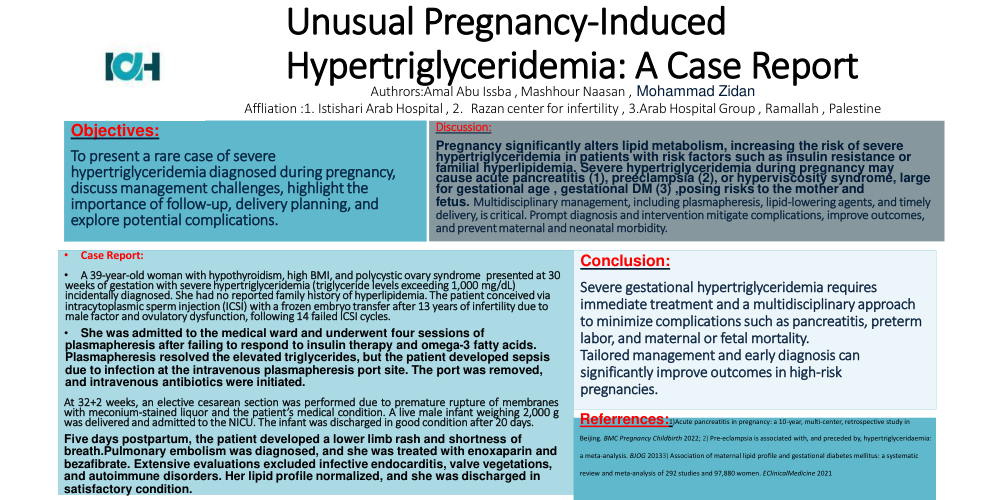
Objectives: To present a rare case ofsevere hypertriglyceridemia diagnosed during pregnancy, discussmanagement challenges, highlightthe importance of follow-up, delivery planning, and explore potential complications. Case Report: A 39-year-oldwomanwith hypothyroidism, high BMI, and polycystic ovary syndrome presented at 30 weeks of gestationwith severehypertriglyceridemia (triglyceride levels exceeding 1,000 mg/dL) incidentallydiagnosed. She had no reported family history of hyperlipidemia. The patient conceived via intracytoplasmic sperminjection(ICSI)with a frozen embryo transfer after 13 years of infertility due to male factor and ovulatory dysfunction,following 14 failed ICSI cycles. She was admitted to the medical ward and underwent four sessions of plasmapheresis after failing to respond to insulin therapy and omega-3 fatty acids. Plasmapheresis resolved the elevated triglycerides, but the patient developed sepsis due to infection at the intravenous plasmapheresis port site. The port was removed, and intravenous antibiotics were initiated. At 32+2 weeks, an elective cesarean section was performed due to premature rupture of membranes with meconium-stained liquor and the patient’s medical condition. A live male infant weighing 2,000 g was deliveredand admittedto theNICU. The infantwas discharged in good condition after 20 days. Five days postpartum, the patient developed a lower limb rash and shortness of breath. Pulmonary embolism was diagnosed, and she was treated with enoxaparin and bezafibrate. Extensive evaluations excluded infective endocarditis, valve vegetations, and autoimmune disorders. Her lipid profile normalized, and she was discharged in satisfactory condition. Discussion: Pregnancy significantly alters lipid metabolism, increasing the risk of severe hypertriglyceridemia in patients with risk factors such as insulin resistance or familial hyperlipidemia. Severe hypertriglyceridemia during pregnancy may cause acute pancreatitis (1), preeclampsia (2), or hyperviscosity syndrome, large for gestational age , gestational DM (3) ,posing risks to the mother and fetus. Multidisciplinary management, including plasmapheresis, lipid-lowering agents, and timely delivery, is critical. Prompt diagnosis and interventionmitigate complications, improve outcomes, and preventmaternal and neonatalmorbidity. Conclusion: Severe gestational hypertriglyceridemia requires immediate treatment and a multidisciplinary approach to minimize complicationssuch as pancreatitis, preterm labor, and maternal or fetal mortality. Tailoredmanagement and early diagnosis can significantly improve outcomesin high-risk pregnancies. Referrences:1)Acute pancreatitis in pregnancy: a 10-year, multi-center, retrospective study in Beijing. BMC Pregnancy Childbirth 2022; 2) Pre-eclampsia is associated with, and preceded by, hypertriglyceridaemia: a meta-analysis. BJOG 20133) Association of maternal lipid profile and gestational diabetes mellitus: a systematic review and meta-analysis of 292 studies and 97,880 women. EClinicalMedicine 2021