2,281 posters, 63 videos, 56 audios, 43 topics, 18 sessions, 6,174 authors, 2,323 institutions
ePostersLive by SciGen Technologies S.A. All rights reserved.
RCOG World Congress 2025
June 23 - 25, 2025 | ExCeL London, UK
EP.1677
Severe aplastic anemia in pregnancy due to Parvovirus B19 infection
Poster Presenter
Authors
Affiliations
Part of Topic
Maternal medicine
SEVERE APLASTIC ANAEMIA IN PREGNANCY FOLLOWING ACUTE PARVOVIRUS B19 INFECTION IN A PREVIOUSLY HEALTHY WOMAN
AUTHORS: HAROONA KHALIL; RUTA GADA; AHMED ELSHISHINI; ASMAA AMER
AFFILIATION: 1 IPSWICH HOSPITAL, EAST SUFFOLK & NORTH ESSEX NHS FOUNDATION TRUST
Parvovirus b19 infection in pregnancy can lead to adverse fetal outcomes, including severe fetal anemia, hydrops, and even fetal demise. maternal complications are uncommon – transient aplastic crises typically occur only in those with underlying hemolytic disorders. Progression to severe aplastic anemia (AA) in an immunocompetent pregnant woman is exceedingly rare. We report a case of severe aa triggered by acute parvovirus b19 infection in a previously healthy pregnant patient, highlighting diagnostic and management challenges.
Parvovirus B19 can rarely cause life-threatening aplastic anemia in pregnancy, with serious maternal risks (e.g. sepsis, hemorrhage) and fetal complications (e.g. growth restriction, preterm birth)【1】. Treatment is mainly supportive during pregnancy, as definitive therapies (e.g. atg, cyclosporine) are deferred until postpartum due to fetal risk【2】. In this case, multidisciplinary care and transfusion support prolonged pregnancy into the third trimester, avoiding extreme prematurity. Clinicians should consider viral causes in unexplained pancytopenia, especially parvovirus b19【3】. early diagnosis, close fetal monitoring, and coordinated care can yield positive outcomes even in severe maternal illness.
This case underscores the importance of early recognition of atypical presentations in pregnancy, timely multidisciplinary coordination, and vigilant monitoring in managing severe hematologic complications. Future research should explore the mechanisms of parvovirus B19–induced marrow suppression in immunocompetent hosts and optimize strategies for supportive care and maternal-fetal outcomes in rare, high-risk cases.
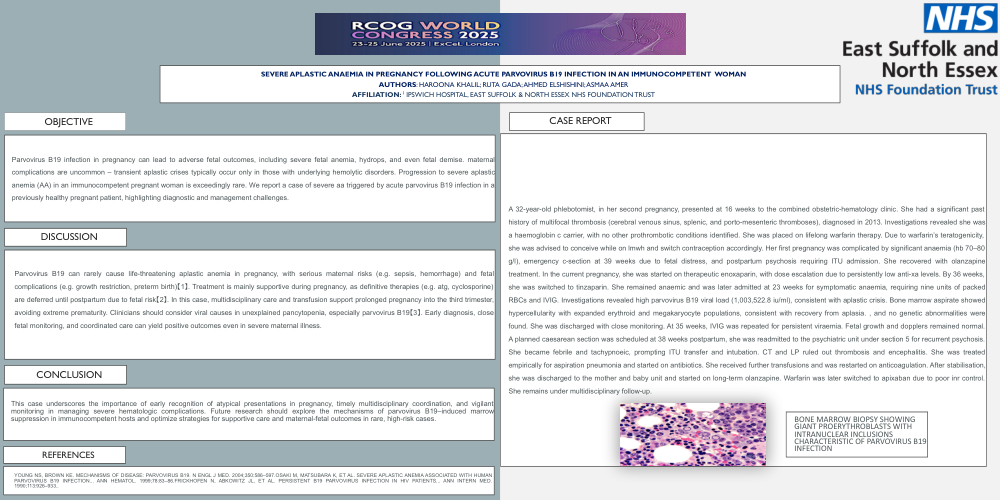
A 32-year-old phlebotomist, in her second pregnancy, presented at 16 weeks to the combined obstetric-hematology clinic. She had a significant past history of multifocal thrombosis (cerebral venous sinus, splenic, and porto-mesenteric thromboses), diagnosed in 2013. Investigations revealed she was a haemoglobin c carrier, with no other prothrombotic conditions identified. She was placed on lifelong warfarin therapy. Due to warfarin’s teratogenicity, she was advised to conceive while on lmwh and switch contraception accordingly. Her first pregnancy was complicated by significant anaemia (hb 70–80 g/l), emergency c-section at 39 weeks due to fetal distress, and postpartum psychosis requiring ITU admission. She recovered with olanzapine treatment. In the current pregnancy, she was started on therapeutic enoxaparin, with dose escalation due to persistently low anti-xa levels. By 36 weeks, she was switched to tinzaparin. She remained anaemic and was later admitted at 23 weeks for symptomatic anaemia, requiring nine units of packed RBCs and IVIG. Investigations revealed high parvovirus B19 viral load (1,003,522.8 iu/ml), consistent with aplastic crisis. Bone marrow aspirate showed hypercellularity with expanded erythroid and megakaryocyte populations, consistent with recovery from aplasia. , and no genetic abnormalities were found. She was discharged with close monitoring. At 35 weeks, IVIG was repeated for persistent viraemia. Fetal growth and dopplers remained normal. A planned caesarean section was scheduled at 38 weeks postpartum, she was readmitted to the psychiatric unit under section 5 for recurrent psychosis. She became febrile and tachypnoeic, prompting ITU transfer and intubation. CT and LP ruled out thrombosis and encephalitis. She was treated empirically for aspiration pneumonia and started on antibiotics. She received further transfusions and was restarted on anticoagulation. After stabilisation, she was discharged to the mother and baby unit and started on long-term olanzapine. Warfarin was later switched to apixaban due to poor inr control. She remains under multidisciplinary follow-up.
YOUNG NS, BROWN KE. MECHANISMS OF DISEASE: PARVOVIRUS B19. N ENGL J MED. 2004;350:586–597.OSAKI M, MATSUBARA K, ET AL. SEVERE APLASTIC ANEMIA ASSOCIATED WITH HUMAN PARVOVIRUS B19 INFECTION... ANN HEMATOL. 1999;78:83–86.FRICKHOFEN N, ABKOWITZ JL, ET AL. PERSISTENT B19 PARVOVIRUS INFECTION IN HIV PATIENTS... ANN INTERN MED. 1990;113:926–933..