2,281 posters, 63 videos, 56 audios, 43 topics, 18 sessions, 6,174 authors, 2,323 institutions
ePostersLive by SciGen Technologies S.A. All rights reserved.
RCOG World Congress 2025
June 23 - 25, 2025 | ExCeL London, UK
EP.1674
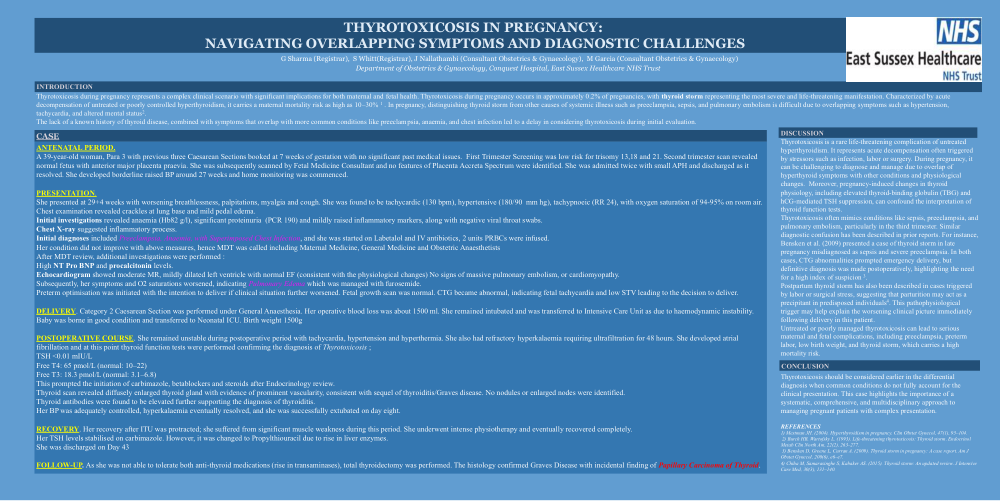
Thyrotoxicosis in Pregnancy: Navigating Overlapping Symptoms and Diagnostic Challenges
Poster Presenter
Part of Topic
Maternal medicine
INTRODUCTION
Thyrotoxicosis during pregnancy represents a complex clinical scenario with significant implications for both maternal and fetal health. Thyrotoxicosis during pregnancy occurs in approximately 0.2% of pregnancies, with thyroid storm representing the most severe and life-threatening manifestation. Characterized by acute decompensation of untreated or poorly controlled hyperthyroidism, it carries a maternal mortality risk as high as 10–30% 1 . In pregnancy, distinguishing thyroid storm from other causes of systemic illness such as preeclampsia, sepsis, and pulmonary embolism is difficult due to overlapping symptoms such as hypertension, tachycardia, and altered mental status2.
The lack of a known history of thyroid disease, combined with symptoms that overlap with more common conditions like preeclampsia, anaemia, and chest infection led to a delay in considering thyrotoxicosis during initial evaluation.
CASE
ANTENATAL PERIOD.
A 39-year-old woman, Para 3 with previous three Caesarean Sections booked at 7 weeks of gestation with no significant past medical issues. First Trimester Screening was low risk for trisomy 13,18 and 21. Second trimester scan revealed normal fetus with anterior major placenta praevia. She was subsequently scanned by Fetal Medicine Consultant and no features of Placenta Accreta Spectrum were identified. She was admitted twice with small APH and discharged as it resolved. She developed borderline raised BP around 27 weeks and home monitoring was commenced.
PRESENTATION.
She presented at 29+4 weeks with worsening breathlessness, palpitations, myalgia and cough. She was found to be tachycardic (130 bpm), hypertensive (180/90 mm hg), tachypnoeic (RR 24), with oxygen saturation of 94-95% on room air. Chest examination revealed crackles at lung base and mild pedal edema.
Initial investigations revealed anaemia (Hb82 g/l), significant proteinuria (PCR 190) and mildly raised inflammatory markers, along with negative viral throat swabs.
Chest X-ray suggested inflammatory process.
Initial diagnoses included Preeclampsia, Anaemia, with Superimposed Chest Infection, and she was started on Labetalol and IV antibiotics, 2 units PRBCs were infused.
Her condition did not improve with above measures, hence MDT was called including Maternal Medicine, General Medicine and Obstetric Anaesthetists
After MDT review, additional investigations were performed :
High NT Pro BNP and procalcitonin levels.
Echocardiogram showed moderate MR, mildly dilated left ventricle with normal EF (consistent with the physiological changes) No signs of massive pulmonary embolism, or cardiomyopathy.
Subsequently, her symptoms and O2 saturations worsened, indicating Pulmonary Edema which was managed with furosemide.
Preterm optimisation was initiated with the intention to deliver if clinical situation further worsened. Fetal growth scan was normal. CTG became abnormal, indicating fetal tachycardia and low STV leading to the decision to deliver.
DELIVERY. Category 2 Caesarean Section was performed under General Anaesthesia. Her operative blood loss was about 1500 ml. She remained intubated and was transferred to Intensive Care Unit as due to haemodynamic instability.
Baby was borne in good condition and transferred to Neonatal ICU. Birth weight 1500g
POSTOPERATIVE COURSE. She remained unstable during postoperative period with tachycardia, hypertension and hyperthermia. She also had refractory hyperkalaemia requiring ultrafiltration for 48 hours. She developed atrial fibrillation and at this point thyroid function tests were performed confirming the diagnosis of Thyrotoxicosis ;
TSH <0.01 mIU/L
Free T4: 65 pmol/L (normal: 10–22)
Free T3: 18.3 pmol/L (normal: 3.1–6.8)
This prompted the initiation of carbimazole, betablockers and steroids after Endocrinology review.
Thyroid scan revealed diffusely enlarged thyroid gland with evidence of prominent vascularity, consistent with sequel of thyroiditis/Graves disease. No nodules or enlarged nodes were identified.
Thyroid antibodies were found to be elevated further supporting the diagnosis of thyroiditis.
Her BP was adequately controlled, hyperkalaemia eventually resolved, and she was successfully extubated on day eight.
RECOVERY. Her recovery after ITU was protracted; she suffered from significant muscle weakness during this period. She underwent intense physiotherapy and eventually recovered completely.
Her TSH levels stabilised on carbimazole. However, it was changed to Propylthiouracil due to rise in liver enzymes.
She was discharged on Day 43
FOLLOW-UP. As she was not able to tolerate both anti-thyroid medications (rise in transaminases), total thyroidectomy was performed. The histology confirmed Graves Disease with incidental finding of Papillary Carcinoma of Thyroid.
DISCUSSION
Thyrotoxicosis is a rare life-threatening complication of untreated hyperthyroidism. It represents acute decompensation often triggered by stressors such as infection, labor or surgery. During pregnancy, it can be challenging to diagnose and manage due to overlap of hyperthyroid symptoms with other conditions and physiological changes. Moreover, pregnancy-induced changes in thyroid physiology, including elevated thyroid-binding globulin (TBG) and hCG-mediated TSH suppression, can confound the interpretation of thyroid function tests.
Thyrotoxicosis often mimics conditions like sepsis, preeclampsia, and pulmonary embolism, particularly in the third trimester. Similar diagnostic confusion has been described in prior reports. For instance, Bensken et al. (2009) presented a case of thyroid storm in late pregnancy misdiagnosed as sepsis and severe preeclampsia. In both cases, CTG abnormalities prompted emergency delivery, but definitive diagnosis was made postoperatively, highlighting the need for a high index of suspicion 3.
Postpartum thyroid storm has also been described in cases triggered by labor or surgical stress, suggesting that parturition may act as a precipitant in predisposed individuals4. This pathophysiological trigger may help explain the worsening clinical picture immediately following delivery in this patient.
Untreated or poorly managed thyrotoxicosis can lead to serious maternal and fetal complications, including preeclampsia, preterm labor, low birth weight, and thyroid storm, which carries a high mortality risk.
CONCLUSION
Thyrotoxicosis should be considered earlier in the differential diagnosis when common conditions do not fully account for the clinical presentation. This case highlights the importance of a systematic, comprehensive, and multidisciplinary approach to managing pregnant patients with complex presentation.