2,281 posters, 63 videos, 56 audios, 43 topics, 18 sessions, 6,174 authors, 2,323 institutions
ePostersLive by SciGen Technologies S.A. All rights reserved.
RCOG World Congress 2025
June 23 - 25, 2025 | ExCeL London, UK
EP.1671
Geller Syndrome: A Rare Presentation of Hypokalemia and Hypertension in Pregnancy
Poster Presenter
Authors
Andrea Kinnan, Molly Carrig, Tyler Steele, Spencer Cutrow, Katie Myers
Affiliations
Part of Topic
Maternal medicine
Geller Syndrome: A Rare Presentation of Hypokalemia and Hypertension in Pregnancy
Case Introduction
31-year-old female G1P0 at 34 weeks 5 days gestation presented with nausea/vomiting and decreased fetal movement. Pregnancy complicated by anxiety/depression and restless leg syndrome (controlled with iron infusions). Patient with normal BMI, non-smoker, no alcohol use in pregnancy, and no other drug use.
Hospital Course
Hypokalemia on initial presentation; K of 2.8 mmol/L. Symptom resolution with medications and potassium repletion. Discharged home next day. Readmission 7 days later with recurrent symptoms, hypokalemia and new onset hypertension. Potassium repletion with both IV and PO potassium chloride. Nephrology consulted when hypokalemia persisted despite treatment.
Diagnosis and Outcome
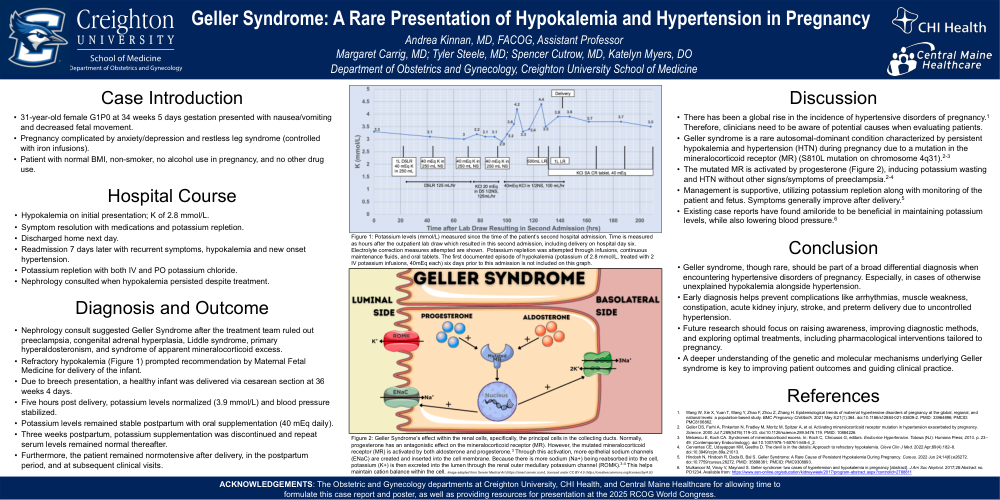
Nephrology consult suggested Geller Syndrome after the treatment team ruled out preeclampsia, congenital adrenal hyperplasia, Liddle syndrome, primary hyperaldosteronism, and syndrome of apparent mineralocorticoid excess. Refractory hypokalemia (Figure 1) prompted recommendation by Maternal Fetal Medicine for delivery of the infant. Due to breech presentation, a healthy infant was delivered via cesarean section at 36 weeks 4 days. Five hours post delivery, potassium levels normalized (3.9 mmol/L) and blood pressure stabilized. Potassium levels remained stable postpartum with oral supplementation (40 mEq daily). Three weeks postpartum, potassium supplementation was discontinued and repeat serum levels remained normal thereafter. Furthermore, the patient remained normotensive after delivery, in the postpartum period, and at subsequent clinical visits.
Discussion
There has been a global rise in the incidence of hypertensive disorders of pregnancy. Therefore, clinicians need to be aware of potential causes when evaluating patients. Geller syndrome is a rare autosomal-dominant condition characterized by persistent hypokalemia and hypertension (HTN) during pregnancy due to a mutation in the mineralocorticoid receptor (MR) (S810L mutation on chromosome 4q31). The mutated MR is activated by progesterone (Figure 2), inducing potassium wasting and HTN without other signs/symptoms of preeclampsia. Management is supportive, utilizing potassium repletion along with monitoring of the patient and fetus. Symptoms generally improve after delivery. Existing case reports have found amiloride to be beneficial in maintaining potassium levels, while also lowering blood pressure.
Conclusion
Geller syndrome, though rare, should be part of a broad differential diagnosis when encountering hypertensive disorders of pregnancy. Especially, in cases of otherwise unexplained hypokalemia alongside hypertension. Early diagnosis helps prevent complications like arrhythmias, muscle weakness, constipation, acute kidney injury, stroke, and preterm delivery due to uncontrolled hypertension. Future research should focus on raising awareness, improving diagnostic methods, and exploring optimal treatments, including pharmacological interventions tailored to pregnancy. A deeper understanding of the genetic and molecular mechanisms underlying Geller syndrome is key to improving patient outcomes and guiding clinical practice.