2,281 posters, 63 videos, 56 audios, 43 topics, 18 sessions, 6,174 authors, 2,323 institutions
ePostersLive by SciGen Technologies S.A. All rights reserved.
RCOG World Congress 2025
June 23 - 25, 2025 | ExCeL London, UK
EP.1662
Case report on antenatal care of a renal transplant recipient on Tacrolimus
Poster Presenter
Authors
Affiliations
Part of Topic
Maternal medicine
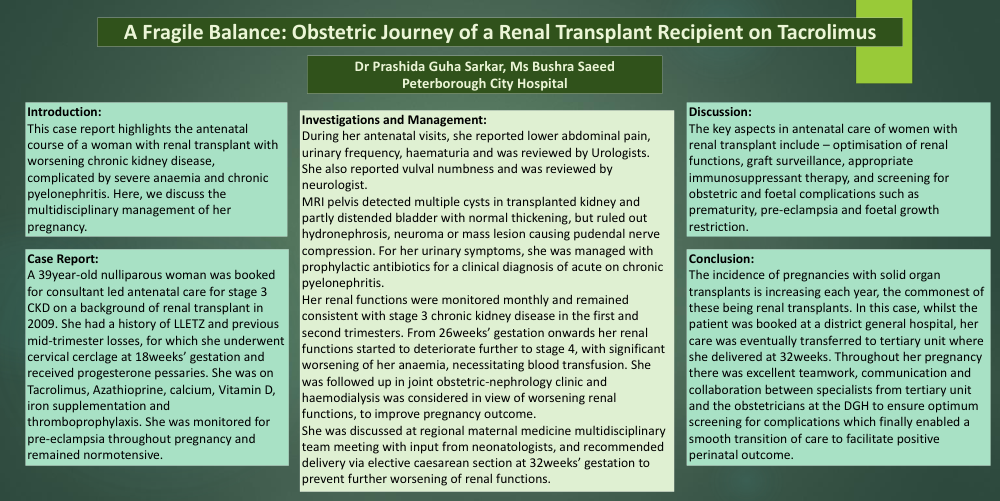
Title: A Fragile Balance: Obstetric Journey of a Renal Transplant Recipient on Tacrolimus
Authors: Dr Prashida Guha Sarkar, Ms Bushra Saeed, Peterborough City Hospital
Introduction: This case report highlights the antenatal course of a woman with renal transplant with worsening chronic kidney disease, complicated by severe anaemia and chronic pyelonephritis. Here, we discuss the multidisciplinary management of her pregnancy.
Case Report: A 39year-old nulliparous woman was booked for consultant led antenatal care for stage 3 CKD on a background of renal transplant in 2009. She had a history of LLETZ and previous mid-trimester losses, for which she underwent cervical cerclage at 18weeks’ gestation and received progesterone pessaries. She was on Tacrolimus, Azathioprine, calcium, Vitamin D, iron supplementation and thromboprophylaxis. She was monitored for pre-eclampsia throughout pregnancy and remained normotensive.
Investigations and Management: During her antenatal visits, she reported lower abdominal pain, urinary frequency, haematuria and was reviewed by Urologists. She also reported vulval numbness and was reviewed by neurologist. MRI pelvis detected multiple cysts in transplanted kidney and partly distended bladder with normal thickening, but ruled out hydronephrosis, neuroma or mass lesion causing pudendal nerve compression. For her urinary symptoms, she was managed with prophylactic antibiotics for a clinical diagnosis of acute on chronic pyelonephritis. Her renal functions were monitored monthly and remained consistent with stage 3 chronic kidney disease in the first and second trimesters. From 26weeks’ gestation onwards her renal functions started to deteriorate further to stage 4, with significant worsening of her anaemia, necessitating blood transfusion. She was followed up in joint obstetric-nephrology clinic and haemodialysis was considered in view of worsening renal functions, to improve pregnancy outcome. She was discussed at regional maternal medicine multidisciplinary team meeting with input from neonatologists, and recommended delivery via elective caesarean section at 32weeks’ gestation to prevent further worsening of renal functions.
Discussion: The key aspects in antenatal care of women with renal transplant include – optimisation of renal functions, graft surveillance, appropriate immunosuppressant therapy, and screening for obstetric and foetal complications such as prematurity, pre-eclampsia and foetal growth restriction.
Conclusion: The incidence of pregnancies with solid organ transplants is increasing each year, the commonest of these being renal transplants. In this case, whilst the patient was booked at a district general hospital, her care was eventually transferred to tertiary unit where she delivered at 32weeks. Throughout her pregnancy there was excellent teamwork, communication and collaboration between specialists from tertiary unit and the obstetricians at the DGH to ensure optimum screening for complications which finally enabled a smooth transition of care to facilitate positive perinatal outcome.