2,281 posters, 63 videos, 56 audios, 43 topics, 18 sessions, 6,174 authors, 2,323 institutions
ePostersLive by SciGen Technologies S.A. All rights reserved.
RCOG World Congress 2025
June 23 - 25, 2025 | ExCeL London, UK
EP.1656
Postpartum Ovarian Vein Thrombosis, A case report
Poster Presenter
Authors
Amina Butt, Bander Abdullah, Aya Mohamed Ali Nasr, Aisha Aziz, samar MOHAMED
Affiliations
Part of Topic
Maternal medicine
Postpartum Ovarian Thrombosis, A case Report
Butt Amina , Bander Abdullah, Ali Nasr Aya, Aziz Aysha, Mohamed Samar
Objective:
Ovarian vein thrombosis (OVT), a rare but known complication during pregnancy and postpartum. By presenting this case we will learn about the management of such rare pathology.
Case:
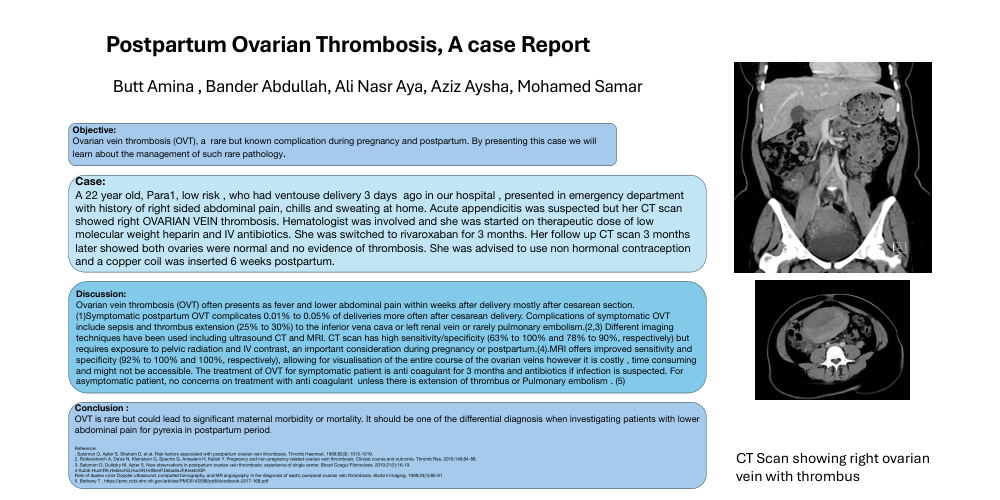
A 22 year old, Para1, low risk , who had ventouse delivery 3 days ago in our hospital , presented in emergency department with history of right sided abdominal pain, chills and sweating at home. Acute appendicitis was suspected but her CT scan showed right OVARIAN VEIN thrombosis. Hematologistwas involved and she was started on therapeutic dose of low molecular weight heparin and IV antibiotics. She was switched to rivaroxaban for 3 months. Her follow up CT scan 3 months later showed both ovaries were normal and no evidence of thrombosis. She was advised to use non hormonal contraception and a copper coil was inserted 6 weeks postpartum.
Discussion:
Ovarian vein thrombosis (OVT) often presents as fever and lower abdominal pain within weeks after delivery mostly after cesareansection. (1)Symptomatic postpartum OVT complicates 0.01% to 0.05% of deliveries more often after cesarean delivery. Complications of symptomatic OVT include sepsis and thrombus extension (25% to 30%) to the inferior vena cava or left renal vein or rarely pulmonary embolism.(2,3) Different imaging techniques have been used including ultrasound CT and MRI. CT scan has high sensitivity/specificity (63% to 100% and 78% to 90%, respectively) but requires exposure to pelvic radiation and IV contrast, an important consideration during pregnancy or postpartum.(4).MRI offers improved sensitivity and specificity (92% to 100% and 100%, respectively), allowing for visualisation of the entire course of the ovarian veins however it is costly , time consuming and might not be accessible. The treatment of OVT for symptomatic patient is anti coagulant for 3 months and antibiotics if infection is suspected. For asymptomatic patient, no concerns on treatment with anti coagulant unless there is extension of thrombus or Pulmonary embolism . (5)
Conclusion :
OVT is rare but could lead to significant maternal morbidity or mortality. It should be one of the differential diagnosis when investigating patients with lower abdominal pain for pyrexia in postpartum period.
Reference:
. Salomon O, Apter S, Shaham D, et al. Risk factors associated with postpartum ovarian vein thrombosis. Thromb Haemost. 1999;82(3): 1015-1019.
2. Rottenstreich A, Da’as N, Kleinstern G, Spectre G, Amsalem H, Kalish Y. Pregnancy and non-pregnancy related ovarian vein thrombosis: Clinical course and outcome. Thromb Res. 2016;146:84-88.
3. Salomon O, Dulitzky M, Apter S. New observations in postpartum ovarian vein thrombosis: experience of single center. Blood CoagulFibrinolysis. 2010;21(1):16-19.
4 Kubik-HuchRA,HebischG,HuchR,HilfikerP,DebatinJF,KrestinGP.
Role of duplex color Doppler ultrasound, computed tomography, and MR angiography in the diagnosis of septic puerperal ovarian vein thrombosis. Abdom Imaging. 1999;24(1):85-91
5 Bethany T , https://pmc.ncbi.nlm.nih.gov/articles/PMC6142588/pdf/bloodbook-2017-168.pdf