2,281 posters, 63 videos, 56 audios, 43 topics, 18 sessions, 6,174 authors, 2,323 institutions
ePostersLive by SciGen Technologies S.A. All rights reserved.
RCOG World Congress 2025
June 23 - 25, 2025 | ExCeL London, UK
EP.1650
Successful Management of Severe or Complicated Malaria in Pregnancy(Rare in UK)
Poster Presenter
Authors
Affiliations
Part of Topic
Maternal medicine
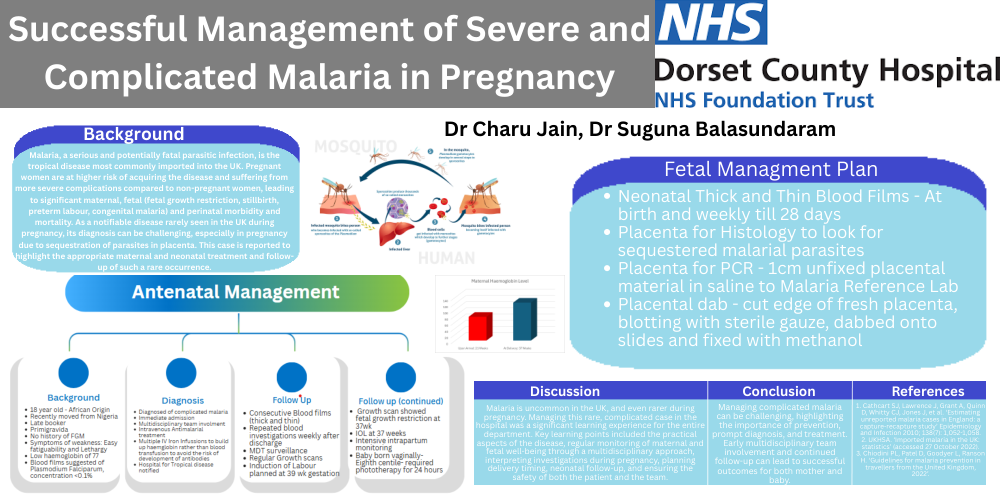
Successful Management of Severe and Complicated Malaria in Pregnancy
Dr Charu Jain, Dr Suguna Balasundaram
Background:
Malaria, a serious and potentially fatal parasitic infection, is the tropical disease most commonly imported into the UK. Pregnant women are at higher risk of acquiring the disease and suffering from more severe complications compared to non-pregnant women, leading to significant maternal, fetal (fetal growth restriction, stillbirth, preterm labour, congenital malaria) and perinatal morbidity and mortality. As a notifiable disease rarely seen in the UK during pregnancy, its diagnosis can be challenging, especially in pregnancy due to sequestration of parasites in placenta. This case is reported to highlight the appropriate maternal and neonatal treatment and follow-up of such a rare occurrence.
Antenatal Management:
Background:
- 18 year old - African Origin
- Recently moved from Nigeria
- Late booker
- Primigravida
- No history of FGM
- Symptoms of weakness: Easy fatiguability and Lethargy
- Low haemoglobin of 77
- Blood films suggested of Plasmodium Falciparum, concentration <0.1%
- Diagnosed of complicated malaria
- Immediate admission
- Multidisciplinary team involment
- Intravenous Antimalarial treatment
- Multiple IV Iron Infussions to build up haemglobin rather than blood transfusion to avoid the risk ofdevelopment of antibodies
- Hospital for Tropical disease notified
Follow Up:
- Consecutive Blood films (thick and thin)
- Repeated blood investigations weekly after discharge
- MDT surveillance
- Regular Growth scans
- Induction of Labour planned at 39 wk gestation
- Growth scan showedfetal growth restriction at 37wk
- IOL at 37 weeks
- Intensive intrapartum monitoring
- Baby born vaginally- Eighth centile- required phototherapy for 24 hours
Fetal Managment Plan:
- Neonatal Thick and Thin Blood Films - At birth and weekly till 28 days
- Placenta for Histology to look for sequestered malarial parasites
- Placenta for PCR - 1cm unfixed placental material in saline to Malaria Reference Lab
- Placental dab - cut edge of fresh placenta, blotting with sterile gauze, dabbed onto slides and fixed with methanol
1. Cathcart SJ, Lawrence J, Grant A, Quinn D, Whitty CJ, Jones J, et al. ‘Estimating unreported malaria cases in England: a capture-recapture study’ Epidemiology and Infection 2010; 138(7): 1,052-1,058.
2. UKHSA. ‘Imported malaria in the UK: statistics’ (accessed 27 October 2022).
3. Chiodini PL, Patel D, Goodyer L, Ranson H. ‘Guidelines for malaria prevention in travellers from the United Kingdom, 2022’.