2,281 posters, 63 videos, 56 audios, 43 topics, 18 sessions, 6,174 authors, 2,323 institutions
ePostersLive by SciGen Technologies S.A. All rights reserved.
RCOG World Congress 2025
June 23 - 25, 2025 | ExCeL London, UK
EP.1647
The Management of Acute Hyponatraemia During The Peripartum Period
Poster Presenter
Authors
Affiliations
Part of Topic
Maternal medicine
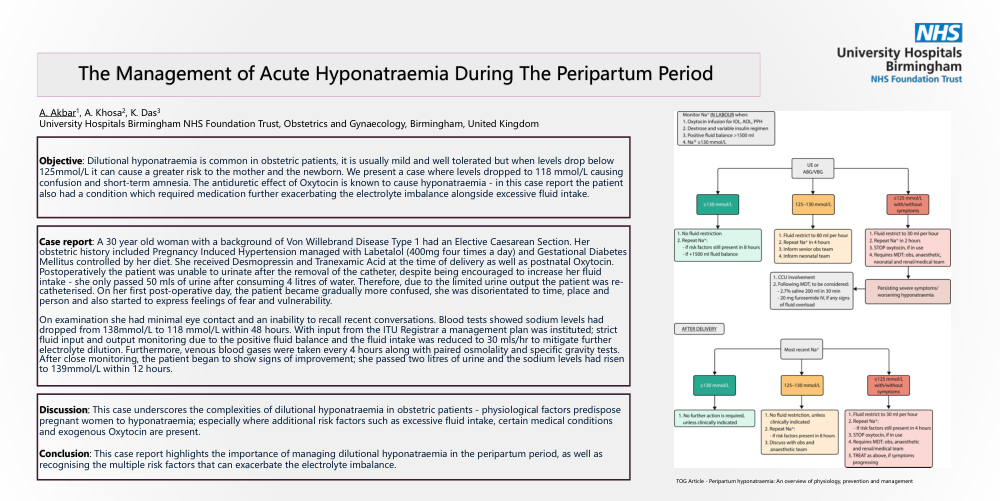
Case report: A 30 year old woman with a background of Von Willebrand Disease Type 1 had an Elective Caesarean Section. Her obstetric history included Pregnancy Induced Hypertension managed with Labetalol (400mg four times a day) and Gestational Diabetes Mellitus controlled by her diet. She received Desmopressin and Tranexamic Acid at the time of delivery as well as postnatal Oxytocin. Postoperatively the patient was unable to urinate after the removal of the catheter, despite being encouraged to increase her fluid intake - she only passed 50 mls of urine after consuming 4 litres of water. Therefore, due to the limited urine output the patient was re-catheterised. On her first post-operative day, the patient became gradually more confused, she was disorientated to time, place and person and also started to express feelings of fear and vulnerability. On examination she had minimal eye contact and an inability to recall recent conversations. Blood tests showed sodium levels had dropped from 138mmol/L to 118 mmol/L within 48 hours. With input from the ITU Registrar a management plan was instituted; strict fluid input and output monitoring due to the positive fluid balance and the fluid intake was reduced to 30 mls/hr to mitigate further electrolyte dilution. Furthermore, venous blood gases were taken every 4 hours along with paired osmolality and specific gravity tests. After close monitoring, the patient began to show signs of improvement; she passed two litres of urine and the sodium levels had risen to 139mmol/L within 12 hours.
Discussion: This case underscores the complexities of dilutional hyponatraemia in obstetric patients - physiological factors predispose pregnant women to hyponatraemia; especially where additional risk factors such as excessive fluid intake, certain medical conditions and exogenous Oxytocin are present.
Conclusion: This case report highlights the importance of managing dilutional hyponatraemia in the peripartum period, as well as recognising the multiple risk factors that can exacerbate the electrolyte imbalance.