2,281 posters, 63 videos, 56 audios, 43 topics, 18 sessions, 6,174 authors, 2,323 institutions
ePostersLive by SciGen Technologies S.A. All rights reserved.
RCOG World Congress 2025
June 23 - 25, 2025 | ExCeL London, UK
EP.1646
Postpartum ovarian vein thrombosis
Poster Presenter
Part of Topic
Maternal medicine
POST PARTUM OVARIAN VEIN THROMBOSIS : A case report A.Fatima1 , G.Paz1, A.Khalid1
1.Department of Obstetrics and Gynecology, University Hospital Waterford Ireland
Objective: Ovarian vein thrombosis is a rarely seen condition and can usually be misdiagnosed as appendicitis. Timely diagnosis of the condition can prevent serious complications.
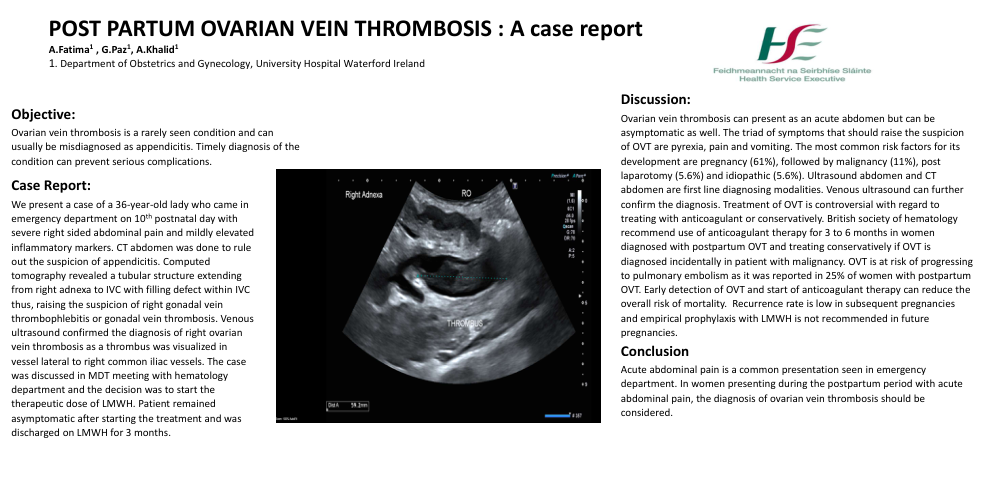
Case Report: We present a case of a 36-year-old lady who came in emergency department on 10th postnatal day with severe right sided abdominal pain and mildly elevated inflammatory markers. CT abdomen was done to rule out the suspicion of appendicitis. Computed tomography revealed a tubular structure extending from right adnexa to IVC with filling defect within IVC thus, raising the suspicion of right gonadal vein thrombophlebitis or gonadal vein thrombosis. Venous ultrasound confirmed the diagnosis of right ovarian vein thrombosis as a thrombus was visualized in vessel lateral to right common iliac vessels. The case was discussed in MDT meeting with hematology department and the decision was to start the therapeutic dose of LMWH. Patient remained asymptomatic after starting the treatment and was discharged on LMWH for 3 months.
Discussion: Ovarian vein thrombosis can present as an acute abdomen but can be asymptomatic as well. The triad of symptoms that should raise the suspicion of OVT are pyrexia, pain and vomiting. The most common risk factors for its development are pregnancy (61%), followed by malignancy (11%), post laparotomy (5.6%) and idiopathic (5.6%). Ultrasound abdomen and CT abdomen are first line diagnosing modalities. Venous ultrasound can further confirm the diagnosis. Treatment of OVT is controversial with regard to treating with anticoagulant or conservatively. British society of hematology recommend use of anticoagulant therapy for 3 to 6 months in women diagnosed with postpartum OVT and treating conservatively if OVT is diagnosed incidentally in patient with malignancy. OVT is at risk of progressing to pulmonary embolism as it was reported in 25% of women with postpartum OVT. Early detection of OVT and start of anticoagulant therapy can reduce the overall risk of mortality. Recurrence rate is low in subsequent pregnancies and empirical prophylaxis with LMWH is not recommended in future pregnancies.
Conclusion Acute abdominal pain is a common presentation seen in emergency department. In women presenting during the postpartum period with acute abdominal pain, the diagnosis of ovarian vein thrombosis should be considered.