2,281 posters, 63 videos, 56 audios, 43 topics, 18 sessions, 6,174 authors, 2,323 institutions
ePostersLive by SciGen Technologies S.A. All rights reserved.
RCOG World Congress 2025
June 23 - 25, 2025 | ExCeL London, UK
EP.1643
Management of Takayasu Arteritis in Pregnancy and Delivery
Poster Presenter
Authors
Affiliations
Part of Topic
Maternal medicine
Management of Takayasu Arteritis in Pregnancy and Delivery
S El Hamamy, H Naseem, T Oosterhouse
Case Report
A 30 year old primigravid patient diagnosed with
Takayasu Arteritis at 16
At time of diagnosis she had complete obliteration of radial and brachial pulses with decreased right carotid pulse
on doppler.
The patient was on prednisolone, tocilizumab,
aspirin, omeprazole, calcium and vitamin D prior to
pregnancy.
She had serial growth scans and a OGTT to screen for
gestational diabetes which was normal.
The patient transferred care between hospitals,
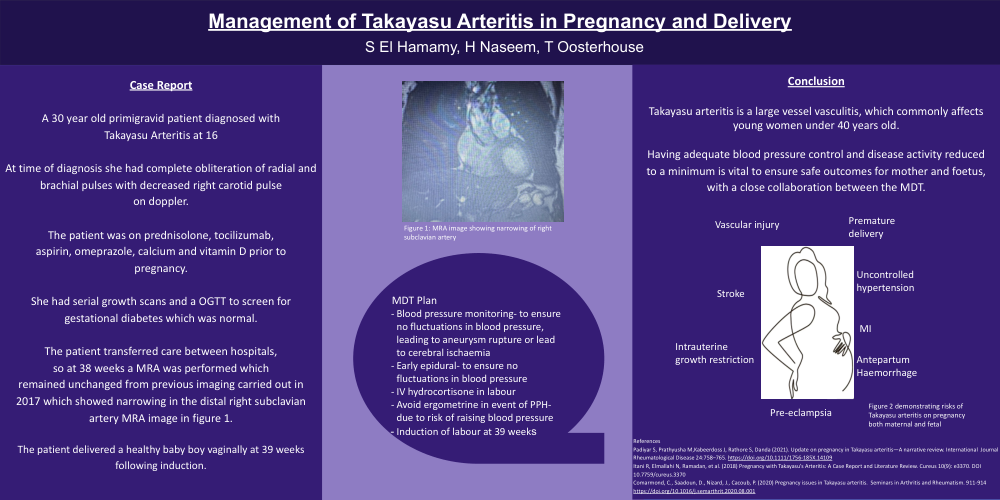
so at 38 weeks a MRA was performed which
remained unchanged from previous imaging carried out in
2017 which showed narrowing in the distal right subclavian artery MRA image in figure 1.
The patient delivered a healthy baby boy vaginally at 39 weeks following induction.
MDT Plan
-
Blood pressure monitoring- to ensure no fluctuations in blood pressure, leading to aneurysm rupture or lead to cerebral ischaemia
-
Early epidural- to ensure no fluctuations in blood pressure
-
IV hydrocortisone in labour
-
Avoid ergometrine in event of PPH- due to risk of raising blood pressure
Induction of labour at 39 weeks
Conclusion
Takayasu arteritis is a large vessel vasculitis, which commonly affects young women under 40 years old.
Having adequate blood pressure control and disease activity reduced to a minimum is vital to ensure safe outcomes for mother and foetus, with a close collaboration between the MDT.