2,281 posters, 63 videos, 56 audios, 43 topics, 18 sessions, 6,174 authors, 2,323 institutions
ePostersLive by SciGen Technologies S.A. All rights reserved.
RCOG World Congress 2025
June 23 - 25, 2025 | ExCeL London, UK
EP.1640
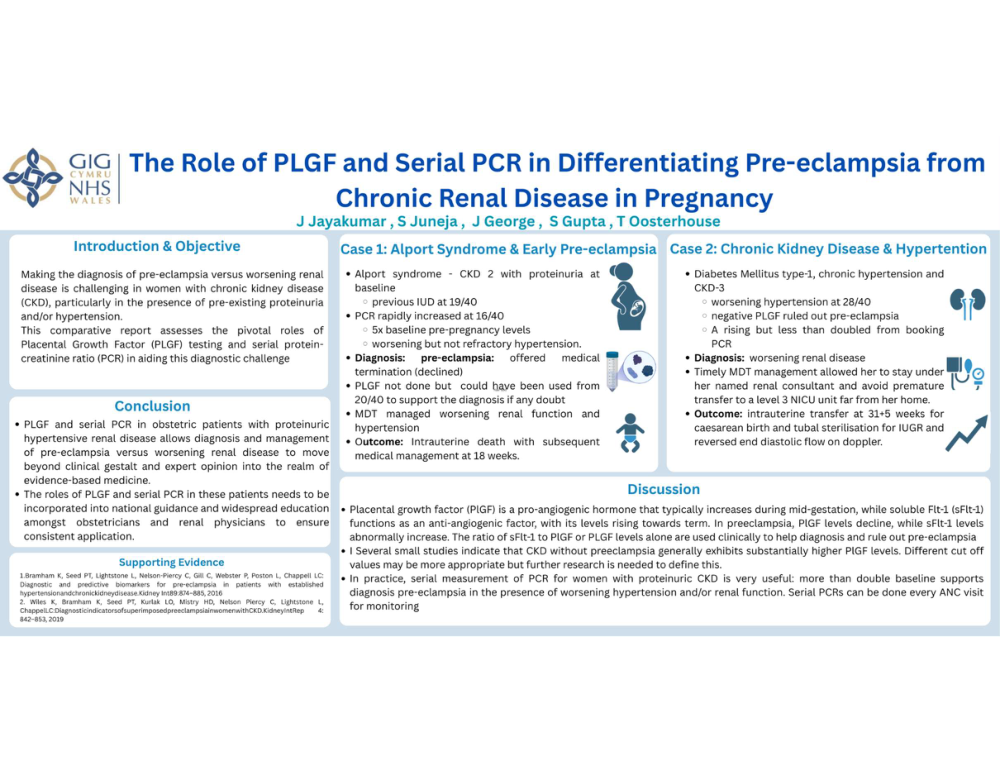
The use of PLGF testing and serial PCR in Obstetric Renal Patients
Poster Presenter
Authors
Jayaprabha Jayakumar, Shreya Gupta, Samriddhi Juneja, Jesin George, Tabitha Oosterhouse
Affiliations
Part of Topic
Maternal medicine
INTRODUCTION & OBJECTIVE
Making the diagnosis of pre-eclampsia versus worsening renal disease is challenging in women with chronic kidney disease (CKD), particularly in the presence of pre-existing proteinuria and/or hypertension.
This comparative report assesses the pivotal roles of Placental Growth Factor (PLGF) testing and serial protein-creatinine ratio (PCR) in aiding this diagnostic challenge
CASE 1 : ALPORT SYNDROME AND EARLY PRE ECLAMPSIA
- Alport syndrome - CKD 2 with proteinuria at baseline
- previous IUD at 19/40
- PCR rapidly increased at 16/40
- 5x baseline pre-pregnancy levels
- worsening but not refractory hypertension.
- Diagnosis: pre-eclampsia: offered medical termination (declined)
- PLGF not done but could have been used from 20/40 to support the diagnosis if any doubt
- MDT managed worsening renal function and hypertension
- Outcome: Intrauterine death with subsequent medical management at 18 weeks.
CASE 2: CHRONIC KIDNEY DISEASE AND HYPERTENSION
- Diabetes Mellitus type-1, chronic hypertension and CKD-3
- worsening hypertension at 28/40
- negative PLGF ruled out pre-eclampsia
- A rising but less than doubled from booking PCR
- Diagnosis: worsening renal disease
- Timely MDT management allowed her to stay under her named renal consultant and avoid premature transfer to a level 3 NICU unit far from her home.
- Outcome: intrauterine transfer at 31+5 weeks for caesarean birth and tubal sterilisation for IUGR and reversed end diastolic flow on doppler.
BACKGROUND
- Placental growth factor (PlGF) is a pro-angiogenic hormone that typically increases during mid-gestation, while soluble Flt-1 (sFlt-1) functions as an anti-angiogenic factor, with its levels rising towards term. In preeclampsia, PlGF levels decline, while sFlt-1 levels abnormally increase. The ratio of sFlt-1 to PlGF or PLGF levels alone are used clinically to help diagnosis and rule out pre-eclampsia
- I Several small studies indicate that CKD without preeclampsia generally exhibits substantially higher PlGF levels. Different cut off values may be more appropriate but further research is needed to define this.
- In practice, serial measurement of PCR for women with proteinuric CKD is very useful: more than double baseline supports diagnosis pre-eclampsia in the presence of worsening hypertension and/or renal function. Serial PCRs can be done every ANC visit for monitoring
CONCLUSION
- PLGF and serial PCR in obstetric patients with proteinuric hypertensive renal disease allows diagnosis and management of pre-eclampsia versus worsening renal disease to move beyond.
- The roles of PLGF and serial PCR in these patients needs to be incorporated into national guidance and widespread education amongst obstetricians and renal physicians to ensure consistent application.
CONCLUSION
1.Bramham K, Seed PT, Lightstone L, Nelson-Piercy C, Gill C, Webster P, Poston L, Chappell LC: Diagnostic and predictive biomarkers for pre-eclampsia in patients with established hypertensionandchronickidneydisease.Kidney Int89:874–885, 2016
2. Wiles K, Bramham K, Seed PT, Kurlak LO, Mistry HD, Nelson Piercy C, Lightstone L, ChappelLC:DiagnosticindicatorsofsuperimposedpreeclampsiainwomenwithCKD.KidneyIntRep 4: 842–853, 2019