2,281 posters, 63 videos, 56 audios, 43 topics, 18 sessions, 6,174 authors, 2,323 institutions
ePostersLive by SciGen Technologies S.A. All rights reserved.
RCOG World Congress 2025
June 23 - 25, 2025 | ExCeL London, UK
EP.1639
Diagnosis and Management of Rectosigmoid Cancer in Pregnancy
Poster Presenter
Authors
Affiliations
Part of Topic
Maternal medicine
Diagnosis and Management of a Rectosigmoid Cancer in Pregnancy: A Case Study
A.ThompsonST7 MBChB MRCOG, 1 E.HoltST5 1and E.HaslettObstetrician and Gynaecologist MBChB DFSRH DRCOG FRCOG MA1
Blackpool Victoria Hospital, Blackpool Teaching Hospitals NHS Foundation Trust
INTRODUCTION
• The diagnosis of a malignancy in pregnancy is rare.
• The incidence of cancer in pregnancy is 1:1,000 per year, however the incidence is increasing. 2
• The most commonly diagnosed cancers in pregnancy are Breast Cancer, Cervical Cancer and Melanoma.3
CASE STUDY •
A 35-year-old, G4P3 (x3 Caesarean Sections) was diagnosed at 18/40 with a large rectal cancer.
• She reported a year long history of PR bleeding and had a positive Faecal Occult Test (FIT). Referral for an urgent colonoscopy was performed as a 2 week wait.
• Colonoscopy was performed at 17 weeks gestation which identified a 10cm rectosigmoid/ upper rectal tumour. Biopsies confirmed a moderately differentiated adenocarcinoma.
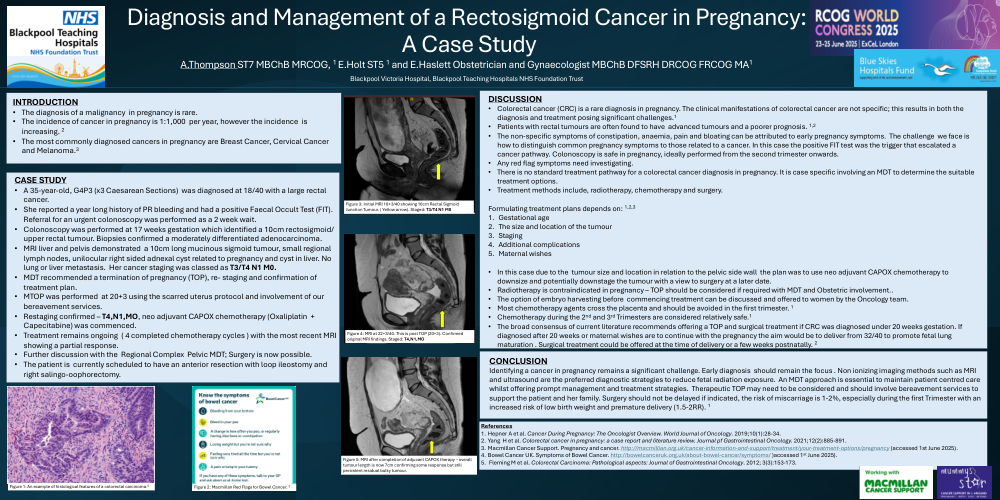
• MRI liver and pelvis demonstrated a 10cm long mucinous sigmoid tumour, small regional lymph nodes, unilocular right sided adnexal cyst related to pregnancy and cyst in liver. No lung or liver metastasis. Her cancer staging was classed as T3/T4 N1 M0.
• MDT recommended a termination of pregnancy (TOP), re- staging and confirmation of treatment plan.
• MTOP was performed at 20+3 using the scarred uterus protocol and involvement of our bereavement services.
Restaging confirmed – T4,N1,MO, neo adjuvant CAPOX chemotherapy (Oxaliplatin + Capecitabine) was commenced.
• Treatment remains ongoing ( 4 completed chemotherapy cycles ) with the most recent MRI showing a partial response.
• Further discussion with the Regional Complex Pelvic MDT; Surgery is now possible.
• The patient is currently scheduled to have an anterior resection with loop ileostomy and right salingo-oophorectomy.
DISCUSSION
• Colorectal cancer (CRC) is a rare diagnosis in pregnancy. The clinical manifestations of colorectal cancer are not specific; this results in both the diagnosis and treatment posing significant challenges.1
• Patients with rectal tumours are often found to have advanced tumours and a poorer prognosis. 1,2
• The non-specific symptoms of constipation, anaemia, pain and bloating can be attributed to early pregnancy symptoms. The challenge we face is how to distinguish common pregnancy symptoms to those related to a cancer. In this case the positive FIT test was the trigger that escalated a cancer pathway. Colonoscopy is safe in pregnancy, ideally performed from the second trimester onwards.
• Any red flag symptoms need investigating.
• There is no standard treatment pathway for a colorectal cancer diagnosis in pregnancy. It is case specific involving an MDT to determine the suitable treatment options. • Treatment methods include, radiotherapy, chemotherapy and surgery. Formulating treatment plans depends on: 1,2,3 1. Gestational age 2. The size and location of the tumour 3. Staging 4. Additional complications 5.Maternal wishes
• In this case due to the tumour size and location in relation to the pelvic side wall the plan was to use neo adjuvant CAPOX chemotherapy to downsize and potentially downstage the tumour with a view to surgery at a later date.
• Radiotherapy is contraindicated in pregnancy – TOP should be considered if required with MDT and Obstetric involvement.. • The option of embryo harvesting before commencing treatment can be discussed and offered to women by the Oncology team. • Most chemotherapy agents cross the placenta and should be avoided in the first trimester. 1
• Chemotherapy during the 2nd and 3rd Trimesters are considered relatively safe.1
• The broad consensus of current literature recommends offering a TOP and surgical treatment if CRC was diagnosed under 20 weeks gestation. If diagnosed after 20 weeks or maternal wishes are to continue with the pregnancy the aim would be to deliver from 32/40 to promote fetal lung maturation . Surgical treatment could be offered at the time of delivery or a few weeks postnatally. 2
CONCLUSION
Identifying a cancer in pregnancy remains a significant challenge. Early diagnosis should remain the focus . Non ionizing imaging methods such as MRI and ultrasound are the preferred diagnostic strategies to reduce fetal radiation exposure. An MDT approach is essential to maintain patient centred care whilst offering prompt management and treatment strategies. Therapeutic TOP may need to be considered and should involve bereavement services to support the patient and her family. Surgery should not be delayed if indicated, the risk of miscarriage is 1-2%, especially during the first Trimester with an increased risk of low birth weight and premature delivery (1.5-2RR). 1