2,281 posters, 63 videos, 56 audios, 43 topics, 18 sessions, 6,174 authors, 2,323 institutions
ePostersLive by SciGen Technologies S.A. All rights reserved.
RCOG World Congress 2025
June 23 - 25, 2025 | ExCeL London, UK
EP.1637
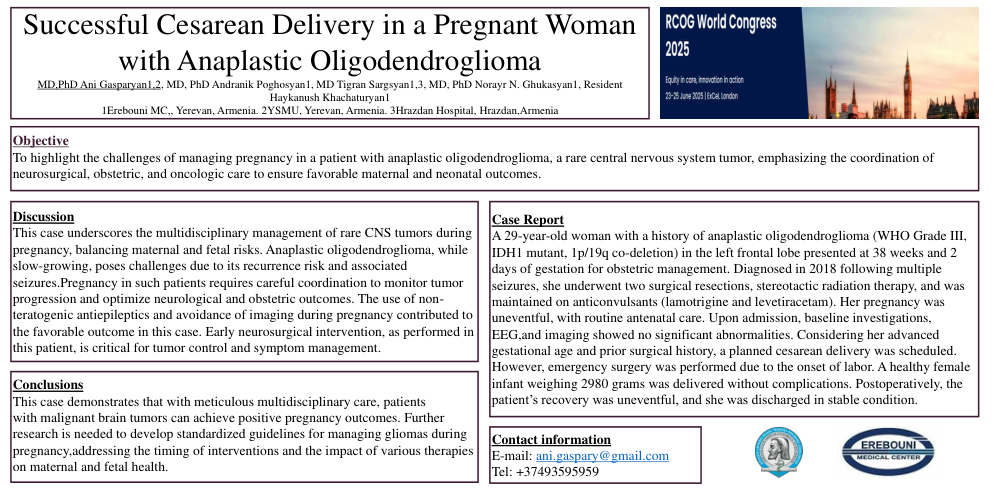
Successful Cesarean Delivery in a Pregnant Woman with Anaplastic Oligodendroglioma
Poster Presenter
Authors
Ani Gasparyan, Andranik Poghosyan, Tigran Sargsyan, Haykanush Khachaturyan
Affiliations
Part of Topic
Maternal medicine
Successful Cesarean Delivery in a Pregnant Woman with Anaplastic Oligodendroglioma
MD,PhD Ani Gasparyan1,2, MD, PhD Andranik Poghosyan1, MD Tigran Sargsyan1,3, MD, PhD Norayr N. Ghukasyan1,Resident Haykanush Khachaturyan1Erebouni MC, Yerevan, Armenia. 2YSMU, Yerevan, Armenia. 3Hrazdan Hospital, Hrazdan, Armenia
Case report
Objective
To highlight the challenges of managing pregnancy in a patient with anaplastic oligodendroglioma, a rare central nervous system tumor, emphasizing the coordination of neurosurgical, obstetric, and oncologic care to ensure favorable maternal and neonatal outcomes.
Case Report
A 29-year-old woman with a history of anaplastic oligodendroglioma (WHO Grade III, IDH1 mutant, 1p/19q co-deletion) in the left frontal lobe presented at 38 weeks and 2 days of gestation for obstetric management. Diagnosed in 2018 following multiple seizures, she underwent two surgical resections, stereotactic radiation therapy, and was maintained on anticonvulsants (lamotrigine and levetiracetam). Her pregnancy was uneventful, with routine antenatal care. Upon admission, baseline investigations, EEG, and imaging showed no significant abnormalities. Considering her advanced gestational age and prior surgical history, a planned cesarean delivery was scheduled. However, emergency surgery was performed due to the onset of labor. A healthy female infant weighing 2980 grams was delivered without complications. Postoperatively, the patient’s recovery was uneventful, and she was discharged in stable condition.
Discussion
This case underscores the multidisciplinary management of rare CNS tumors during pregnancy, balancing maternal and fetal risks. Anaplastic oligodendroglioma, while slow-growing, poses challenges due to its recurrence risk and associated seizures. Pregnancy in such patients requires careful coordination to monitor tumor progression and optimize neurological and obstetric outcomes. The use of non-teratogenic antiepileptics and avoidance of imaging during pregnancy contributed to the favorable outcome in this case. Early neurosurgical intervention, as performed in this patient, is critical for tumor control and symptom management.
Conclusions
This case demonstrates that with meticulous multidisciplinary care, patients with malignant brain tumors can achieve positive pregnancy outcomes. Further research is needed to develop standardized guidelines for managing gliomas during pregnancy, addressing the timing of interventions and the impact of various therapies on maternal and fetal health.